Test Drive Two Fiat 500 Twinairs | Fiat
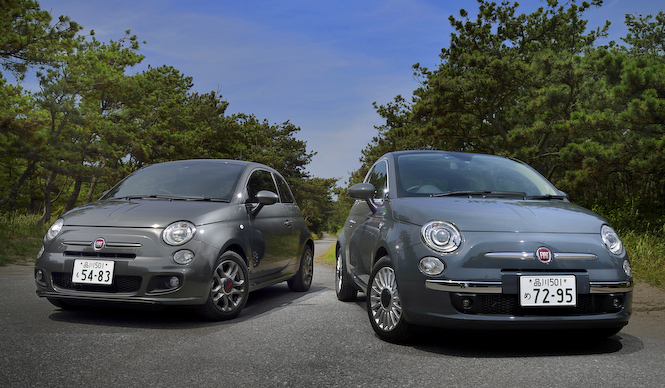
Fiat 500 TwinAir Lounge
Fiat 500S TwinAir
Test Drive: Two Fiat 500 TwinAirs
The Fiat "500" (Cinquecento) is the car that represents Fiat today. It carries over the looks of the second-generation 500, the "Nuova 500," and was released in 2007, marking the 50th anniversary of the Nuova 500's debut. It has been highly acclaimed and is an icon in the automotive world, generating buzz in Japan every time a variation or limited edition model appears. This time, we feature two 500s equipped with the high-tech two-cylinder "TwinAir" engine, which debuted in Europe in 2010 and in Japan in 2011. One is the standard model, the "500 TwinAir Lounge," and the other is the manual transmission "500S TwinAir". The driver is Fumio Ogawa.
Text by OGAWA FumioPhotographs by ABE Masaya
Fiat's Two-Cylinder Engine Rides the Tailwinds
The current trend in the automotive industry is downsizing. Among these, the Fiat "500 TwinAir" with its mere two cylinders stands out. Although it was released in 2011, with the addition of the manual transmission 500S in April of this year, alongside the existing two-pedal Dualogic specification, we decided to test drive both simultaneously.
The Fiat 500 is the fourth generation of the current model.
The lineage includes the 1936 "500" (driven by Gregory Peck in "Roman Holiday"), the '57 "Nuova 500," the '91 "Cinquecento" (the Italian pronunciation of 500), and the current model from 2007. Its compact body and high level of refinement as a daily driver have been passed down through generations.
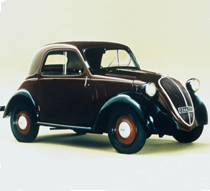
Fiat 500 Topolino
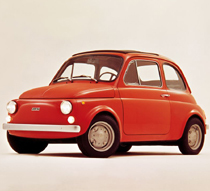
Fiat Nuova 500
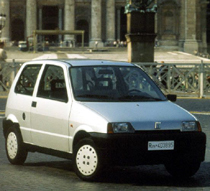
Fiat Cinquecento
Incidentally, the third-generation Cinquecento is often not counted in the 500 lineage, but since Fiat's headquarters at the time explicitly stated it was the successor to the Nuova 500, it's reasonable to include it. It was highly refined as a small people mover.
The appeal of the current 500 lies in its cute styling and the wide variety of models available.
The styling draws heavily from the image of the 1950s Nuova 500, emphasizing rounded shapes to create an endearing front face.
The dimensions are in line with modern standards, with a relatively generous wheelbase of 2,300mm supporting a 3,545mm two-door hatchback body.
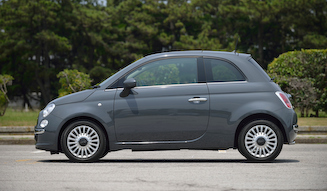
The bold choice of an inline two-cylinder engine might not feel out of place for Europeans in their 40s and above who know the Nuova 500 was also a two-cylinder. More importantly, there's a forward-looking spirit that embraces bold technological advancements. With these factors as tailwinds, the two-cylinder engine cars seem to be running smoothly under the TwinAir name.
Upon driving it, the car performs surprisingly well. Those who particularly love cars and understand the joy of driving with a revving engine might even feel a certain sportiness.
Fiat 500 TwinAir Lounge
Fiat 500S TwinAir
Test Drive: Two Fiat 500 TwinAirs (2)
First, the 500 TwinAir Lounge
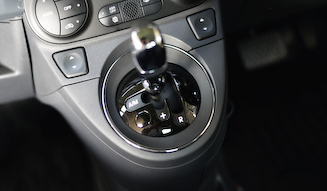
Until now, the 500 TwinAir in Japan was equipped with a two-pedal manual transmission called Dualogic. This system uses a machine to operate the clutch, offering some convenience and better fuel efficiency than a torque converter automatic.
The advantage of Dualogic is that the 500 TwinAir can be driven with ease.
When you're not used to it, you might drive with your foot constantly on the accelerator, thinking it's a torque converter automatic, and feel a jolt when the clutch disengages for a shift. Once you get accustomed to the operation, you can judge from the tachometer when it's time to shift up and ease off the accelerator pedal, allowing for a smooth shift. It feels similar to operating a manual transmission.
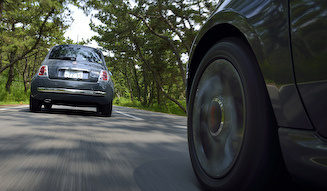
The 500 TwinAir's maximum torque of 145Nm is generated at 1,900rpm, so despite its displacement of less than 900cc, it can accelerate surprisingly strongly. Especially in city traffic, the automatic mode of Dualogic (which automatically shifts up and down) allows for a drive that is not significantly different from an automatic car with a larger displacement.
When you want to drive more actively, you can use the manual operation mode to shift up and down, fully utilizing the power of the turbo engine, which delivers significant torque from around 3,000rpm.
Incidentally, this manual mode operates in reverse to most cars: pulling back shifts up, and pushing forward shifts down, a pattern similar to racing cars. BMW, which favors a sporty image, also uses a similar pattern.
The suspension is well-balanced, with firm dampers that prevent the car from bouncing, even on rough roads or at high speeds. It's skillfully set up. The springs are slightly soft, so quick lane changes might be less comfortable for passengers, but this also contributes to the car's pleasant ride.
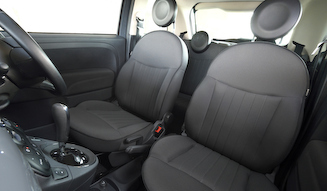
The seats, with their relatively high seating position, are comfortable and make long drives less tiring. The new generation 500 proves itself to be an excellent people mover once again.
Fiat 500 TwinAir Lounge
Fiat 500S TwinAir
Test Drive: Two Fiat 500 TwinAirs (3)
More Fun with a Manual Transmission?
The newly added 500S shares the same engine output and torque as the Dualogic models (POP and LOUNGE as of July 2013), with its main distinguishing feature being the 5-speed manual transmission.
Could a manual transmission make it even better? The answer to the question that those interested in the 500 TwinAir might have is a resounding "Yes." I was impressed by how well they combine.
The manual transmission is well-suited because, although the two-cylinder engine's maximum torque is rated at 1,900rpm, it actually delivers significant power around 3,000rpm. The engine's revving characteristics are good, so by using gear changes to keep the engine within its strong torque band, you can enjoy a satisfying drive.
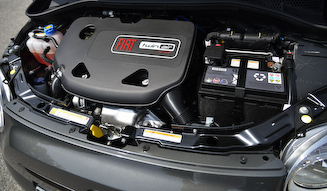
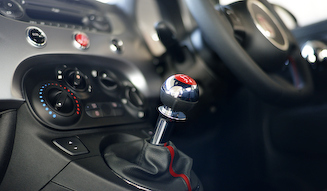
The gears have a somewhat long throw, and to make matters worse, the shift knob is too large, making it difficult to operate. However, it's still enjoyable. Anyone with experience driving a small-displacement manual car will quickly adapt to the 500S. In fact, they'll likely feel compelled to actively support this car.
The beauty of the 500S is that it reaffirms the fundamental truth that a car doesn't move actively without a driver.
Perhaps we've become too accustomed to automatic transmissions with high torque. While the 500S is far from the world of 0-100 km/h in three seconds, it offers the joy of driving by skillfully using the accelerator and shift lever.
This reminds us of how everyone used to drive cars. That's what makes it so good.
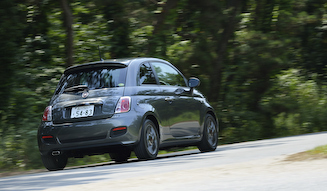
Fiat 500 TwinAir Lounge
Fiat 500S TwinAir
Test Drive: Two Fiat 500 TwinAirs (4)
If You're Buying a 500—
The 500 TwinAir is a car that captivates car enthusiasts.
Sold under a different brandAbarthare very well-made, excellent sports cars, but isn't it interesting that, while using the same platform, there are also models that prioritize comfort?
The 500 lineup includes the "TwinAir Lounge" (2.5 million yen), "TwinAir Pop" (2.2 million yen), and the "500S" (2.25 million yen). What are its rivals? The Volkswagen "up!" (similar body size, 999cc 3-cylinder engine, 1.49-1.86 million yen), the Peugeot "208" (especially the 1.2-liter 3-cylinder "Allure" at 1.99 million yen), and the Chrysler "Ypsilon" (equipped with the same two-cylinder engine, 2.35 million yen). While the up! is strong in the market in terms of pricing and actual sales, the factor of "fun to drive" makes it difficult to make a simple comparison of price differences.
The importer promotes it as environmentally friendly, but unfortunately, nowadays, the new 1.2-liter 4-cylinder engine in the "Golf" boasts "fuel economy exceeding the Prius on highways" (Volkswagen Group Japan PR), while the 500 TwinAir's fuel economy of around 15 km/liter is, in fact, not as high as expected.
This might also be due to the body being too heavy for the engine. As mentioned earlier, trying to drive it spiritedly tends to lead to revving the engine, which negatively impacts fuel economy.
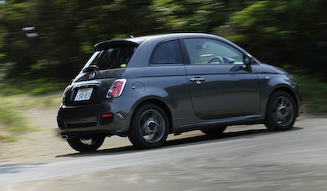
However, for those who drive around 10,000 km per year, there's no need to fuss over such a difference in fuel economy (we state this definitively). What's important might be whether you can enjoy being with the car on a daily basis.
From the stylish (yet not ostentatious) interior design to the body that suits colors like gray so well, once you drive it, you'll likely never forget it.
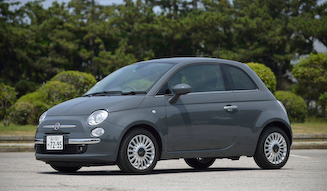
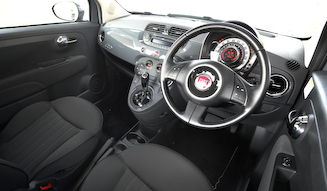
Whether it's the cute sound of the two-cylinder engine, the "tokotoko-tokotoko," it all comes down to whether you can fall in love with this 500 TwinAir. If your emotional judgment leads to a "go," then it will surely become a wonderful partner you can be with for life, surpassing all other rivals.

Fiat 500 TwinAir Lounge
Body Dimensions: Length 3,545 x Width 1,625 x Height 1,515 mm
Wheelbase: 2,300 mm
Tread Front/Rear: 1,415 / 1,410 mm
Weight: 1,040 kg (1,050 kg with sunroof)
Engine: 875 cc Inline 2-cylinder DOHC Turbo
Compression Ratio: 10.0:1
Bore x Stroke: 80.5 x 86.0 mm
Max. Output: 63kW (85ps) / 5,500 rpm (57kW (77ps) / 5,500rpm with ECO switch)
Max. Torque: 145Nm (14.8kgm) / 1,900rpm (100Nm (10.2kgm) / 2,000rpm with ECO switch)
Transmission: 5-speed Sequential with Automatic Mode (Dualogic)
Drivetrain: FF
Front Suspension: MacPherson Strut with Stabilizer
Rear Suspension: Torsion Beam with Stabilizer
Tires: 185/55R15
Brakes Front/Rear: Disc / Drum
Fuel Economy (JC08 Mode): 24.0 km/ℓ
CO2 Emissions: 97 g/km
Price: 2.5 million yen
Fiat 500 TwinAir Lounge
Body Dimensions: Length 3,585 x Width 1,625 x Height 1,515 mm
Wheelbase: 2,300 mm
Tread Front/Rear: 1,415 / 1,410 mm
Weight: 1,010 kg
Engine: 875 cc Inline 2-cylinder DOHC Turbo
Compression Ratio: 10.0:1
Bore x Stroke: 80.5 x 86.0 mm
Max. Output: 63kW (85ps) / 5,500 rpm (57kW (77ps) / 5,500rpm with ECO switch)
Max. Torque: 145Nm (14.8kgm) / 1,900rpm (100Nm (10.2kgm) / 2,000rpm with ECO switch)
Transmission: 5-speed Manual
Drivetrain: FF
Front Suspension: MacPherson Strut with Stabilizer
Rear Suspension: Torsion Beam with Stabilizer
Tires: 185/55R15
Brakes Front/Rear: Disc / Drum
Fuel Economy (JC08 Mode): 26.6 km/ℓ
CO2 Emissions: 88 g/km
Price: 2.25 million yen