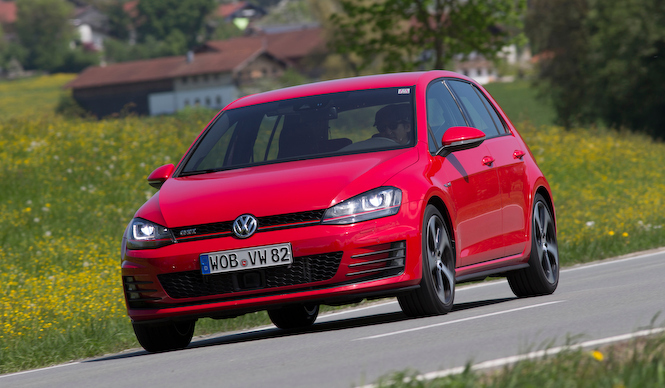
January 23, 2015
Test Drive: Volkswagen Golf GTI | Volkswagen
Volkswagen Golf GTI
Test Drive: Volkswagen Golf GTI
The seventh generation Volkswagen "Golf" has been replaced, andGolfhas been well-received in Japan. However, some Golf fans, while considering the Japanese 1.2-liter and 1.4-liter engine models, might be waiting for the "GTI" already announced in Europe?The "GTI" announced in EuropeSo, OPENERS asked Hirohisa Kaneko, who test-drove the new "GTI" a little earlier. Mr. Kaneko, how was the new GTI?
Text by KANEKO Hirohisa
Tartan Check Seats = GTI?
Mr. Suzuki from the OPENERS editorial department asked me about the new Volkswagen "Golf GTI".
He knew I had driven the GTI in Germany and Austria in May. He had also read the test drive report I wrote immediately after returning to Japan.
"How does the GTI compare to the Golf 1.2 and 1.4?"
I see, it's natural to want to compare them since the base Golf itself has undergone a full model change and has just been announced in Japan. The Golf's reputation is very high, so some people might think it's sufficient as is, and apparently, some are waiting to see how the Japanese-spec GTI turns out before deciding which one to buy.
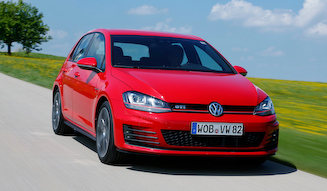
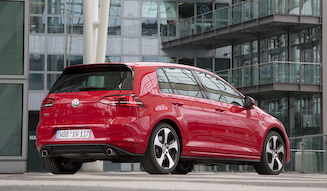
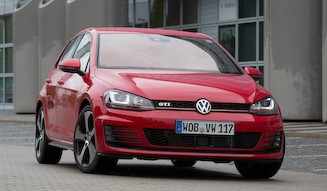
Volkswagen Golf GTI
Volkswagen Golf
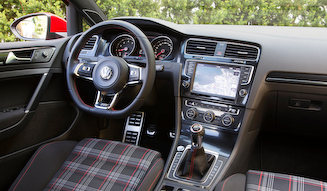
"Mr. Kaneko, you also drove the TSI 1.4 and the diesel GTD along with the GTI, didn't you? What does the GTI have that the others don't? Please write about more than just the tartan check seat fabric and the golf ball-shaped shift lever."
Volkswagen Golf GTI
Test Drive: Volkswagen Golf GTI (2)
What the GTI Has Exclusively: Part 1 - Engine
There are several things exclusive to the GTI. First is the engine.
It's a GTI-exclusive 2-liter turbocharged 4-cylinder. It's the "EA888" model, which has been around since the previous generation, but with several technical modifications.
The EGR cooler that cools exhaust gas is integrated into the cylinder head, and the fuel injection system now combines direct injection with multi-point injection, similar to Toyota's "D-4" unit. Neither of these are things the driver directly sees while driving, nor are they essential to know, but this continuous stream of updates and optimizations is the history and essence of the GTI.
Maximum output is 220ps/4,500-6,200rpm, and maximum torque is 350Nm/1,500-4,400rpm. These are 10ps and 70Nm increases in power and torque, respectively, from the previous generation GTI.
There's an even higher-performance version, the "GTI Performance," with 10 more horsepower and an electronically controlled differential lock, but it's not available in the Japanese market. The Japanese version comes only with the 220ps engine and a 6-speed DSG. There is no 6-speed manual.
What the GTI Has Exclusively: Part 2 - Chassis
On the chassis side, the "XDS+" is exclusive to the GTI.
It's an evolution of the previous XDS, with an expanded range of application for improved accuracy and agility. It aims to reduce understeer by momentarily applying the brakes to the inner wheel during cornering.
I have a vivid impression of the XDS.
When the previous GTI debuted, the ability to drive at high speeds and accelerations far exceeding previous standards on the mountain roads of Castelet in Southern France was none other than the effect of the XDS.
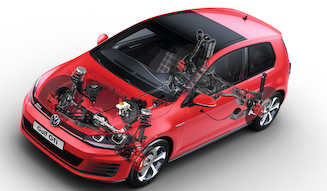
Even when clearing uphill corners with the throttle open, the car doesn't drift outwards due to understeer. At that moment, the inner front wheel must have been braked momentarily, but of course, you can't feel it, and you can trace the intended line.
It was exhilarating to drive through corners with steep ascents and descents and various radii, with the previous GTI maintaining almost neutral steering.
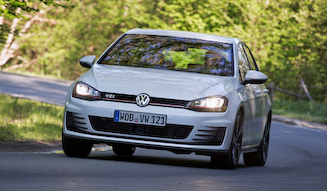
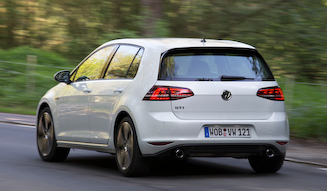
In addition, several other driver assistance and convenience systems are adopted, but many of these were introduced in the new Golf.
Volkswagen Golf GTI
Test Drive: Volkswagen Golf GTI (3)
The New GTI: Remarkable Evolution
Previous Golf GTIappeared near the end of the Golf series, but the new GTI, on the other hand, was announced shortly after the completely renewed Golf series.was announced.The new model, referred to as "Golf 7," features a completely new chassis andMQBan innovative modular transverse matrix production system, achieving significant advancements. The new GTI builds upon this foundation, resulting in remarkable evolution.
In Germany and Austria, I test-drove the GTI, the Golf with the1.4-liter engine, and the diesel "GTD".GTDAlthough the GTD is not imported to Japan, what all three models had in common was the significant impact of the renewed chassis.
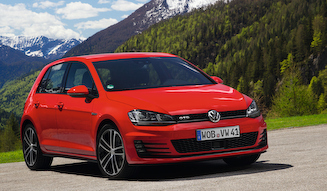
Volkswagen Golf GTD
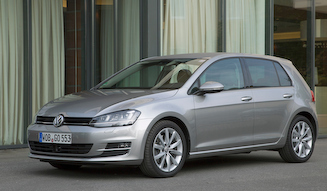
Volkswagen Golf 1.4 TSI
Upon entering the Autobahn and merging into traffic flowing at around 150 km/h, the first things I noticed were the quietness and the high level of rigidity.
Engine noise, road noise, and wind noise were remarkably shut out, making the cabin exceptionally peaceful. Even when entering the unrestricted section and exceeding 200 km/h, I could hold a conversation with passengers without raising my voice. When I experimentally lowered the window, air was rushing in with tremendous force, and the tires were pounding the road with a roar. Even the slight vibrations from the floor at high speeds were completely eliminated.
Tenacious Powertrain
The Golf 1.4 is generally no different in this regard. The difference lies in the acceleration power due to the difference in engine output. The GTI's mid-range acceleration on the unrestricted sections of the Autobahn, where speeds are significantly higher than on Japanese highways, is far superior.
What was impressive about the GTI's engine, along with its acceleration, was its tenacity.
At 100 km/h, the engine speed is 2,200 rpm in 6th gear. Even on a slight incline, it accelerates powerfully in 6th gear. The 6-speed manual version displays a recommended gear on the instrument panel, and it immediately suggests "shift up" to save fuel. This is not an empty promise; even when decelerating for some reason and then accelerating again, the instruction to downshift was less frequent than my own judgment as a driver.
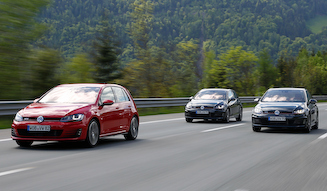
In other words, it's an engine with excellent flexibility. It's by no means an engine that's fun to rev like a sports car, but this high degree of flexibility will greatly contribute to everyday usability and fuel economy.
Volkswagen Golf GTI
Test Drive: Volkswagen Golf GTI (4)
Testing the DSG Model
In the DSG version, in addition to the engine's flexibility, the gear changes themselves are automated by the DSG, resulting in even more perfect shift management. Although there was no mention of specific advancements in the new GTI's DSG itself, I was once again impressed by its intelligence.
In normal mode, it shifts up whenever possible for fuel economy, and the shifts are so smooth with minimal shock that you barely notice them. In sport mode, it holds the engine revs higher and shifts quickly, allowing for some shock. Upshifts and downshifts can be freely controlled using the paddles.
I also tried the three modes of the adaptive chassis control system "DCC," and all of them were set within a reasonable range, providing satisfactory results.
When selecting sport mode, you can clearly feel the reduction in suspension vertical movement.
The system then works more effectively to suppress vertical movement when going over bumps or uneven surfaces. It switches to a sportier feel, but it doesn't become overly stiff.
The comfort mode, exclusive to the GTI, is the opposite: the soft ride would be comfortable in city driving at lower speeds. On the highway, there's a lingering oscillation after bumps.
Normal mode is somewhere in between.
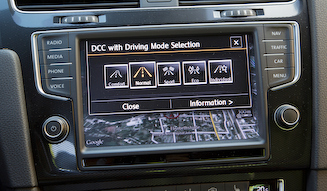
Adaptive chassis control "DCC," also optionally available on the "Highline" 1.4-liter engine model in Japan
The damper setting when the DCC is not ordered as an option is "very close to the normal mode" (according to Manfred Ulrich, Head of Chassis Tuning in Passenger Car Development), so you can decide based on your budget and intended use.
The steering feel was also different. Of course, this is partly due to the larger diameter and wider tires, but compared to the Golf 1.4, it's slightly heavier, and consequently, it transmits road conditions more directly.
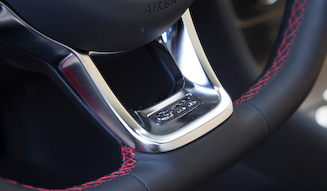
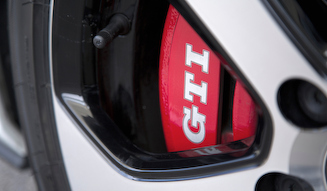
The GTI's forte is its dynamic performance that leads the flow of traffic, sharp handling, and agile responsiveness. It was clearly felt that these have been improved from the previous generation.
It remains a well-balanced, all-around sporty car with excellent performance, much like an outstanding student with no particular weaknesses.
"The GTI is a sporty car that can be used in everyday life. It's not an extreme sports car. We haven't sacrificed anything for performance." (Albert Merz, Head of Project Management, Technical Development)
The new GTI is built upon the foundation of the completely redesigned Golf 7 chassis, incorporating the latest devices.
Volkswagen Golf GTI
Test Drive: Volkswagen Golf GTI (5)
The Essence of the Golf GTI
To summarize, I was impressed by the comfortable and soft ride, smooth handling, high level of quietness, and the elimination of micro-vibrations, which were common to both the new GTI and the Golf 1.4 TSI.
The new GTI, released not long after the full model change of the Golf, strongly conveyed a sense of dual evolution. The Golf GTI's essence as a "realistic sports car" has remained unchanged since its first generation.
Models like the MINI, Fiat "500," and Volkswagen'sThe Beetlemay share the same name as their predecessors and leverage their iconic exterior designs, but they are deliberately manufactured with the same name and similar styling despite having different concepts and content.
There are other such cars if you list them.
However, the Golf GTI is different. Even in its seventh generation, it continues the concept of taking the standard Golf, equipping it with a powerful engine, and using devices to enhance it into a sporty and fast front-wheel-drive car.
This concept is driven by the philosophy that "new technology always leads to evolution from the previous model." This is modernism.
The cumulative production of 1.9 million units for previous generations is likely proof that the concept of taking the practical Golf and making it faster and sportier has continued to be supported.
For those who understand what the GTI is, I want them to appreciate the advancements in the new model. For those who think, "If it's that different from the Golf 1.4, maybe I should wait," I recommend waiting. It's worth the wait.
Conversely, the opinion, "The GTI might be good, but I'll start with the Golf 7," is also understandable. As Mr. Merz said, the GTI is built upon the Golf 7, and its performance is not achieved at the expense of anything.
The new GTI and Golf 7 form concentric circles.

Volkswagen Golf GTI
Body Dimensions | Length 4,268 x Width 1,790 x Height 1,442 mm
Wheelbase | 2,631 mm
Tread Front/Rear | 1,538 / 1,516 mm
Weight | 1,370 kg
Engine | 1,984cc Inline 4-cylinder DOHC Turbo
Max Output | 162 kW (220ps) / 4,500-6,200 rpm
Max Torque | 350Nm / 1,500-4,400 rpm
Transmission | 6-speed Automatic (6DSG)
Drivetrain | FF
Suspension Front | MacPherson Strut with Anti-roll Bar
Suspension Rear | 4-link with Anti-roll Bar
Tires | 225/45R17
Brakes Front/Rear | Ventilated Disc (312x25mm) / Disc (300x12mm)
0-100km/h Acceleration | 6.5 seconds
Top Speed | 244 km/h
Fuel Consumption (NEDC) | 6.4 ℓ/100km
CO2 Emissions | 148 g/km
Price | From €28,350
Golf GTI Domestic Impression by Fumio Ogawa here