
Lexus IS Road Test | Lexus
Lexus IS
Lexus IS: A Road Test
LexusThe new "IS" leads Lexus's sporty image.prototype, pre-production model—this model, which OPENERS has been following, has finally...Japan launch...arrived. We finally had the opportunity to road test the production model with Japanese plates. An impression by Fumio Ogawa.
Text by OGAWA FumioPhotographs by ARAKAWA Masayuki
Design that Embodies the IS
The Lexus "IS" underwent a full model change on May 16, 2013. As Lexus developers themselves say, "The IS is about driving," this model is characterized by its aggressive looks, including the new front grille, and its performance, exemplified by the "IS 350 F SPORT" packed with driving-focused equipment such as a four-wheel steering system.
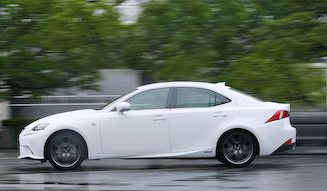
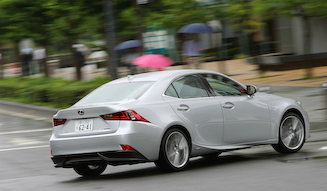
The actual car features a design that minimizes character lines, relying on the expression of its surfaces to create contours. Its flowing roofline and the shoulder line that runs straight from front to tail are distinctive. Furthermore, the large spindle grille is eye-catching.
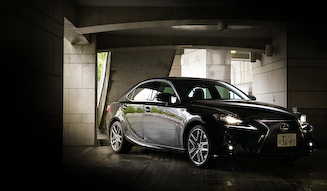
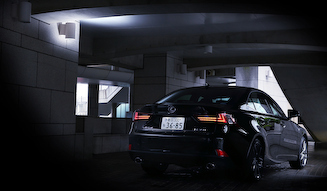
While the actual opening might not be that large due to aerodynamics, the design conveys the impression that Lexus is housing a large (and presumably powerful) engine.
In my personal opinion, the previous IS had a lingering image of being the "LS" or the "youngest son" compared to the GS" models. While adopting a bookend concept overall (a method of giving a strong, common design image across the lineup from bottom to top), the IS effectively utilizes its coupe-like roofline for elegance, possessing a distinct character that is subtle yet stands out, which I appreciate.
Testing the IS 350 F SPORT and IS 300h F SPORT
The models test-driven in Yokohama were the "IS 350 F SPORT" (5.95 million yen), the most performance-oriented in the series, and the "IS 300h F SPORT" (5.38 million yen), which aims to provide an engaging driving experience despite being a hybrid. While the latter is equipped with the THS-II hybrid system, both are rear-wheel-drive with engines mounted at the front.
It was impressive how both shared a core identity as a refined, sporty sedan with a smooth ride, demonstrating a consistent and well-executed finish.
Lexus IS
Lexus IS: A Road Test (2)
The IS 350 F SPORT Leads Lexus's Driving Experience
The "IS350" is powered by a 3.5-liter V6 engine producing 318ps. It is the only model in the lineup equipped with an 8-speed automatic transmission. It boasts a sports shift function, notable for its integration with a G-sensor.
The advantage lies in optimal gear control during cornering. By downshifting to the appropriate gear based on acceleration at the corner's entry, it avoids the issue of entering a corner in too high a gear, leading to a lack of effective torque band and sluggishness on exit.
Furthermore, the F SPORT model features a computer-controlled cornering system called "LDH ( LexusDynamic Handling System)."
Lexus explains this system, which balances safety with driving enjoyment, as comprising multiple technologies.
One is "DRS (Dynamic Rear Steering)." Based on information such as vehicle speed and steering input, it optimally controls the steering angle of the rear wheels in conjunction with the front wheels. Lexus claims it "achieves agile steering response during medium-speed driving on winding roads."
This is integrated with variable gear ratio steering and EPS (Electric Power Steering).
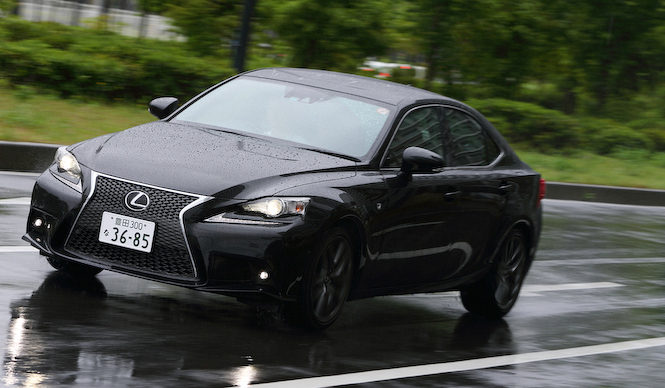
The cockpit impression is good, along with the dedicated seats, as the chief development engineer emphasized that a "20mm lower hip point and a 3-degree more upright steering wheel" achieve a sportier driving position. The body settles in naturally.
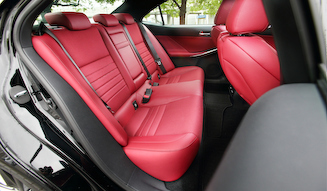
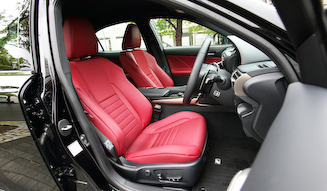
While I cannot be definitive without longer-term use, the F SPORT's dedicated seats, made using Lexus's first "skin-integrated foam molding" (likely referring to the structural material) where the structural material and skin are formed as one, offer good cushioning and support. There was no discomfort in the lumbar area. I felt that vibrations and harshness were effectively absorbed.
Choose SPORT Mode for the Best Experience
In Normal mode, as the engine speed approaches 2,000 rpm, the torque, which peaks at 380Nm at 4,800 rpm, builds progressively, allowing you to feel the acceleration.
However, the "Sport" mode, which offers better torque response and reacts sensitively to even slight pedal inputs, allows you to better enjoy the car's strengths.
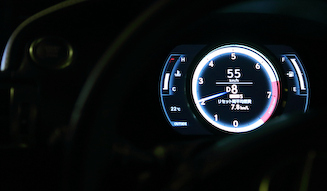
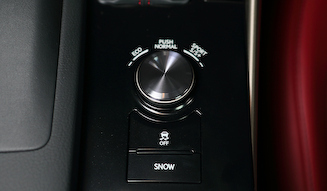
The transmission also uses lower gears more actively. The torque doesn't taper off; it powerfully propels the 1,640kg vehicle all the way to the redline.
During this time, subtle throttle control is possible, allowing for acceleration and deceleration as desired. However, selecting the "Sport S+" mode available on the F SPORT quickens the steering ratio and actively engages the aforementioned cornering control, allowing the car to trace the driver's intended line effortlessly, without any disturbance.
Lexus IS
Lexus IS: A Road Test (3)
The Hybrid F SPORT: IS 300h F SPORT
In addition to the standard IS 300h (4.8 million yen), there is the Version L (5.38 million yen) with exclusive features like 17-inch tires, rear side airbags, auto-dimming door mirrors, and semi-aniline leather seats, as well as the F SPORT. This is the same configuration as the IS 350.
Although I test-drove the F SPORT (5.38 million yen), the differences from the IS 350 version are that it uses an electronic continuously variable transmission and does not offer the LexusDynamic Handling System (LDH).
The hybrid system's core is a combination of a 2.5-liter 4-cylinder Atkinson cycle engine and an electric motor.
The system's total maximum output is 220ps. Fuel economy is 23.2 km/ℓ under the JC08 mode.
The development team emphasized that "by refining the transmission feel, the driving enjoyment has increased compared to before," highlighting improvements in sportiness.
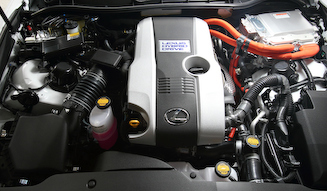
Indeed, along with a substantial ride quality due to the 1,670kg vehicle weight, the finely controlled torque delivery makes the driving experience, particularly in the mid-speed range, surprisingly pleasant and faithful to the driver's intentions.
While the gasoline engine model primarily prioritizes driving performance at the expense of fuel economy, the hybrid 300h likely compensates for this. It still offers genuine handling enjoyment.
The near 50:50 front-to-rear weight distribution, achieved through measures like repositioning the battery, likely contributes to the hybrid model's excellent maneuverability. However, for those seeking truly engaging driving dynamics, other models with superior engine power and feel are available.
It would be wise to choose the version that best suits your preferences.
EV Driving is Also Possible
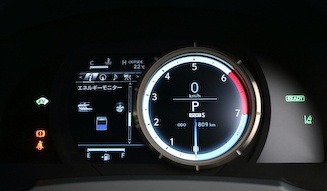
Unfortunately, due to the test drive event and the resulting ample battery charge, opportunities to experience EV mode were limited. However, up to 50 km/h, the surprisingly powerful drive of the relatively heavy body was evident.
Toyota calls fuel-efficient driving "eco-drive." For vehicles equipped with G-BOOK, "eco-points" earned through a certain level of eco-driving can be "donated" through virtual exchanges to any project within the Japan National Commission for UNESCO's World Heritage projects.
This kind of initiative, linking driving with play, is not available for gasoline cars.
Lexus IS
Lexus IS: A Road Test (4)
The Benchmark: The 3 Series
When I spoke with the development team at the test drive event, they surprisingly revealed that "the benchmark for the IS is the BMW 3 Series." They explained that "for example, even the AT shift schedule prioritizes human感覚 (sensory perception) appropriate for driving conditions like acceleration."
The representative humbly analyzed, "The program that holds a lower gear after deceleration for overtaking is necessary for enjoyable driving when anticipating re-acceleration. However, this leads to poor fuel economy. Conversely, if the upshifts are too quick, the driver might feel a lack of power when pressing the accelerator for re-acceleration. Balancing environmental concerns, maneuverability, and the driver's senses is crucial. The 3 Series's shift modes are skillfully programmed to provide a sense of enjoyment."
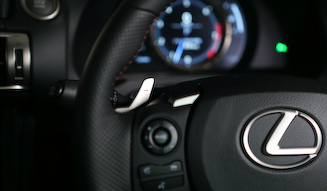
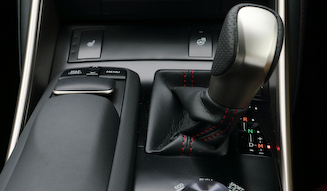
Audi's optional "Audi drive select," which allows selection of engine and steering characteristics, suspension stiffness, etc., was also studied. "Beyond the vehicle settings in Sport and Comfort modes, what was most interesting was the AUTO mode, where the vehicle automatically switches between these two modes. The program that controls when to switch to Comfort and when to switch to Sport was a great learning experience" (same representative). This demonstrates their commitment to researching competitors to compete on a global scale.
Meanwhile, the IS F SPORT's suspension system is equipped with NAVI-AI-AVS, which controls the damper's damping force. Leveraging the advantages of electronic control, the same development representative proudly stated, "We have thoroughly tuned it to ensure stable performance in all driving conditions."
It is challenging to use intangible elements like感覚 (sensory perception) as a benchmark for vehicle development, but BMW's and Audi's approaches to these sensory aspects seem to have contributed to the refinement of this area.
The IS's Duality and Future Potential
LexusIS is, in a sense, a car of duality.
When the driver consciously selects Sport+ mode, beyond the comfortable four-door sedan, lies another, extraordinary sporty world.
While the feel differs from the "Audi A4" and "BMW 3 Series," the pure sportiness felt in the F SPORT clearly defines the character of Lexus, and particularly the IS 350.
It will be interesting to see how safety features, including autonomous driving, evolve in some imported cars ( Mercedes-Benz's new E-Class", Cadillac's ATS", Volkswagen's new Golf", Volvo's V40) and how models that further enhance fuel efficiency and sportiness will be developed. I look forward to driving them.
It must be challenging to cover both luxury and sport in a single car, but in Germany, AMG serves as a formidable rival, creating models that balance these aspects at a high level. I send my encouragement to Lexus as well.
Lexus IS 350
Body Dimensions: Length 4,665 x Width 1,810 x Height 1,430mm
Wheelbase: 2,800 mm
Tread Front/Rear: 1,535/1,550 mm (Rear 1,540mm for F SPORT only)
Minimum Ground Clearance: 135 mm
Minimum Turning Radius: 5.2 meters
Trunk Capacity: 480 liters
Weight: 1,630 kg (1,640 kg for F SPORT)
Engine: 3,456 cc V6 Direct Injection DOHC
Maximum Output: 234kW (318ps) / 6,400 rpm
Maximum Torque: 380Nm (38.7kgm) / 4,800 rpm
Transmission: 8-speed Automatic (8-Speed SPDS)
Drivetrain: FR
Tires Front/Rear: 225/40R18 / 255/35R18
Fuel Economy (JC08 mode): 10.0 km/ℓ
Price: 5.2 million yen ("version L" 5.75 million yen, "F SPORT" 5.95 million yen)
Lexus IS 300h
Body Dimensions: Length 4,665 x Width 1,810 x Height 1,430mm
Wheelbase: 2,800 mm
Tread Front/Rear: 1,535/1,550 mm (Rear 1,540mm for F SPORT only)
Minimum Ground Clearance: 135 mm
Minimum Turning Radius: 5.2 meters
Trunk Capacity: 450 liters
Weight: 1,670 kg
Engine: 2,493 cc Inline-4 Direct Injection DOHC (Atkinson cycle)
Engine Maximum Output: 131kW (178ps) / 6,000 rpm
Engine Maximum Torque: 221Nm (22.5kgm) / 4,200-4,800 rpm
Motor Maximum Output: 105kW (143ps)
Motor Maximum Torque: 300Nm (30.6kgm)
System Maximum Output: 162kW (220ps)
Transmission: Electronic Continuously Variable Transmission
Battery: Nickel-metal hydride
Drivetrain: FR
Tires Front/Rear: 225/40R18 / 255/35R18
Fuel Economy (JC08 mode): 23.2 km/ℓ
Price: 4.8 million yen ("version L" 5.38 million yen, "F SPORT" 5.38 million yen)
Lexus IS 250
Body Dimensions: Length 4,665 x Width 1,810 x Height 1,430mm
Wheelbase: 2,800 mm
Tread Front/Rear: 1,535/1,550 mm (Rear 1,540mm for F SPORT only)
Minimum Ground Clearance: 135 mm
Minimum Turning Radius: 5.2 meters
Trunk Capacity: 480 liters
Weight: 1,580 kg
Engine: 2,499 cc V6 Direct Injection DOHC
Maximum Output: 158kW (215ps) / 6,400 rpm
Maximum Torque: 260Nm (26.5kgm) / 3,800 rpm
Transmission: 6-speed Automatic (6 Super ECT)
Drivetrain: FR
Tires Front/Rear: 225/40R18 / 255/35R18
Fuel Economy (JC08 mode): 11.6 km/ℓ
Price: 4.2 million yen ("version L" 4.8 million yen, "F SPORT" 4.8 million yen)