January 23, 2015
Test Drive: The 7th Generation Golf | Volkswagen
Volkswagen Golf
Test Drive: The 7th Generation Golf
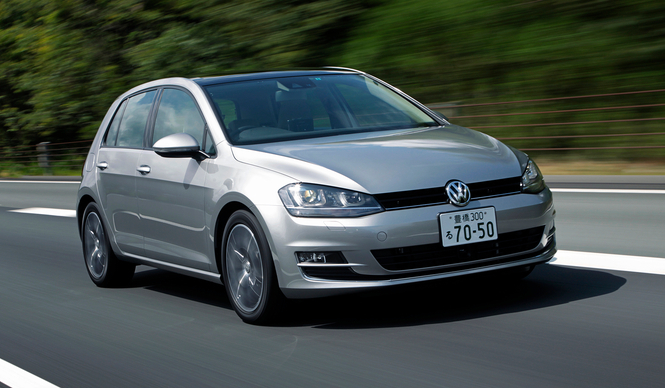
Since the first generation debuted in 1975, the Volkswagen Golf has a 38-year history. The 7th generation, evolved through a full model change, has finally landed in Japan. Fumio Ogawa took the wheel of the "Comfortline" with its 1.2-liter engine and the "Highline" with its 1.4-liter engine, which are the first to be released in Japan.
Text by OGAWA FumioPhotographs by MOCHIZUKI Hirohiko
A Model Change Enhancing the Predecessor's Strengths
The 7th generation VolkswagenGolf hasReleased in Japan on June 25, 2013 undergone a complete model change, adopting a new generation platform. We immediately bring you a driving impression of the new Golf with its newly designed engine.
predecessorWhile using the 5th generation platform, it had already reached a high level in terms of handling, fuel economy, and comfort. Therefore, how the Golf would evolve with a full model change was of great interest to automotive journalists like myself.
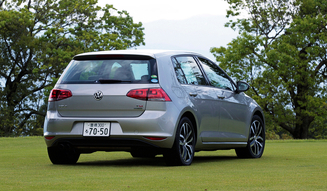
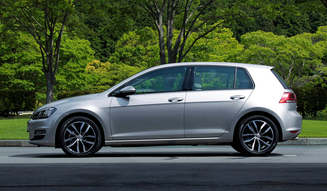
This GolfMQBplatform, designed for transverse engines. The engine has also been newly designed for weight reduction and improved efficiency, and a newly developed multi-link suspension has been adopted for the rear on higher-grade models. There are many points to note.
In a word, they have brought a sense of premium quality. Smooth acceleration, supple ride, agile handling, and excellent quietness. Once you drive it, you realize it's a model change that builds upon the strengths of its predecessor.
Regarding my impression that "the styling, such as the character line on the side, gives a strong sporty impression," Volkswagen Group Japan responded that the sporty aspect will be complemented by models like the upcoming GTI and "R" models.
Volkswagen Golf
Test Drive: The 7th Generation Golf (2)
1.2-Liter TSI Engine Model Achieves Fuel Economy Close to Japanese Hybrids
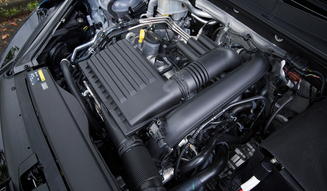
The new Golf is available with two engine options: 1.2-liter and 1.4-liter. The 1.2-liter four-cylinder unit features a newly designed aluminum block. While its maximum output of 105ps and maximum torque of 175Nm remain unchanged with the intercooled turbocharger, the engine management system has been updated and the engine is lighter, resulting in a fuel economy of 21.0 km/liter (1.2-liter model) under the JC08 mode. Volkswagen Group Japan (VGJ) proudly states, "For driving patterns that involve a lot of highway use, the overall fuel economy approaches that of Japanese hybrid vehicles."
The models equipped with this 1.2-liter engine are the "TSI Trendline" (2.49 million yen) and "TSI Comfortline" (2.69 million yen). The difference lies only in the equipment; the driving performance is fundamentally the same. I was impressed that the power felt increased compared to the previous model, providing sufficient performance for daily use in both city and highway driving.
The headroom is ample, and the rear seats, due to a lowered seating position, provide a feeling akin to being in a premium sedan, as VGJ suggests, which I found convincing.
The steering wheel, with its pleasingly tactile, subtly three-dimensional grip, offers light steering effort. The car responds well, making it agile even through corners. It seems that one of the development themes for car manufacturers recently is to create enjoyment even when making a turn at a traffic light. While it's unclear if the Volkswagen development team shared the same objective, the new Golf offers a similar sense of fun. It should make for an enjoyable drive in everyday use.
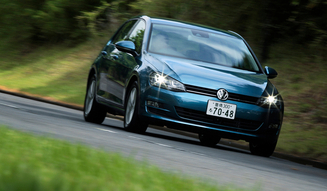
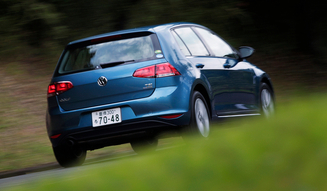
On the highway, likely due to the aerodynamic body, the speed builds effortlessly, providing more than enough power for the engine displacement. Noise intrusion from the road and wind is minimal, suggesting that long-distance drives would be relatively fatigue-free. I had read criticisms that the 1.2-liter model's rear suspension, a trailing arm type, felt harsh, but I experienced no such issues. The ride became particularly smooth when an adult male occupied the rear seat.
Volkswagen Golf
Test Drive: The 7th Generation Golf (3)
1.4-Liter Engine Now Exclusively Single-Turbo
The previous Golf offered a 1.4-liter engine with either a single turbocharger (122ps) in the "Comfortline" or a supercharger and turbocharger (160ps) in the "Highline." This time, it has been consolidated into a single-turbo "TSI Highline."
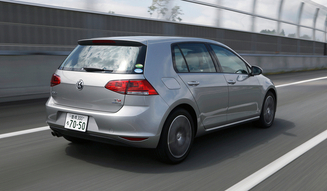
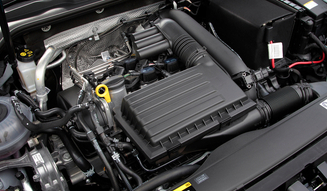
The new "TSI Highline" (2.99 million yen) boasts a maximum output of 140ps and a maximum torque of 250Nm. While these figures are lower than the previous twin-charged model, I felt the previous Highline was somewhat "over the top" and its differentiation from the GTI was unclear. Therefore, I approve of this new model's "intermediate character" (VGJ).
Furthermore, it features "Active Cylinder Management," which deactivates two of the four cylinders during light load driving to improve fuel economy and reduce CO2 emissions per kilometer.
The engine offers ample torque, clearly more powerful than the 1.2-liter. The test car was equipped with the optional "Adaptive Chassis Control 'DCC'," allowing damping selection between "Sport," "Normal," and "Comfort" modes.
Additionally, the "Driving Profile Selection" function adjusts engine and shift programs, accelerator response, and steering torque according to these three modes.
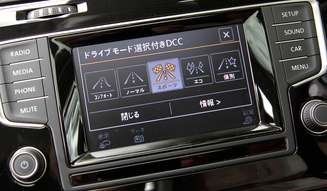
For instance, selecting the "Sport" mode, the sportiest setting, results in a noticeably more spirited performance. The car accelerates with even the slightest press of the accelerator pedal. This feature would enhance the driving experience on winding roads. While not as extreme as the previous "Highline," it's suited for drivers who enjoy spirited driving. However, I found the "Comfort" mode to be perfectly adequate.
The ride quality is equally supple and refined in the 1.4-liter model. Comfort, rather than sportiness, seems to be its forte. During driving, chassis vibrations are almost nonexistent, and noise intrusion is minimal, giving the impression of a car from one or two classes above. The 1.4-liter's multi-link rear suspension likely improves its ability to follow road imperfections and enhances stability during cornering, though I couldn't confirm this during my test drive.
Volkswagen Golf
Test Drive: The 7th Generation Golf (4)
A Clear Sign of the Golf's New Generation
The interior design is functional. Controls are placed where needed (however, the switch for the optional "Adaptive Chassis Control DCC" is hidden by the shift lever in right-hand drive models, making it difficult to use).
The monitor screen uses touch sensors, which might feel familiar to smartphone users. However, blind operation can be somewhat challenging.
The seats, whether in cloth or optional leather, are comfortable, offering good cushioning and support. In this regard, Japanese cars still seem to lag behind. The "Highline" features glossy black panels, similar to "High Up!", which lend a modern touch. It's a clear indication that the Golf has entered a new generation.
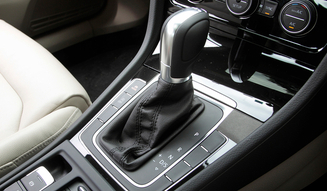
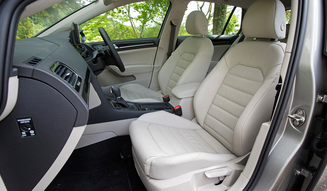
The panel fit and finish felt of higher quality in previous generations. I wish they would enhance the sense of premium quality with this new glossy panel, and I hope it becomes available in other models as well.
The new Golf, advertised as having "the best fuel economy in Golf history," is also expected to see the introduction of a diesel engine model by the end of 2014. Currently, all three models qualify for "100% eco-car tax reduction."
Although I couldn't experience them this time, the comprehensive safety features are likely to be a significant factor for buyers. The following features are standard on all models:
Pre-crash brake system "Front Assist Plus"
Proactive Occupant Protection
Multi-collision brake system
Driver fatigue detection system
Electronic parking brake
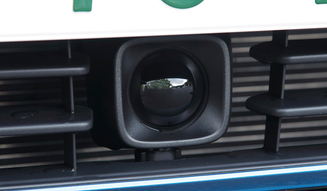
The 1.2 "Comfortline" and 1.4 "Highline" models are equipped with "Adaptive Cruise Control" with full-speed follow function. If the preceding vehicle stops, the Golf will also stop, and then resume following the preceding vehicle while maintaining the set speed with a light press of the accelerator pedal.
The "Highline" further includes the "Lane Keep Assist System," which detects unintentional lane departure and provides steering wheel vibration and automatic steering correction.
Recently,Volvo "V40"exemplified by the Volvo "V40," a wealth of safety features is increasingly welcomed by consumers. It's not hard to imagine that Golf buyers place a particularly high emphasis on safety. In this regard as well, the new Golf has certainly evolved as a family car for a new generation.

Volkswagen Golf TSI Trendline
Volkswagen Golf TSI Comfortline
Body Dimensions: Length 4,265 x Width 1,800 x Height 1,460 mm
Wheelbase: 2,635 mm
Tread Front/Rear:
(Trendline) 1,550/1,520 mm
(Comfortline) 1,545/1,515 mm
Trunk Capacity: 380-1,270 Liters
Minimum Turning Radius: 5.2 Meters
Weight: 1,240 kg
Engine: 1,197 cc Inline 4-Cylinder Direct Injection Turbo
Max Output: 77 kW (105 ps) / 4,500-5,500 rpm
Max Torque: 175 Nm / 1,400-4,000 rpm
Transmission: 7-Speed Automatic (7DSG)
Compression Ratio: 10.5:1
Drivetrain: FF
Tires:
(Trendline) 195/65R15
(Comfortline) 205/55R16
Fuel Economy (JC08 Mode): 21.0 km/ℓ
Price:
(Trendline) 2.49 million yen
(Comfortline) 2.69 million yen
Volkswagen Golf TSI Highline
Body Dimensions: Length 4,265 x Width 1,800 x Height 1,460 mm
Wheelbase: 2,635 mm
Tread Front/Rear: 1,535/1,510 mm
Trunk Capacity: 380-1,270 Liters
Minimum Turning Radius: 5.2 Meters
Weight: 1,320 kg
Engine: 1,395 cc Inline 4-Cylinder Direct Injection Turbo
Max Output: 103 kW (140 ps) / 4,500-6,000 rpm
Max Torque: 250 Nm / 1,500-3,500 rpm
Transmission: 7-Speed Automatic (7DSG)
Compression Ratio: 10.0:1
Drivetrain: FF
Tires: 225/45R17
Fuel Economy (JC08 Mode): 19.9 km/ℓ
Price: 2.99 million yen