Test Drive Chrysler 300 SRT8 | SRT
Chrysler 300 SRT8 | Chrysler 300 SRT8
American High-Performance Sedan
Test Drive: Chrysler 300 SRT8
Late last year, the "Chrysler 300" marked the revival of the Chrysler brand in Japan.Chrysler 300This year, the high-performance car brand, SRT, landed in Japan along with the Chrysler 300 and Jeep Grand Cherokee.SRT Lands in JapanSimultaneously, the "Chrysler 300 SRT8," based on the Chrysler 300, was released. What SRT technology is infused into this model? What is its performance like? Tatsuya Otani explains.
Text by OTANI Tatsuya
Photographs by ARAKAWA Masayuki
What Makes the SRT Different?
If asked what distinguishes it from the regular "300," I couldn't immediately answer.
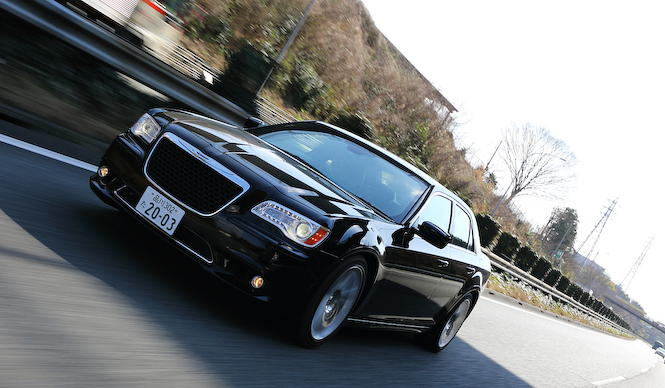
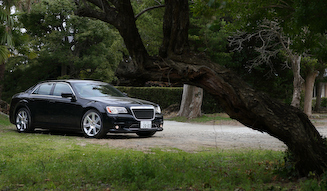
But the visual impression is clearly different.
This one is several notches more powerful and wilder.
It feels like the hint of roguishness that was barely concealed in the new 300 has finally been laid bare.
SRT stands for Street and Racing Technology. It's a special brand born from the integration of two teams within Chrysler specializing in high-performance car manufacturing: Viper and Plymouth Prowler. Think of it as Chrysler's equivalent to Mercedes-Benz's AMG or BMW's M.
However, SRT differs significantly from European high-performance cars in two aspects. Firstly, the technology used and the overall atmosphere exuded by the car are distinctly American. Secondly, the price is surprisingly low.
What is the HEMI Engine?
The SRT's technology is symbolized by its engine.
Many fans know that Chrysler's high-performance engine is nicknamed HEMI, derived from its hemispherical combustion chambers.
But hemispherical combustion chambers are hardly novel today. So why does Chrysler proudly use the HEMI name? The reason lies in its OHV (Overhead Valve) valvetrain.
Chrysler 300 SRT8 | Chrysler 300 SRT8
American High-Performance Sedan
Test Drive: Chrysler 300 SRT8 (2)
The HEMI Tradition
This might get a bit technical, but OHV is a valvetrain configuration where the intake and exhaust valves are located in the cylinder head. Meanwhile, the camshaft that determines valve timing is positioned low, near the crankshaft, and it drives the valves via pushrods, which are essentially rods.
Compared to the SV (Side Valve) system that preceded OHV, OHV offered the advantage of a more compact combustion chamber. However, generally, OHV layouts align the intake and exhaust valves in a straight line, making it difficult to increase valve surface area. In simple terms, the cylinder bore is smaller than the sum of the intake and exhaust valve diameters.
Chrysler ingeniously devised a valvetrain mechanism that allowed for a layout where the intake and exhaust valves faced each other. Furthermore, this enabled the combustion chamber shape to approximate a hemisphere. A hemispherical combustion chamber reduces surface area, thereby minimizing heat loss.
When Chrysler introduced the HEMI engine in the 1960s, this was a groundbreaking design.
However, the "facing valve layout" that was difficult with OHV is now easily achievable with common DOHC engines; in fact, it's a natural consequence of DOHC. Therefore, it's not strictly necessary to specify it as HEMI. Yet, their pride in continuing to build high-performance engines with OHV likely keeps the traditional HEMI name alive.
A Smile Spreads Across Your Face
BMW, which continues to produce inline-six engines, also combines traditional technology with its own identity and originality. Similarly, American manufacturers often stick to unique technologies in motorsports, yet frequently engage in close competition with European rivals (American cars won the GT Pro or GT1 class at the 24 Hours of Le Mans for three consecutive years from 2009 to 2011).
Therefore, American high-performance technology should not be underestimated simply because of its older fundamental design.
The 6.4-liter V8 engine in the Chrysler 300 SRT8 produces 472 hp at 6,100 rpm and 631 Nm of torque at 4,150 rpm. Moreover, this engine's responsiveness and smoothness are on par with the latest German power units.
In fact, the meticulously engineered mechanism, refined over 50 years, delivers a tangible sense of its operation, bringing a smile to your face.
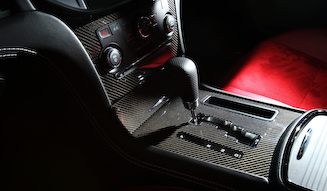
Yet, it lacks the temperamental nature often found in older high-performance engines. The five-speed automatic transmission and rear-wheel drive offer smooth starting manners, and aside from being a bit noisy, there's no inconvenience for a wife heading out for grocery shopping.
Chrysler 300 SRT8 | Chrysler 300 SRT8
American High-Performance Sedan
Test Drive: Chrysler 300 SRT8 (3)
Unleashing its Fangs
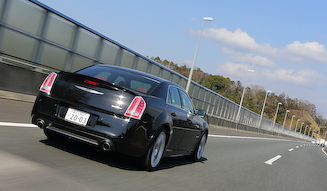
However, when you press the throttle pedal deeply, the 300 SRT8 reveals its hidden ferocity. The acceleration above 4,000 rpm can only be described as violent. This is when the HEMI's full performance is unleashed.
The body, which shares fundamental components with the previous generation Mercedes-Benz E-Class, boasts high rigidity, showing no signs of strain even under significant impact. The front seats are spacious, and the rear offers ample legroom, allowing passengers to cross their legs comfortably.
The steering effort is on the heavier side. The grip is also thick, conveying a strong sense of solid stability.
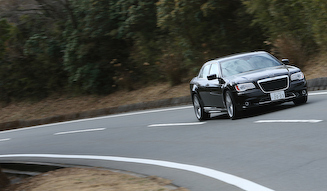
One thing is certain: this is not a car designed for nimble cornering on winding mountain roads.
Speaking of solidity, the ride quality is similar. While the robust body prevents discomfort, you can feel the large, heavy 20-inch tires suspended at the end of the firm suspension.
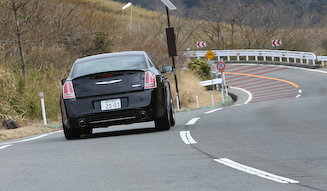
Bargain Price
However, these are evaluations based on European standards. Conversely, for those accustomed to American high-performance cars, the precise steering, the flat ride, the smooth and responsive engine, and the solid interior and exterior craftsmanship would elicit a "Wow, American cars have come this far!" reaction.
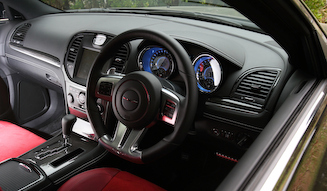
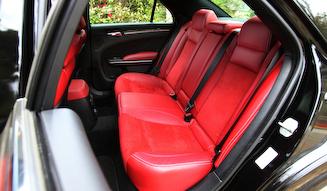
In any case, rather than nitpicking minor imperfections, it's more rewarding to fully enjoy the car's macho American character. Let's overlook the poor fuel economy of 5.9 km/L in JC08 mode, which drops to 3 km/L when you floor it.
After all, a high-performance sedan with such originality and undeniable quality is available for 6.38 million yen. It goes without saying that its German rivals would cost more than twice that amount.

Chrysler 300 SRT8
Body Dimensions | Length 5,090 x Width 1,905 x Height 1,485 mm
Wheelbase | 3,050 mm
Tread Front/Rear | 1,630 / 1,615 mm
Weight | 2,020 kg
Engine | 6,416 cc V8 OHV
Compression Ratio | 10.9 : 1
Bore x Stroke | 103.9 x 94.6 mm
Max. Output | 347 kW (472 hp) / 6,100 rpm
Max. Torque | 631 Nm (64.3 kgm) / 4,150 rpm
Transmission | 5-speed Automatic
Drivetrain | FR
Tires | 245/45ZR20
Fuel Economy (JC08 Mode) | 5.9 km/ℓ
Price | 6.38 million yen