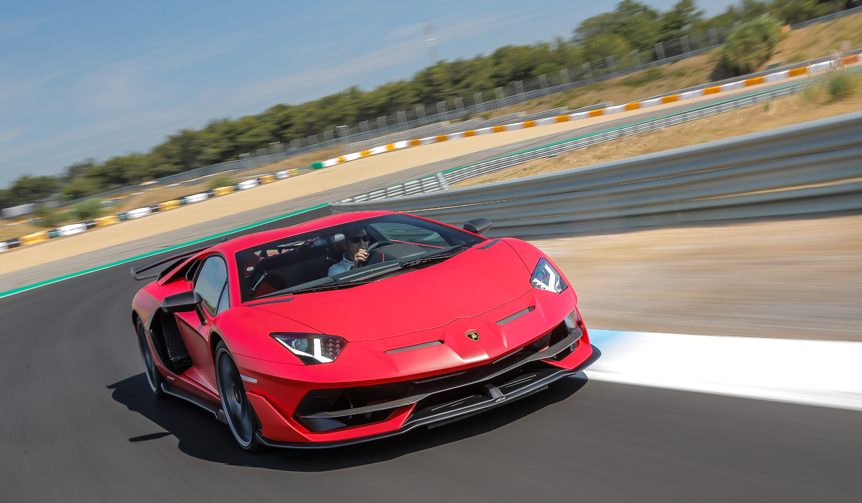
Testing the Evolution of the Aventador SVJ on the Circuit | Lamborghini
Lamborghini Aventador SVJ
Lamborghini's Latest Flagship
Testing the Evolution of the Aventador SVJ on the Circuit
Announced in August 2018, the Lamborghini Aventador SVJ is the brand's new flagship model. It features a more powerful V12 engine and the latest active aerodynamics system than the limited-edition Aventador SV (Super Veloce), setting a new production car record on the Nürburgring Nordschleife. Tatsuya Otani had the opportunity to test this pinnacle of the Aventador family on the circuit and confirm its evolution.
Text by OTANI Tatsuya
A High-Performance Model Where Power Isn't the Only Highlight
The Aventador SVJ is Lamborghini's new flagship model. Its 6.5-liter naturally aspirated V12 engine produces a record-breaking 770 hp at 8,500 rpm and 720 Nm at 6,750 rpm for a production Lamborghini V12, achieving incredible performance figures: a top speed exceeding 350 km/h, 0-100 km/h in 2.8 seconds, 0-200 km/h in 8.6 seconds, and 0-300 km/h in 24.0 seconds. Even more astonishing is its Nürburgring Nordschleife lap time of 6:44.97, the fastest for a production car. This means the Aventador SVJ is not just powerful but also exceptionally superior in handling.
How Did Lamborghini Create This SVJ?
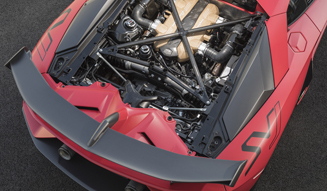
To begin with the engine, the exhaust system's overall length was shortened by relocating the tailpipe position from low within the rear diffuser to a high position alongside the taillights, thereby reducing back pressure. The intake system also saw revisions to the intake manifold shape to reduce intake resistance. However, the most notable change is the switch from conventional steel intake valves to titanium. This lighter valve allows for quicker response to camshaft movements. Lamborghini's engineers leveraged this characteristic of titanium valves to extend the valve open duration as much as possible during the intake stroke, successfully drawing more air into the combustion chamber.
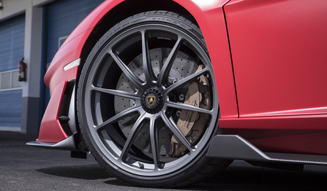
Regarding the suspension, while the spring rates are identical to the Aventador SV (the limited-edition model that was the most powerful in the Aventador series before the SVJ's debut), the damper's damping force has been increased by an average of 15 percent, and the anti-roll bars have been strengthened by 50 percent. The tires are the same Pirelli P Zero Corsa as the Aventador SV, but their structure and compound have been revised to improve grip levels and enhance control at the limit.
However, the Aventador SVJ's most significant feature lies in its aerodynamics. The system, which Lamborghini calls 'ALA 2.0,' is an improved version of the variable aerodynamic system 'ALA' introduced with the Huracán Performante.
Lamborghini Aventador SVJ
Lamborghini's Latest Flagship
Testing the Evolution of the Aventador SVJ on the Circuit (2)
ALA Controls the Body Through Airflow
The key feature of ALA is not changing the angle of the entire wing or altering the front spoiler's shape, as seen in conventional variable aerodynamic systems. Instead, it controls airflow by moving compact flaps (air deflectors) to increase downforce or reduce drag.
For example, the rear wing has numerous small slits near the trailing edge of its underside. By placing electronically controlled flaps in the path of airflow guided into these slits, it's possible to either expel air from the slits or block it. When the flaps are closed and air is not expelled from the slits, the wing's cross-sectional shape causes the airflow beneath the wing to move faster than the airflow above it. This lowers the air pressure beneath the wing, effectively creating a vacuum effect that pulls the car downwards, generating greater downforce.
Conversely, when the flaps are open and air is expelled from the slits, the pressure reduction beneath the wing is suppressed, decreasing the downward force acting on the entire wing. This reduction in downforce is accompanied by reduced air resistance, allowing for higher top speeds.
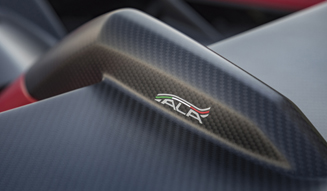
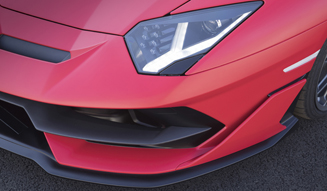
Another characteristic of ALA is its ability to create differential downforce between the left and right sides, achieved by controlling the aerodynamic properties through the opening and closing of compact flaps rather than moving the entire wing. Consequently, just as a bulldozer turns left or right by varying the speed of its tracks, ALA can generate forces that steer the car left or right using air. This reduces the amount of steering input required during cornering, minimizes tire rolling resistance, and leads to further gains in speed.
Compared to the ALA in the Huracán Performante (which Lamborghini refers to as ALA 1.0), ALA 2.0 reportedly achieves a more uniform airflow expulsion from the slits, further enhancing the system's effectiveness.
So, what was the driving experience like in the Aventador SVJ, equipped with the latest technology throughout? We had the chance to get behind the wheel at Estoril Circuit, a former venue for the F1 Portuguese Grand Prix.
Lamborghini Aventador SVJ
Lamborghini's Latest Flagship
Testing the Evolution of the Aventador SVJ on the Circuit (3)
The Joy of Taming a 770hp Bull
As soon as I started driving on the track, I was immediately struck by the richer feedback felt through the steering wheel compared to before. The exhaust note from the V12 engine, which redlines at 8,700 rpm, became even more exhilarating, unleashing a truly screaming sound as it revved. The engine torque felt stronger across the entire range, and the acceleration seemed sharper.
As I turned the weighty steering wheel towards the corner, the nose pointed towards the apex smoothly, but the response was by no means overly sensitive. Combined with the strong grip of the rear tires, the sense of security was immense.
Even when increasing cornering speed further, the steering characteristics didn't abruptly reverse into oversteer. Instead, it maintained a stable, slight understeer. It seemed that at the very limit of tire grip, the stability control intervened to maintain this slight understeer, ensuring the car's stable posture was precisely maintained even when pressing the throttle pedal harder. For someone like myself, whose driving skills are clearly inferior to a professional racing driver, this characteristic felt rather easy to handle.
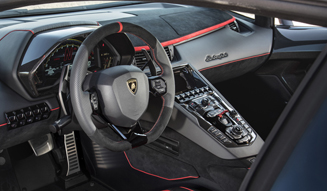
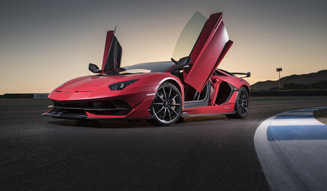
However, the Aventador SVJ isn't just about maintaining a controlled cornering attitude. For instance, switching the driving mode to 'Sport' allows for a bit more tail slide. In this setting, if you push the car to its limits through a corner and then ease off the throttle pedal as you approach the exit, the reduced load on the rear wheels allows them to slide outwards slightly, transitioning from neutral steering to a near-oversteer attitude. Controlling the cornering attitude with the throttle pedal in this manner allows you to experience an almost heavenly joy, the satisfaction of taming a 770hp bull.
This level of controllability is something not often experienced in previous Aventadors. Maurizio Reggiani, head of Lamborghini's engineering, explained, 'The basic stability has been further improved by the 4WS system introduced with the Aventador S and ALA 2.0, enhancing the stability control's responsiveness and enabling this kind of control.'
The Aventador SVJ offers the sensory thrill of its V12 engine and outstanding chassis performance. Priced at 51,548,373 yen, its production is limited to just 900 units worldwide, and unfortunately, it is already close to being sold out.

Lamborghini Aventador SVJ
Body Dimensions | Length 4,943 x Width 2,098 x Height 1,136 mm
Wheelbase | 2,700 mm
Tread Front/Rear | 1,720 / 1,680 mm
Minimum Ground Clearance | 115 ±2 mm
Weight | 1,525 kg
Weight Distribution Front:Rear | 43 : 57
Engine | 6,498 cc 60° V12 DOHC 48-valve
Compression Ratio | 11.8±0.2 : 1
Bore x Stroke | 95 x 76.4 mm
Maximum Output | 566 kW (770 ps) / 8,500 rpm
Maximum Torque | 720 Nm / 6,750 rpm
Maximum Engine Speed | 8,700 rpm
Transmission | 7-speed ISR
Drivetrain | 4WD
Front Suspension | Horizontal magnetorheological dampers with pushrod system
Rear Suspension | Horizontal magnetorheological dampers with pushrod system
Front Brakes | φ400×38 mm Carbon-ceramic ventilated discs
Rear Brakes | φ380×38 mm Carbon-ceramic ventilated discs
Tires Front/Rear | 255/30ZR20 / 355/25R21 (Pirelli P Zero Corsa)
Top Speed | Over 350 km/h
0-100 km/h Acceleration | 2.8 seconds
0-200 km/h Acceleration | 8.6 seconds
0-300 km/h Acceleration | 24.0 seconds
100-0 km/h Deceleration | 30 meters
Front/Rear Weight Distribution | 43 : 57
Minimum Turning Radius | 5.75 meters
Fuel Consumption (NEDC Value) | 19.6 L/100km (approx. 5.1 km/L)
CO2 Emissions | 452 g/km
Fuel Tank Capacity | 85 liters