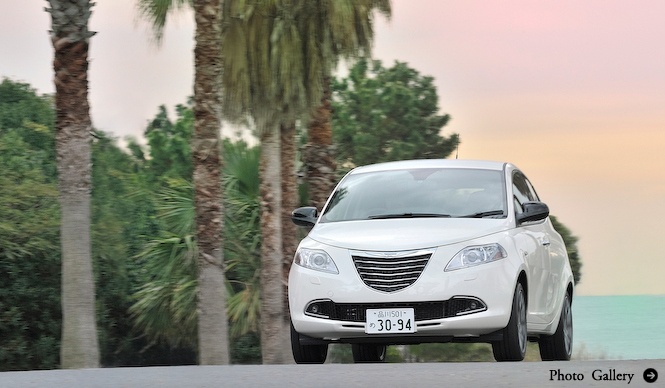
First Drive of the Chrysler Ypsilon | Chrysler
Chrysler Ypsilon
First Drive: The Ypsilon
On November 15th,Arrival in Japan from Chrysler Brandthe third-generation "Ypsilon" made its debut. In its home country of Italy, it is sold under the Lancia brand. With a compact engine and compact body, it appears to be a two-door hatchback at first glance, but it is actually a four-door, five-seater. OPENERS had the opportunity to test drive the Ypsilon, which balances elegant style with practicality, in Tokyo with Fumio Ogawa.
Text by OGAWA Fumio
Photographs by ABE Masaya
A Distinctive Compact Car
The "Ypsilon" hatchback, with its two-cylinder engine, leads the charge in the era of downsizing. While the brand has changed from Lancia to Chrysler, it retains the European lineage of a marque skilled in crafting small cars.
Fiat Chrysler was born from corporate mergers and acquisitions. The Chrysler Ypsilon, launched in November 2012 by its Japanese subsidiary, Fiat Chrysler Japan, is equipped with a mere 875cc two-cylinder turbo engine in its compact 3,835mm body. It is a model that truly embodies the downsizing trend (reducing engine displacement) sweeping across Europe.
The first generation of the Ypsilon was unveiled in 1994.
From its inception, its selling point has been the combination of a compact body with premium craftsmanship and a stylish design. Although developed based on the Fiat "500 TwinAir," it is a model whose unique character is sure to pique the interest of car enthusiasts.
The third-generation Ypsilon we test drove around Odaiba proved to be a car with a distinct personality, in the best sense of the word, both in its styling and its ride.
Chrysler Ypsilon
First Drive: The Ypsilon (Part 2)
Striking Styling
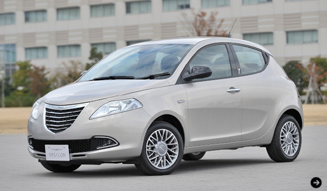
"A unique form elevated to the realm of art" is the tagline Fiat Chrysler Japan uses to describe the Ypsilon. Whether one agrees with this assertion or not, it is undeniably a car that leaves a strong visual impression.
Car designers say that the essence of automotive styling lies in balance. Indeed, the Ypsilon's side profile is beautiful. The relationship between the front and rear wheels, and the body including the front and rear overhangs, is harmoniously resolved. This is difficult to discern from images alone. You will likely be struck by it when you see it on the road.
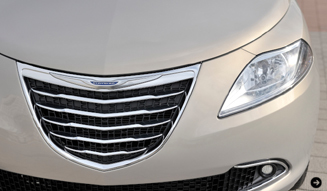
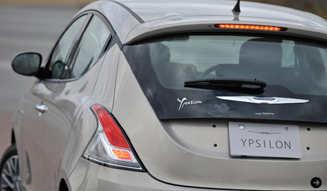
Details such as the rear door handles hidden within the molding, the flowing shape of the rear combination lamps, and the front grille, which pays homage to the DeSoto "Airflow"—a product representing 1930s industrial design and a former Chrysler-owned brand—could be seen as design for design's sake. However, the overall proportions are meticulously crafted and well-executed.
It Drives Well!
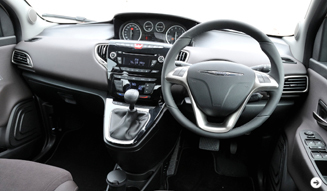
My first impression upon driving it was admiration for how surprisingly well it performed. The 145Nm of torque is set to be delivered at 1,900rpm, but when you press the accelerator from a standstill, the engine easily surpasses 3,000rpm, and the car accelerates without any hesitation.
The gearbox is a 5-speed, 2-pedal system with an automated manual transmission. If you drive it like a conventional torque converter automatic, keeping the accelerator pedal pressed down carelessly, you will feel a jolt during shifts.
While the jolts felt significantly improved compared to previous iterations, for a smoother drive, it's best to ease off the accelerator slightly at appropriate moments to prompt upshifts.
The cabin's quietness is generally good, but the non-intrusive "tokotoko-tokotoko..." popping sound of the inline-two-cylinder engine becomes more noticeable during acceleration, which isn't entirely unpleasant. While rapid acceleration and deceleration might not be its forte, it can easily keep pace with traffic on highways like the Shuto Expressway in Tokyo.
Chrysler Ypsilon
First Drive: The Ypsilon (Part 3)
It Should Meet the Expectations of Italian Car Fans
The most striking aspect of the Ypsilon is its handling. In a word, it is superbly sporty. The sensation of cornering with remarkable agility, reminiscent of the negative camber setup (where the tires are angled inwards) of Alfas from a bygone era, is truly exhilarating.
From driving with attention to optimal torque through gear and accelerator control, to handling that faithfully follows the driver's intentions, it is a car that offers a wonderfully cohesive driving experience. It possesses the elements that fans expect from an Italian car, such as the joy of fully appreciating a small vehicle.
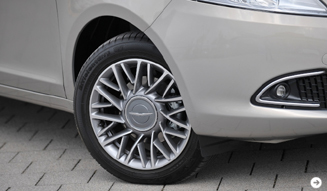
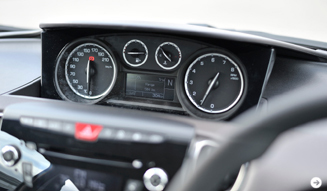
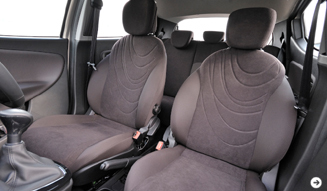
The ride comfort is by no means bad, and the packaging allows for two 175cm passengers to sit in the rear seats (though headroom is limited). It is a car designed with far more practicality and functionalism than its appearance might suggest. The model I test drove was the "Platinum" (2.6 million yen), the higher trim level. However, the "Gold" (2.35 million yen) with 185/55R15 tires and fabric seats, instead of the 195/45R16 tires and leather seats, might offer a softer ride. I am intrigued and would like to test drive it if I have the chance.
You'll Surely Grow to Like It
Among the Ypsilon's rivals are other attractive and distinctive cars, such as the Fiat "500 TwinAir" (from 2.3 million yen), with the same engine, and the Volkswagen "up!" (from 1.49 million yen), with its 999cc three-cylinder engine.
While the "up!" evokes a sense of similarity to the design of smartphones and other devices, feeling almost non-automotive, the Ypsilon can be seen as aiming for a different direction within the established grammar of automotive design. Which is better is a matter of personal preference, but I believe that even without overthinking it, you will surely grow to like the Ypsilon.

Chrysler Ypsilon
Body Dimensions | Length 3,835 x Width 1,675 x Height 1,520 mm
Wheelbase | 2,390 mm
Tread Front/Rear | 1,415 / 1,410 mm
Weight | 1,090 kg (1,130 kg with sunroof)
Engine | 875cc Inline 2-cylinder Intercooled Turbo
Maximum Output | 63kW (85ps) / 5,500 rpm (57kW (77ps) / 5,500 rpm in Eco mode)
Maximum Torque | 145Nm (14.8kgm) / 1,900 rpm (100Nm (10.2kgm) / 2,000 rpm in Eco mode)
Transmission | 5-speed sequential transmission with AT mode
Drivetrain | FF
Tires Front/Rear | 185/55R15 (Gold) / 195/45R16 (Platinum)
Fuel Economy (JC08 mode) | 19.3 km/ℓ
CO2 Emissions | 97 g/km
Price | Gold 2.35 million yen / Platinum 2.6 million yen