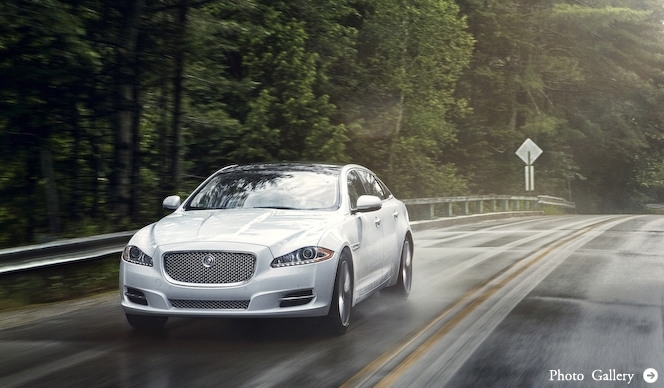
Experience the Jaguar New Era with a Downsized Engine | Jaguar
Jaguar XJ
Test Drive: The XJ with a Downsized Engine
Jaguar once offered cars with 12-cylinder engines and won Le Mans with a 7.4-liter racing car. Many likely associate the brand with a penchant for large displacement engines. Yet, even Jaguar has finallyAdopting Downsized Engines in Minor Updateadopted them. The news of a 2-liter, 4-cylinder engine powering a large-bodied saloon must have been a shock to long-time Jaguar fans. But what is this new downsized engine Jaguar has chosen really like? Yasuhisa Shimashita weighs in!
Text by YASUHISA SHIMASHITA
A 4-Cylinder Engine in the XJ: A "Shocking" Combination
The words "Jaguar" and "downsizing" might seem like an unlikely pairing to some. However, consider that Jaguar has been committed to reducing environmental impact for over a decade by adopting innovative all-aluminum bodies, and their experience with supercharged engines goes back even further. In essence, high efficiency has always been a pursuit for this brand.
Nevertheless, the two new engines they have prepared are bound to bring about a sense of surprise. These are a 3-liter V6 direct-injection supercharged engine and a 2-liter inline 4-cylinder direct-injection turbo engine. Both will be fitted to the XF and the XJ. The combination of a 4-cylinder engine in the XJ, in particular, can be described as shocking.
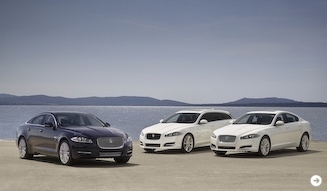
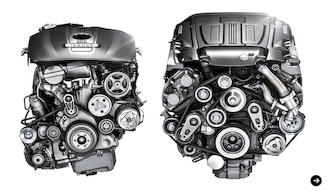
Our test drive took place near London. First behind the wheel was the XJ equipped with the 2-liter turbo unit. This all-aluminum engine produces a maximum output of 240 ps at 5,500 rpm and a peak torque of 340 Nm from 1,800 to 4,000 rpm. Jaguar proudly states that in terms of peak torque, this surpasses even the 3.2-liter V8 engine from a decade ago.
The transmission is an 8-speed automatic. Paired with the XJ, it achieves a 0-100 km/h acceleration of 7.5 seconds and a top speed of 241 km/h, both respectable figures. Meanwhile, fuel consumption is rated at 9.3 L/100km (approximately 10.8 km/L) in the EU combined cycle, with CO2 emissions kept to 216 g/km.
That's a Minor Detail
How does the 2-liter inline 4-cylinder turbo engine perform in the large-class saloon, the XJ?
Curiosity piqued, I set off and was immediately impressed by the smoothness of the initial acceleration. The 8-speed automatic transmission seems to effectively harness the engine's torque delivery, which builds strongly even from low speeds.
The sensation of effortless power building between 2,000 and 3,000 rpm is particularly pleasing, and it feels more than adequate for cruising.
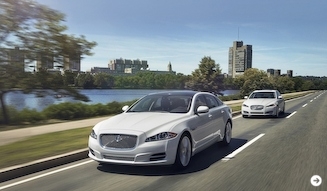
Regarding the sound, while it is indeed a 4-cylinder note, the twin balancer shafts ensure a smooth, refined tone. The active engine mounts also contribute to suppressing vibrations, and since the overall volume isn't excessive, it shouldn't be particularly jarring. The turbocharger's exhaust silencing effect may also play a role.
On the other hand, even when flooring the accelerator on an open stretch, the acceleration response isn't exactly sharp, and pushing it beyond 6,000 rpm doesn't yield a surprisingly strong surge of acceleration. However, if one were to find fault, it would likely be with its behavior under conditions that are unlikely to be encountered in daily driving for the XJ. Frankly, the enhanced agility brought about by the engine's light weight of 138 kg made these aspects seem like minor details.
Jaguar XJ
Test Drive: The XJ with a Downsized Engine (Part 2)
New V6 Engine Rivals V8 Performance
Next, I tested the XJ's 3-liter V6 direct-injection supercharged engine.
This engine, featuring the latest spray-guided direct injection system and a Roots-type supercharger mounted within the V-bank, boasts a maximum output of 340 ps at 6,500 rpm and peak torque of 450 Nm from 3,500 to 5,000 rpm. It is also paired with an 8-speed automatic transmission.
This model achieves 0-100 km/h in 5.9 seconds and reaches its electronically limited top speed of 250 km/h. Fuel consumption is rated at 9.4 L/100km (10.6 km/L), with CO2 emissions at 224 g/km.
This favorable fuel economy is attributed not only to the increased compression ratio of 10.5:1, compared to the 5-liter V8 direct-injection supercharged engine's 9.5:1, but also to the inclusion of the Intelligent Stop-Start system. This system alone is said to improve fuel efficiency by up to 7 percent.

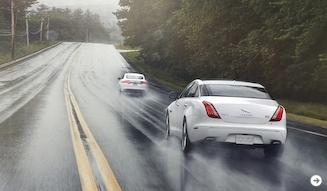
As soon as I switched and started driving, I was overwhelmed by its powerful torque. It's incomparable to the previous 3-liter V6 engine; in fact, its power feels akin to that of the 5-liter V8 engine.
While it doesn't offer the exhilarating response that might outpace your intentions, it reacts precisely as desired at low RPMs and delivers linear power all the way to the high rev range. It's an exceptionally tractable and refined engine characteristic.
The idling stop system, utilizing a twin-solenoid starter, is also well-executed, with no bothersome delay upon restarting. This is a strength of being a later entrant to the market; they have likely studied the feedback from other vehicles in the market thoroughly.
Jaguar XJ
Test Drive: The XJ with a Downsized Engine (Part 3)
Smart and Intelligent
For reference, on our test route combining urban driving and inter-city roads, the onboard fuel economy meter showed 29.2 mpg (approximately 12.4 km/L) for the 2-liter turbo engine and 24.2 mpg (approximately 10.3 km/L) for the 3-liter supercharged engine.
While these figures don't account for heavy city traffic, achieving these numbers, which exceed the published figures without dedicated fuel-saving driving, should be considered more than sufficient.
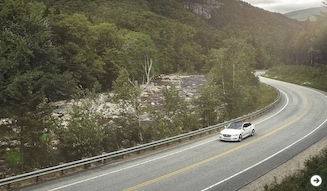
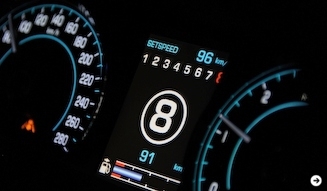
With the introduction of these new engines, both the XJ and XF will see the 2-liter inline 4-cylinder direct-injection turbo engine replace the previous 3-liter naturally aspirated V6, and the 3-liter direct-injection supercharged engine replace the 5-liter V8 direct-injection engine. The 5-liter V8 direct-injection supercharged engine will continue to be offered as the top-tier option, as before.
Personally, I was particularly taken with the 2-liter inline 4-cylinder direct-injection turbo engine. Its performance feels smart and intelligent, and the impact of "a 2-liter engine in the XJ" carries significant symbolic weight. While it remains a question mark how much this will resonate with the current customer base in this segment in Japan, I want to applaud Jaguar's bold decision to introduce it now. I believe its presence will undoubtedly have a considerable impact on the brand's future image.

Jaguar XJ 2.0 i4 Ti
Body Dimensions: Length 5,127 x Width 1,899 x Height 1,456 mm
Wheelbase: 3,032 mm
Tread (Front/Rear): 1,626 / 1,604 mm
Minimum Turning Radius: 5.95 meters
Engine: 2.0-liter inline 4-cylinder turbocharged
Max Output: 240 ps / 5,500 rpm
Max Torque: 340 Nm / 2,000-4,000 rpm
Top Speed: 241 km/h
0-100 km/h Acceleration: 7.9 seconds
Fuel Consumption: 8.9 L/100km
CO2 Emissions: 207 g/km
Jaguar XJ 3.0 V6 S/C
Body Dimensions: Length 5,127 x Width 1,899 x Height 1,456 mm
Wheelbase: 3,032 mm
Tread (Front/Rear): 1,626 / 1,604 mm
Minimum Turning Radius: 5.95 meters
Engine: 3.0-liter V6 supercharged
Max Output: 340 ps / 6,500 rpm
Max Torque: 450 Nm / 3,500-5,000 rpm
Top Speed: 250 km/h (limited)
0-100 km/h Acceleration: 5.9 seconds
Fuel Consumption: 9.4 L/100km
CO2 Emissions: 224 g/km