January 23, 2015
New Golf Overseas Test Drive Report | Volkswagen
Volkswagen Golf
The Seventh Generation
Test Drive of the Evolving Golf
With each iteration, the Volkswagen "Golf" has surprised with its level of refinement. While manufacturers worldwide have used this car as a benchmark, the "Golf" has now evolved into its seventh generation, leaving its followers behind. OPENERS commissioned Yasuhiko Kawamura andYasuhisa Shimashitato evaluate this new Golf. First, Yasuhiko Kawamura takes the wheel to explore the true value of the Golf's evolution!
Domestic Test Drive Report of the New Golf by Fumio Ogawa
Text by KAWAMURA Yasuhiko
How Can It Get Any Better?
How, exactly, can "this thing" possibly get any better? That was my honest thought—as the previous model, which is to say—the Golf 6was due for a model change.
The exterior and interior of the "Golf 6" were impeccably finished, with a quality that was beyond reproach. Its craftsmanship was so high that when compared directly with the more upscale
"Passat",it held its own. In fact, one might even say it rivaled the offerings from the group's premium brand,Audi, almost to the point of being indistinguishable.
Even the most basic 1.2-liter engine offered ample power, more than sufficient for everyday needs. This wasn't just about raw acceleration; the engine's feel and the smoothness of the gear changes also left a very positive impression, appealing to the senses.
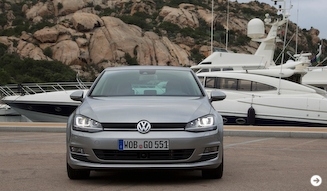
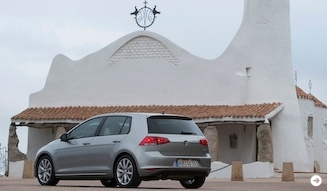
The quietness was already at a high level, to the point where newer rivals that arrived later often felt noisier than the Golf. Most impressive was its handling: while maintaining the rock-solid stability expected of a car born on the Autobahn, its steering was precise. Furthermore, its ride comfort was as supple as that of a much larger, more luxurious sedan. At this point, it truly felt like there was nothing left to criticize.
Therefore, to redesign a car that felt so complete and timeless was bound to be a monumental task, making the question posed at the beginning entirely understandable.
With these thoughts in mind, I traveled for nearly two days from Japan to Sardinia, an island in the Mediterranean belonging to Italy. With an area roughly equivalent to Shikoku, it's a large island with a grand landscape. However, I was a little disappointed that there would be no chance to test it on the highway, despite the abundance of winding roads—a thought based on past visits. With these preconceptions, I eagerly arrived at the hotel located in the northern part of the island, where the international press event for the new Golf, the "Golf 7," was being held.
The "Golf 7," the "New Golf," was set to commence. Arriving with eager anticipation at the hotel located in the northern part of the island, where the international press event for the "Golf 7," or "New Golf," was being held.
The Golf's Quietness Is Unmatched by Rivals
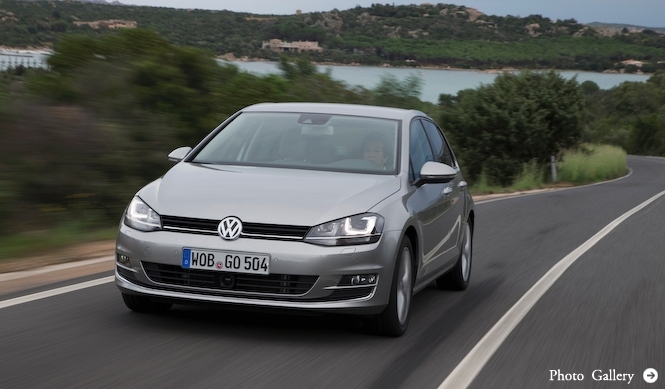
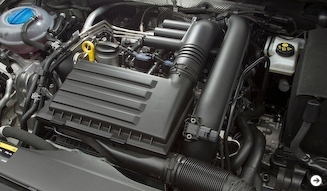
I started the drive in the specification expected to be the main model for the Japanese market: a 1.4-liter turbocharged direct-injection gasoline engine paired with the familiar seven-speed dual-clutch transmission, the "DSG." The immediate differences I felt compared to the previous model were primarily in these two key areas.
First, the overwhelming level of quietness.
As mentioned, the "Golf 6" already boasted superior quietness compared to its contemporary rivals. However, driving the new model with that experience still fresh in my mind, I was genuinely astonished by a level of quietness that was clearly a notch above anything before.
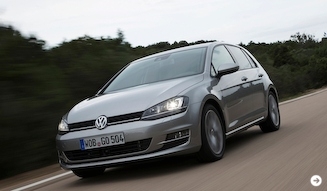
The last time I experienced such "quietness beyond common sense" was during the initial drive ofthe "Peugeot 508."In any case, the quietness of this new "Golf" is truly unmatched by rivals. This was undoubtedly my personal first impression upon starting the test drive.
The second striking impression was the sensation of the car continuing to roll "as if endlessly" even after lifting off the accelerator. In many recent models designed to improve fuel efficiency by reducing rolling resistance, the lack of rapid deceleration when the accelerator is released clearly indicates low rolling resistance.
However, with the new Golf, this effect is exceptionally pronounced. Many recent models incorporate a system where the clutch between the engine and transmission disengages automatically when the accelerator is eased, allowing the car to coast.
Yet, the new Golf achieves a similar "coasting sensation" without explicitly stating the adoption of such a system, and without the tachometer needle dropping to idle speed.
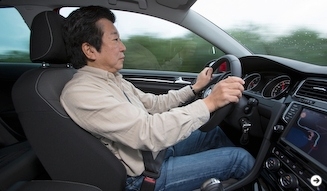
In real-world driving, this characteristic likely contributes significantly to improved fuel economy. Frankly, however, it sometimes felt disconcerting, as if "engine braking was almost non-existent." Even when attempting an aggressive downshift using the paddle shifters due to the lack of engine braking, the engine revved up but the deceleration didn't increase significantly. Perhaps the new era of driving dictates, "If you need to slow down, don't hesitate to use the brakes!"
Volkswagen Golf
The Seventh Generation
Test Drive of the Evolving Golf (3)
A Golf Worthy of the Name
Therefore, apart from these two points, the driving feel of the new Golf could be described as "all within expectations."
Without resorting to costly methods like using new materials, the body structure alone was made 23kg lighter, with a total vehicle weight reduction of up to 100kg claimed. This certainly resulted in a more vigorous initial acceleration. While I regret not being able to test its performance in "Autobahn territory," the stability I experienced in all driving scenarios was certainly at a level worthy of the "Golf" name.
Furthermore, it's worth noting that the overall ride comfort has undoubtedly been refined. However, it's important to consider that all test cars checked on this occasion were equipped with the optional electronically controlled variable damping system.
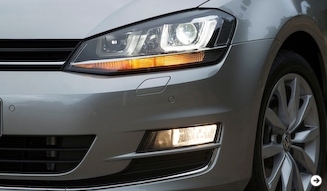
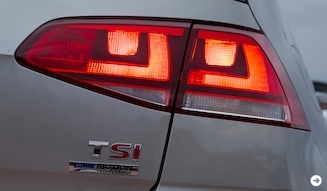
If I had to summarize this model change to the "Golf 7" in one word, it would be "normal evolution." With no radical new ideas adopted, it's understandable if some people feel it looks "unchanged."
However, we must recognize that the stage on which the "Golf 7" now sits, having been refined in every aspect, is exceptionally high. This is because its foundation was the "Golf 6," a model that already possessed extraordinary product appeal even as the "previous generation"!

Volkswagen Golf 1.4 TSI 103kW (140 PS)
Body Dimensions | Length 4,255 x Width 1,790 x Height 1,452 mm
Wheelbase | 2,637 mm
Tread Front/Rear | 1,549/1,520 mm
Trunk Capacity (VDA) | 380-1,270 Liters
Weight | 1,288 kg
Engine | 1,395 cc Inline 4-cylinder Turbo
Max Output | 103 kW (140 PS) / 4,500-6,000 rpm
Max Torque | 250 Nm / 1,500-3,500 rpm
Transmission | 7-speed DSG / 6-speed Manual
Drivetrain | FF
Top Speed | 212 km/h
0-100 km/h Acceleration | 8.4 seconds
Fuel Consumption (NEDC Combined Cycle) | 4.7 L/100 km
CO2 Emissions | 109 g/km
Price | 22,525 Euros