First Drive of the New Lexus LS in the US | Lexus
Lexus LS | LEXUS LS
First Drive of the New Lexus LS in the US
The new "LS," which made its world premiere at this year's Detroit Motor Show in January. How has Lexus's flagship saloon been transformed? This is a report from Hirohisa Kaneko, who test drove the latest LS in the US shortly before its domestic unveiling at the Tokyo Motor Show.
Text by KANEKO Hirohisa
A Boldly Sculpted Interior
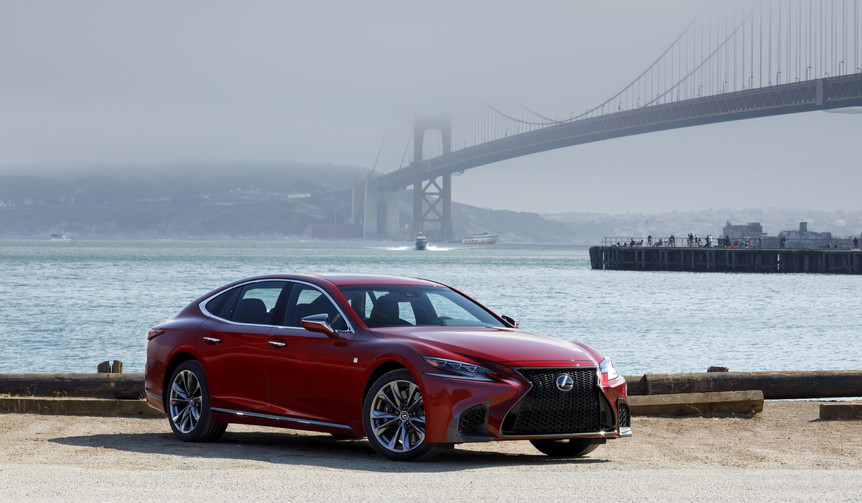
The fully redesigned Lexus "LS" LS in its US specification around San Francisco.
As you can see, it's a bold new creation from Lexus, with a completely revamped interior and exterior design, packed with numerous driving assistance devices and safety features.
The powertrain options are a 3.5-liter V6 twin-turbo gasoline engine (421ps, 61.2kgm) for the "LS500," and a hybrid system combining a 3.5-liter V6 gasoline engine with an electric motor (299ps, 35.5kgm) for the "LS500h." Both are paired with a newly developed 10-speed automatic transmission, and buyers can choose between rear-wheel drive and all-wheel drive.
An "F Sport" version with a sportier suspension setup is also available, but currently, the wheelbase and body are limited to a single configuration.
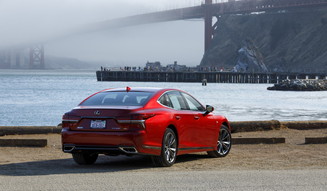
Lexus LS500 F SPORT
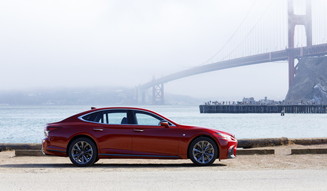
We started our drive from the foot of the Golden Gate Bridge in the "LS500 F Sport," the sporty version with rear-wheel drive powered solely by the engine.
Before setting off, I was captivated by the striking interior design. Not only is the layout functional, easy to see, and user-friendly, but the emotional styling and material choices far surpass those of previous LS models and other Lexus vehicles. The design is powerful and bold.
I had the same impression a year ago with the two-door coupe "LC",
Lexus LS | LEXUS LS
First Drive of the New Lexus LS in the US (2)
Gasoline or Hybrid?
Soon after merging onto Freeway 101 and cruising at around 60 mph (approximately 96 km/h), the cabin was quiet and remarkably comfortable. Acceleration was smooth, allowing us to navigate the dense traffic without feeling the car's substantial size.
This is largely due to the quiet and smooth engine, as well as the 10-speed automatic transmission intelligently shifting gears according to the situation.
Switching between "Comfort" and "Sport" driving modes, the differences were not significant, with both offering ample performance.
While American freeways are often rougher than Japanese roads, with continuous small bumps, the LS500 handled them with stability. Average speeds in congested urban areas in the US have increased compared to the past, and the LS500 inspired great confidence even when driving in such conditions.
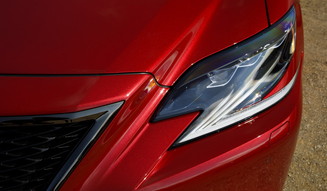
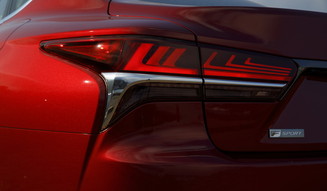
Lexus LS500 F SPORT
However, on the other hand, the ride quality varied significantly depending on the road surface once we exited the freeway, which was an area needing improvement. While quiet on smooth pavement, noise would suddenly and loudly intrude on rougher surfaces, with a gritty sensation transmitted through the steering wheel.
Driving on suburban winding roads and testing nearly all models, the significant impact of road surface variations on the car's response remained the biggest point of dissatisfaction.
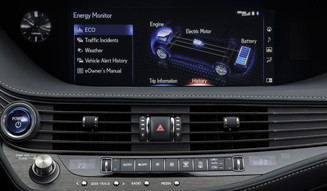
The LS500h's hybrid unit also offers excellent acceleration feel; the rubber-band effect characteristic of hybrids is completely gone, with speed increasing linearly.
Both powertrains suit the LS, but the LS500 is for those seeking power, while the LS500h is for those prioritizing fuel efficiency, quietness, and a smooth ride.
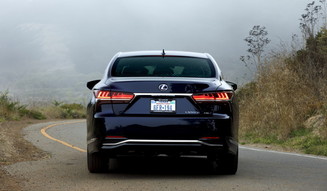
Lexus LS500h
While the "F Sport" does offer a slightly firmer and sportier feel, the difference is minimal. It might be more effective to create clearer distinctions to enhance product appeal.
A key focus in the development of the new LS is the incorporation of various driving assistance devices. Notable features include the "Lane Change Assist," a first for Japanese cars, "Lane Racing Assist" which suppresses excessively fast cornering speeds, and "Active Steering Control" that attempts to avoid collisions by steering the vehicle when pedestrians or other cars are detected. These are advanced and effective devices.
Due to features not being equipped in the US specification or differences in the test environment, we were unable to confirm their effectiveness this time. We look forward to testing them in the recently announced Japanese specification.
Lexus LS | LEXUS LS
First Drive of the New Lexus LS in the US (3)
The Massage Function: Its Value Reassessed
Last but certainly not least, the feature that I felt held the most potential and advantage in the new LS was the massaging seats, standard on higher trims.
What's groundbreaking is that not only the rear seats but all seats, front and back, offer massage functions, and remarkably, the driver can use it while driving.
As this relates to safety, the development team worked in conjunction with the Ministry of Land, Infrastructure, Transport and Tourism to realize this feature.
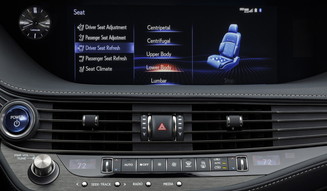
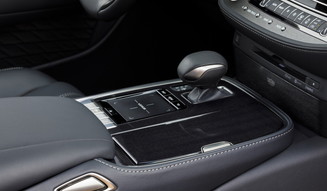
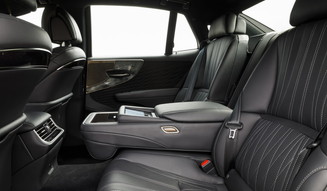
Equally innovative is the inclusion of a "stretch" function that extends muscles vertically, in addition to the "kneading" massage. The massage action extends not only to the seatback but also to the seat cushion, which is also new. I've never experienced a massage seat that felt so comfortable and deeply relaxing.
Each car manufacturer offers its own massage seats. Originally, it was almost a Japanese car exclusive, and European and American manufacturers viewed it coolly in the past. I've heard negative comments from European engineers, such as, "It's incompatible with the essential value of a car." I used to agree.
However, as the value expected from cars is evolving beyond mere transportation, the importance of massage seats is growing. Being able to receive a massage while driving is revolutionary, and as driving automation advances, how drivers spend their time in the car during transit becomes a major consideration. Everyone desires comfort and well-being.
The massage seat, which was sometimes dismissed with a smirk, has been elevated to a truly indispensable luxury feature with the new LS.
While it may be difficult to completely escape the influence of traditional European luxury cars, isn't it Lexus's great mission to shed light on aspects they overlooked and create new value? When you drive the new LS, I recommend turning on the massage function first.

Lexus LS500 | LEXUS LS500
Body Dimensions | Length 5,235 x Width 1,900 x Height 1,450-1,470 mm
Wheelbase | 3,125 mm
Tread Front/Rear | 1,630-1,635 / 1,615-1,635 mm
Ground Clearance | (FR) 144-165mm (4WD) 137-151mm
Weight | (FR) 2,135-2,155kg (4WD) 2,225-2,240kg
Engine | 3,444 cc V6 Twin-Turbo Direct Injection DOHC
Max Output | 310 kW (421 ps) / 6,000 rpm
Max Torque | 600 Nm (61.2 kgm) / 1,600-4,800 rpm
0-60mph Acceleration (0-96km/h) | (FR) 4.6 seconds
Top Speed | 220 km/h
Transmission | 10-speed AT
Drivetrain | FR/4WD
Suspension Front/Rear | Multi-link / Multi-link
Brakes Front/Rear | Ventilated Discs / Ventilated Discs
Tires Front/Rear | 245/50R19 (F SPORT: 245/45R20 / 275/40R20)
Fuel Economy (US Combined) | (RWD) 23mpg (approx. 9.78km/ℓ) (AWD) 21mpg (approx. 8.93 km/ℓ)
Trunk Capacity | 440-480 Liters
Lexus LS500h | LEXUS LS500h
Body Dimensions | Length 5,235 x Width 1,900 x Height 1,450-1,470 mm
Wheelbase | 3,125 mm
Tread Front/Rear | 1,630-1,635 / 1,615-1,635 mm
Ground Clearance | (FR) 147-169mm (4WD) 147-160mm
Weight | (FR) 2,200-2,215kg (4WD) 2,280-2,300kg
Engine | 3,456 cc V6 Direct Injection DOHC
Bore x Stroke | 94.0 x 83.0 mm
Compression Ratio | 13.0
Engine Max Output | 220 kW (299 ps) / 6,600 rpm
System Integrated Output | 264 kW (359 ps)
Motor | AC Synchronous Electric Motor
Drive Battery | Lithium-ion Battery
0-60mph Acceleration (0-96km/h) | (FR) 5.1 seconds (4WD) 5.2 seconds
Top Speed | 220 km/h
Transmission | CVT (Multi Stage Hybrid Transmission)
Drivetrain | FR/4WD
Suspension Front/Rear | Multi-link / Multi-link
Brakes Front/Rear | Ventilated Discs / Ventilated Discs
Tires Front/Rear | 245/50RF19 / 245/45RF20
Fuel Economy (US Combined) | (RWD) 25mpg (approx. 10.6km/ℓ) (AWD) 23mpg (approx. 9.78km/ℓ)