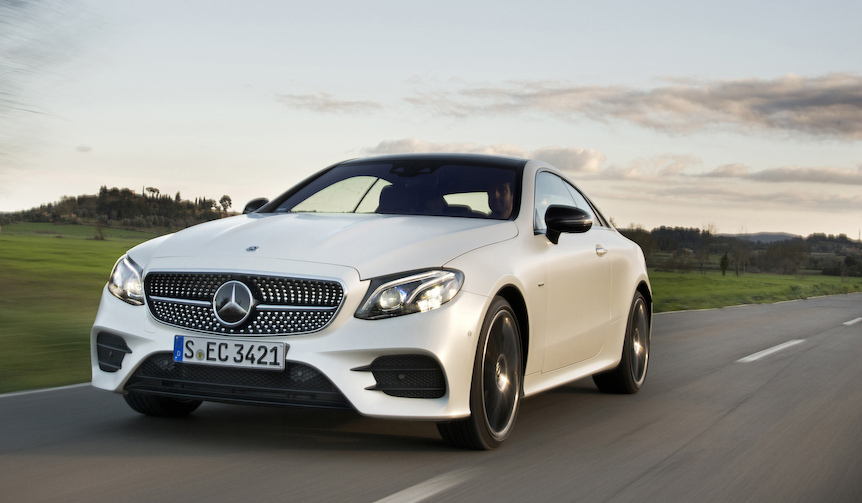
Test Drive: The New Mercedes-Benz E-Class Coupé
Mercedes-Benz E-Class Coupe
Test Drive: The New Mercedes-Benz E-Class Coupé
It made its world premiere in early 2016.The fifth-generation Mercedes-Benz E-Classhas seen its derivative models also transition to a new generation. One of these, the E-Class Coupé, wasThe new sedan lands in Japanannounced last autumn, around the same time the new sedan arrived in Japan. Automotive journalist Tatsuya Otani, who had the opportunity to test drive this new E-Class Coupé in Barcelona, found a particular comment made during the presentation to be surprisingly memorable.
Text by OTANI Tatsuya
Invited to Relax in the Rear Seats
There are many reasons to be drawn to a coupé.
Its flowing roofline is elegant and beautiful.
When going out privately, it offers a stylish and sophisticated feel, akin to pairing a stylish jacket with trousers, rather than the unrefined look of wearing a business suit.
It allows for a clearer expression of one's individuality through the car.—.
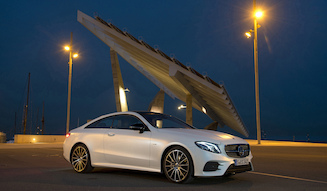
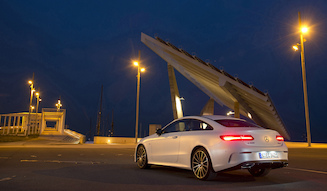
These are just a few of the many reasons, but a statement made by a Mercedes staff member during the presentation gave me pause.
"The Mercedes E-Class Coupé also emphasizes rear-seat comfort. Please, take some time to relax in the rear seats."
Typically, a coupé's roofline slopes downwards towards the rear, limiting rear headroom and making it difficult to spend extended periods in comfort. Furthermore, in the latest E-Class Coupé, the greenhouse (the area enclosed by the side windows above the shoulder line) tapers towards the rear to create a sleek silhouette, which should further restrict lateral space. Yet, why did the Mercedes staff member recommend sitting in the rear? With a slight sense of curiosity, I began the test drive, which started from Barcelona Airport.
Mercedes-Benz E-Class Coupe
Test Drive: The New Mercedes-Benz E-Class Coupé (Part 2)
A Rare Suspension Setup These Days
The first model I drove was the E 400 4MATIC Coupé, equipped with air suspension.
When it launches in Japan, expected around mid-year, two models are slated for release: the E 400 4MATIC Coupé with its V6 3.0-liter engine and all-wheel drive, and the E 300 Coupé with a rear-wheel-drive setup powered by an inline-4 2.0-liter engine. The E 400 4MATIC Coupé will come standard with air suspension, while the E 300 Coupé will feature conventional coil springs. In that sense, the model I test drove was essentially the same as the Japanese specification.
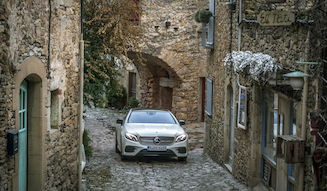
Mercedes-Benz E 400 4MATIC Coupe
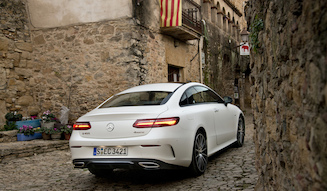
Mercedes-Benz E 400 4MATIC Coupe
Simply put, the ride comfort, handling, and engine feel are very similar to the E 400 4MATIC sedan.
To be precise, while the sedan has a 3.5-liter engine, the coupé, as mentioned, uses a 3.0-liter. However, both share the same maximum output of 333 ps and maximum torque of 480 Nm. The linear power delivery and responsive acceleration, with virtually no perceptible turbo lag, are also identical, making it exceptionally easy to handle.
Furthermore, the smooth rotational feel characteristic of a six-cylinder engine is a strong point of this engine, and combined with its high level of quietness, it perfectly matches the character of the elegantly styled new E-Class Coupé.
What impressed me even more was the ride comfort. Like the E 400 4MATIC sedan, which also features air suspension, this car's suspension is supple, absorbing bumps with minimal harshness and gliding over large undulations.
This setup, the polar opposite of the "sportiness above all else" suspension tuning prevalent today, is reminiscent of the comfort found in classic Mercedes sedans, making it truly unique and valuable.
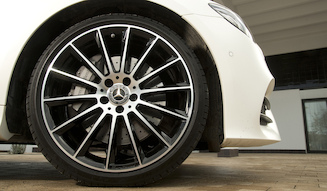
Mercedes-Benz E 400 4MATIC Coupe
Mercedes-Benz E-Class Coupe
Test Drive: The New Mercedes-Benz E-Class Coupé (Part 3)
The E 300: Strengths of a Four-Cylinder Engine
I found no complaints with the E 300 Coupé either.
The test car was equipped with air suspension, unlike the planned Japanese specification, so the ride comfort felt similar to the E 400 4MATIC Coupé. Handling-wise, perhaps due to the lighter four-cylinder engine, it felt more agile and better balanced at the limit. However, within everyday driving ranges, both should be straightforward and easy to manage.
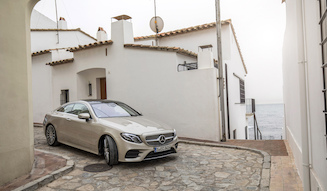
Mercedes-Benz E 300 Coupe
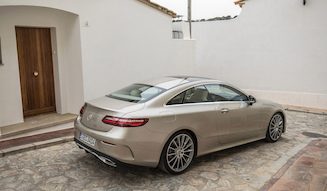
Mercedes-Benz E 300 Coupe
While I had no particular issues with the engine's performance, closer inspection revealed some characteristic four-cylinder vibrations and noise. The level is minor, and one likely wouldn't notice it if driving this car alone, but comparing it directly with the E 400 4MATIC makes the difference between the six-cylinder and four-cylinder engines clear.
I also had a chance to test the coil spring suspension on the E 400 4MATIC, not the E 300. It showed some minor drawbacks compared to the air suspension, particularly in how it transmitted shocks from sharp bumps. Therefore, if budget allows, the E 400 4MATIC would offer a deeper experience of the new Mercedes E-Class Coupé's luxurious world.
Mercedes-Benz E-Class Coupe
Test Drive: The New Mercedes-Benz E-Class Coupé (Part 4)
A Luxurious Space
So, what about the rear-seat comfort mentioned at the beginning?
Firstly, the concerning lateral space was sufficiently secured by configuring the rear seats as two individual seats, positioned towards the center. In fact, there's a wide center armrest between the left and right seats; lifting it reveals a spacious cupholder, indicating a generously proportioned space.
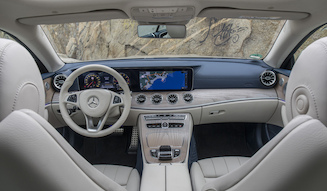
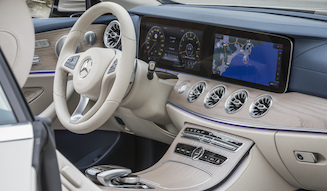
What surprised me even more was the view from the side windows. As evident from the exterior design, the side windows of the new E-Class Coupé are relatively tall and extend far back, providing an excellent view from the rear seats. Moreover, the absence of a B-pillar in the coupé allows the scenery viewed through the side windows to flow uninterrupted from front to rear. This panorama-like vista offers an unparalleled sense of wonder.
The new E-Class Coupé is expected to launch in Japan around mid-year. While pricing has not yet been announced, the E 300 is anticipated to be in the high 7 million yen range, and the E 400 4MATIC slightly over 10 million yen.

Mercedes-Benz E 400 4MATIC Coupe
Body Dimensions: Length 4,826 × Width 1,860 × Height 1,438 mm
Wheelbase: 2,873 mm
Tread Front/Rear: 1,605 / 1,609 mm
Weight: 1,845 kg
Engine: 2,996 cc V6 Turbo
Bore x Stroke: 88.0 × 82.1 mm
Compression Ratio: 10.5
Max Output: 245 kW (333 ps) / 5,200-6,000 rpm
Max Torque: 480 Nm / 1,600-4,000 rpm
Transmission: 9-speed AT (9G-TRONIC)
Drivetrain: 4WD
Tires: 245/45R18
0-100 km/h Acceleration: 5.3 seconds
Top Speed: 250 km/h
Fuel Economy: 8.1 L/100km (approx. 12.3 km/L)
CO2 Emissions: 183 g/km
Trunk Capacity: 425 liters
Mercedes-Benz E 300 Coupe
Body Dimensions: Length 4,826 × Width 1,860 × Height 1,431 mm
Wheelbase: 2,873 mm
Tread Front/Rear: 1,605 / 1,609 mm
Weight: 1,685 kg
Engine: 1,991 cc Inline-4 Turbo
Bore x Stroke: 83.0 × 92.0 mm
Compression Ratio: 9.8
Max Output: 180 kW (245 ps) / 5,500 rpm
Max Torque: 370 Nm / 1,400-4,000 rpm
Transmission: 9-speed AT (9G-TRONIC)
Drivetrain: FR
Tires: 225/55R17
0-100 km/h Acceleration: 6.4 seconds
Top Speed: 250 km/h
Fuel Economy: 6.4 L/100km (approx. 15.6 km/L)
CO2 Emissions: 147 g/km
Trunk Capacity: 425 liters