Test Drive of Lexus' New Flagship Coupe, the LC (Part 1) | Lexus
Lexus LC | The Lexus LC
A Coupe with Uniquely Japanese Values
Test Drive of Lexus' New Flagship Coupe, the LC (Part 1)
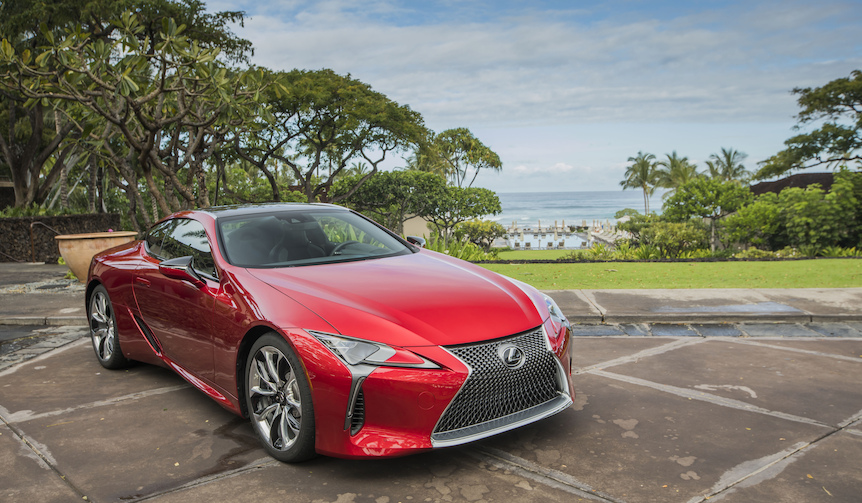
The Lexus "LC," which had its world premiere at the 2016 Detroit Motor Show and recently went on sale in Japan,LC" was released. Based on the design of the 2012 concept car "LF-LC", it is a luxury coupe equipped with a newly developed platform and hybrid system. We had the opportunity to test drive the LC in Hawaii. In this first part, we delve into its origins with comments from the developers.
Text by YAMAGUCHI Koichi
Is the LC a Coupe or a Sports Car?
About a 15-minute drive from Kona International Airport, the gateway to Hawaii Island, brought us to a stunning resort hotel overlooking the beach. There, parked at the entrance, was a brand-new coupe. Its strikingly low and wide form was that of the "LC," Lexus's luxury coupe, released as a symbol of the brand's aim to reach a new stage as a lifestyle brand. In early February, about a month before its launch in Japan, a lifestyle media test drive event for this model was held in the tropical paradise.
"For Lexus to become a more emotional brand, we needed a flagship coupe that embodies the brand, with a design and driving experience that appeals to the user's senses," Chief Engineer Koji Sato explained at the press conference why the LC was developed.
Lexus once had the "LFA" in its lineup as a flagship coupe. However, that car was a supercar with a carbon monocoque body and a V10 engine, a limited edition of only 500 units, and can be seen as a kind of 'advertising balloon.' To compete with European rivals, it was likely deemed necessary to offer a luxurious coupe that leads the brand image as a catalog model.
"If you ask whether it's a sports car or a coupe, I would say it's a coupe. Of course, its performance is that of a sports car, but we never envisioned our customers driving the LC at the Nürburgring,"
said Hiroyasu Sato, Executive Vice President of Lexus International, in response to the author's question about whether the car is a sports car or a coupe. This clearly indicates that the LC is a distinct entity from the LFA. The true value of the LC is not measured by absolute "speed" symbolized by circuit lap times, but by what this car brings to its owner's lifestyle.
Viewed in this light, the body dimensions—4,770mm in length, 1,920mm in width, and 1,345mm in height—which might seem slightly large for a sports car, can be understood as the result of pursuing a more expansive, flowing, and glamorous styling.
Lexus LC | The Lexus LC
A Coupe with Uniquely Japanese Values
Test Drive of Lexus' New Flagship Coupe, the LC (Part 1) (2)
Aiming for a Unique Design
As you know, the LC's styling was inspired by the design of the concept car "LF-LC" unveiled at the 2012 Detroit Motor Show. Like the LF-LC, the LC adopts the classic coupe silhouette of a long nose, a compact cabin, and a short deck, and is undeniably stylish enough to make you stop and stare. It fits perfectly at the entrance of what is arguably Hawaii Island's most luxurious resort hotel, as if it were made for it. Indeed, it was striking to see several American men, presumably tourists, gazing at its unprecedentedly sleek body like boys.
It's no wonder they were observing it with such interest. "What is Lexus design? Simply put, it's about being unique," said Mr. Sato mentioned earlier. And indeed, at first glance, the LC's styling was full of a newness that set it apart from its European and American rivals.
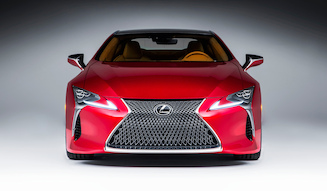
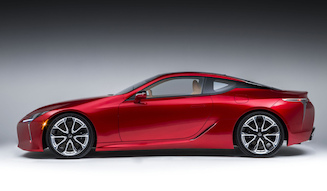
Take the front fenders, for example. In sports cars and coupes from European and American brands, it's common to have muscular "ridges" running along the top of the fenders, as seen in Ferraris and Porsches. However, the LC lacks a conventional fender top. Normally, such a design can make the front appear weak, as if it were sunken between the headlights and the fenders. In contrast, the LC creates a deeply sculpted form that extends from the low-set spindle grille to the nose and roof, achieving a unique presence that resembles nothing else, without resorting to existing design conventions.
According to Mr. Sato, the LC challenges various "taboos" in sports car design language. These attempts are likely what give the LC's styling its unique "newness" for Lexus.
There are two key elements that enable the creation of this unique and dynamic styling. The first is the Product Chief Designer (PCD) system, where the chief designer participates in the project from the initial planning, packaging, and basic styling stages, working closely with the chief engineer to finalize the design. The second is the adoption of the newly developed "Global Architecture-Luxury (GA-L)" platform.
Lexus LC | The Lexus LC
A Coupe with Uniquely Japanese Values
Test Drive of Lexus' New Flagship Coupe, the LC (Part 1) (3)
The Idea That Pursuing Design Leads to Performance
The GA-L, arguably the biggest topic for the LC, is essentially the FR version of TNGA (Toyota New Global Architecture). As evidenced by its adoption in the new "LS" that debuted at the Detroit Motor Show in January, it is a crucial factor in determining the direction of the next-generation Lexus. According to Mr. Sato, this entirely new platform was essential for achieving the low center of gravity and dynamic proportions characteristic of an FR.
Tadao Mori, the Product Chief Designer who, along with Chief Engineer Sato, accomplished the extremely challenging task of translating the styling of the LF-LC concept study almost directly into the production LC, spoke about the LC's exceptionally low and wide hood as a prime example of what the PCD system and GA-L have enabled.
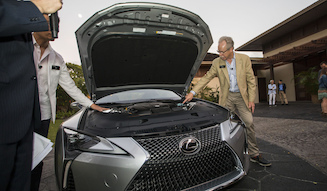
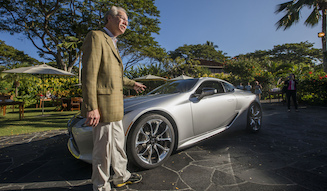
He explained that to achieve the low nose, a key design element for the LC's low and wide form, they spent six months re-evaluating the geometry of the control arms for the newly developed multi-link suspension. Furthermore, to replicate the LF-LC's short front overhang, they developed a new, ultra-compact LED headlamp unit. This anecdote illustrates how crucial design was to the development of the LC.
"Pursuing beautiful design is connected to achieving excellent performance," as Chief Engineer Sato puts it. The GA-L also plays a significant role in refining the LC's vehicle dynamics.
The focus was on "pursuing inertial properties," which essentially means achieving the fundamental requirements for high-performance car development: a low center of gravity, optimized front-rear weight distribution, and weight reduction. For the LC, based on the GA-L, they developed a layout with large-diameter run-flat tires at all four corners, placed the engine behind the front axle (front-midship), and positioned people and heavy components near the center and low down. The center of gravity height is 510mm, and the front-rear weight distribution is close to the generally ideal 50:50.
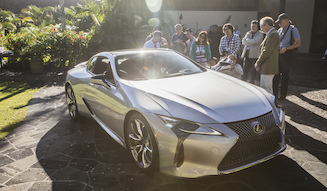

For weight reduction, following the principle of using the right material for the right application, aluminum is used for the front suspension tower, front fenders, and outer door panels, while CFRP (carbon fiber-reinforced plastic) is used for the roof, luggage door, and inner door panels. This not only increases body rigidity but also achieves a weight reduction of approximately 100kg compared to previous models. Simultaneously, these materials contribute to a lower center of gravity and reduced yaw inertia.
"We focused on achieving performance through the car's inherent characteristics, rather than relying on the latest electronic control technologies," Chief Engineer Sato passionately told us at the test drive venue. His words conveyed the ambition of a chief engineer, or rather, a true car enthusiast, to significantly advance Lexus's dynamic quality with the new platform.
Symbolizing this, the development involved extensive driving tests on various roads and circuits worldwide, including the Angel Crest Highway in Los Angeles, USA, and the Nürburgring in Germany, which were set as master roads for testing. This is because the LC also carries the mission of embodying the future driving taste of Lexus.
Lexus LC | The Lexus LC
A Coupe with Uniquely Japanese Values
Test Drive of Lexus' New Flagship Coupe, the LC (Part 1) (4)
Why a 10-Speed Automatic Transmission Was Chosen Over a Dual-Clutch
Two powertrain variations are available to shape the LC's driving experience. The 5.0-liter V8 naturally aspirated engine in the "LC500" is fundamentally the same as that used in the "RC F" and "GS F." Despite its large displacement, it is a high-revving unit that produces a maximum output of 477ps (351kW) at 7,100rpm. For its use in the LC, intake and exhaust efficiency have been improved, such as changing from a single intake to a dual intake, resulting in a 10Nm increase in maximum torque to 540Nm at 4,800rpm (maximum output remains the same).
The transmission is noteworthy. To achieve quick and rhythmic gear changes, they developed a new 10-speed automatic transmission for passenger cars – a world first – by adding an extra gear between the relatively wide gaps of 1st to 4th gears to create closer steps, and making the top gear higher for quietness and fuel efficiency during cruising. The shift speed is also among the world's fastest, at approximately 0.2 seconds.
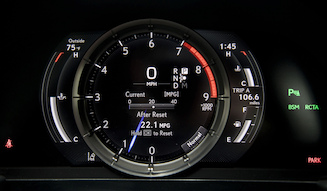
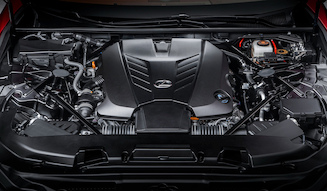
Why, then, was a dual-clutch transmission (DCT), which is now mainstream, not chosen? Chief Engineer Sato's answer to this question perfectly encapsulates the essence of the LC. He explained that current twin-clutch systems cannot achieve the level of smoothness required at startup for the LC.
Meanwhile, the "LC500h" features a newly developed Multi-Stage Hybrid System, which combines Lexus's hybrid system – consisting of a 3.5-liter V6 engine and two electric motors – with a 4-speed automatic transmission, controlling output through 10 effective speeds, including electronic shifts. This eliminates the "rubber band effect," where engine speed and torque increase are mismatched, achieving both direct acceleration feel in response to throttle input and high fuel efficiency. Additionally, the 3.5-liter V6 unit has had its maximum engine speed increased from the previous 6,000rpm to 6,600rpm, achieving a maximum output of 220kW.

Lexus LC 500h | Lexus LC 500h
Body Dimensions | Length 4,770 x Width 1,920 x Height 1,345 mm
Wheelbase | 2,870 mm
Tread Front/Rear | 1,630 / 1,635 mm
Vehicle Weight | 2,000 kg (S package, L package: 2,020 kg)
Minimum Ground Clearance | 140 mm
Engine | 3,456 cc V6 DOHC
Bore x Stroke | 94.0 x 83.0 mm
Compression Ratio | 13.0
Maximum Engine Output | 220 kW (299 ps) / 6,600 rpm
Maximum Engine Torque | 356 Nm (36.3 kgm) / 5,100 rpm
Motor | AC Synchronous Motor
Motor Output | 132 kW (180 ps)
Motor Torque | 300 Nm (30.6 kgm)
Transmission | Multi-Stage Hybrid Transmission
Drivetrain | FR
Suspension Front/Rear | Multi-link / Multi-link
Brakes Front/Rear | Ventilated Discs
Tires Front/Rear | 245/45RF20 / 275/40RF20 (S package: 245/40RF21 / 275/35RF21)
Drive Battery | Lithium-ion Battery
Fuel Economy (JC08 Mode) | 15.8 km/ℓ
Seating Capacity | 4
Price | (Standard) ¥13,500,000 (L package) ¥13,500,000 (S package) ¥14,500,000
Lexus LC 500 | Lexus LC 500
Body Dimensions | Length 4,770 x Width 1,920 x Height 1,345 mm
Wheelbase | 2,870 mm
Tread Front/Rear | 1,630 / 1,635 mm
Vehicle Weight | 1,940 kg (S package, L package: 1,960 kg)
Minimum Ground Clearance | 135 mm
Engine | 4,968 cc V8 DOHC
Bore x Stroke | 94.0 x 89.5 mm
Compression Ratio | 12.3
Maximum Output | 351 kW (477 ps) / 7,100 rpm
Maximum Torque | 540 Nm (55.1 kgm) / 4,800 rpm
Transmission | 10-speed AT (Direct Shift-10AT)
Drivetrain | FR
Suspension Front/Rear | Multi-link / Multi-link
Brakes Front/Rear | Ventilated Discs
Tires Front/Rear | 245/45RF20 / 275/40RF20 (S package: 245/40RF21 / 275/35RF21)
Fuel Economy (JC08 Mode) | 7.8 km/ℓ
Seating Capacity | 4
Price | (Standard) ¥13,000,000 (L package) ¥13,000,000 (S package) ¥14,000,000
Lexus Information Desk
0800-500-5577 (9:00-18:00, open 365 days a year)