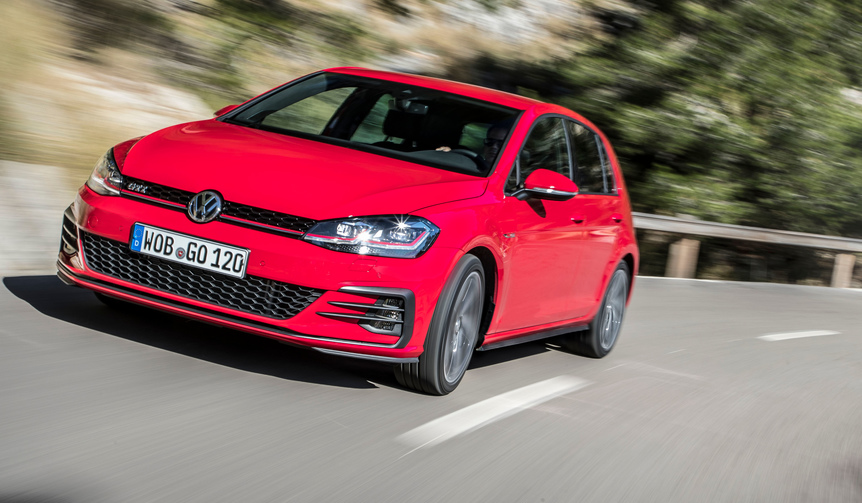
Test Drive the Minor-Changed Golf 7 | Volkswagen
Volkswagen Golf
Test Drive the Minor-Changed Golf 7
Yasuhiko Kawamura test drove the 7th generation Golf, which received a minor change in November 2016. How much has this new model, with only minimal visual changes, actually evolved? An impression from Mallorca before its Japan launch.
Text by KAWAMURA Yasuhiko
Only the Details Have Changed
Wait, what exactly has changed?
Honestly, that was my first impression upon seeing the Golf that had undergone a minor change midway through its model life.
The setting was the airport on the Spanish island of Mallorca, floating in the Mediterranean. Lined up in front of the terminal building, the test cars in various colors gave the unmistakable impression of a genuine "Golf," unchanged in its fundamentals despite the refinements.
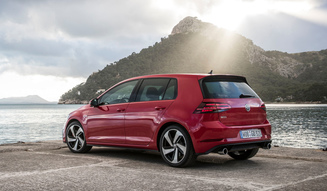
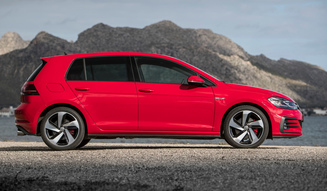
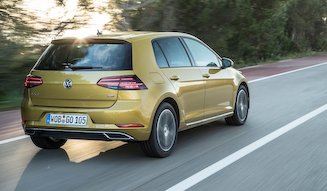
Of course, current owners would keenly notice the subtle changes to the front and rear bumper shapes, and the updated graphics of the rear combination lamps. Even on the GTI, a sportier grade with even fewer changes than the "standard series," current owners would quickly spot how the red line crossing the front grille, now kicking up like wingtips within the headlights, has given it a more powerful "look."
Even so, for those not particularly detail-oriented, the impression of "What has changed?" would likely be stronger. Of course, the deliberate decision not to implement a major image change is, in the first place,The current "Golf 7" debuted in 2012one testament to the high degree of overall design coherence of the current model.
Volkswagen Golf
Test Drive the Minor-Changed Golf 7 (2)
Increasing Digitalization
On the other hand, as indicated by the notation "The digitalised Golf" in the distributed materials, the biggest point of this refinement appears to be the update of various equipment, including safety devices, and the adoption of the latest driving assistance systems. It seems appropriate to introduce this as a refresh of the electrical components, which had begun to fall behind the latest rivals.
For example, the addition of pedestrian detection to the automatic braking system, and the adoption of a completely new multimedia system with a larger display screen. The inclusion of traffic jam assist, which follows the vehicle ahead in traffic jams and includes steering assist, for the adaptive cruise control is one such example.
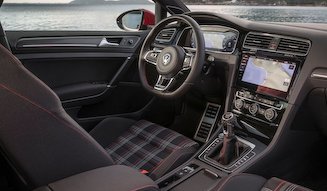
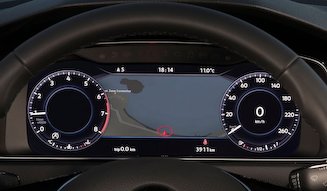
The full virtual cockpit, pioneered by Audi within the group, is also a first for the Golf. Following Audi's lead, the adoption of full LED rear combination lamps, including the "dynamic turn signals" on some higher grades, is another highlight of the latest Golf series to receive a refresh.
With the adoption of these latest electrical technologies, Volkswagen introduces this latest model as the "digitalized Golf." Indeed, the sense of "newness" felt in the interior is certainly greater than that of the exterior.
Volkswagen Golf
Test Drive the Minor-Changed Golf 7 (3)
"Rightsizing" Displacement
However, the Golf has consistently earned its reputation as the benchmark in its class since the debut of the first model in 1974, by virtue of its uncompromising development philosophy in the realm of "driving performance" and its superior dynamic capabilities that always outclass its rivals.
To refine these aspects, the gasoline engine, previously 1.4 liters, has been "increased" to 1.5 liters, while still employing the same direct-injection turbo mechanism.
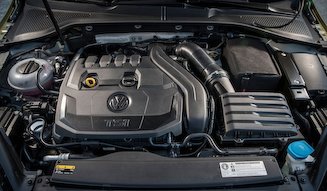
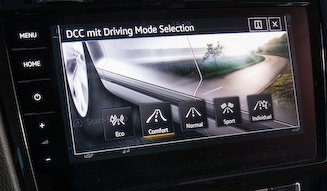
Some might question this change in specifications: "Wait, an increase in displacement, not a decrease?!"
However, this is based on Volkswagen's recently advocated "rightsizing" concept, which posits that "excessive downsizing of displacement, while perhaps beneficial on paper, can negatively impact real-world fuel economy, necessitating a re-evaluation of optimal displacement for each model."
Incidentally, for engines around 1.5 liters, the current trend for new engines seems to be three cylinders. However, Volkswagen states, "With four cylinders, we can employ a cylinder deactivation system, so there is no disadvantage in terms of fuel efficiency."
When I started driving the model equipped with this new engine, developed from the 1.4-liter unit, paired with a 7-speed DSG, I frankly didn't feel a significant difference in power or engine feel compared to the previous model.
This is likely due to the fact that while the maximum output has increased by 10 ps, the maximum torque remains unchanged.
Incidentally, the 0-100 km/h acceleration time for the hatchback model is 8.3 seconds. This data supports the feeling that it is not just sufficient, but "more than enough" fast for everyday driving.
Volkswagen Golf
Test Drive the Minor-Changed Golf 7 (4)
Anticipation Builds for the Next-Generation Golf
At the test drive event, in addition to the "basic Golf," I also test drove the GTI, a hot model whose grade has practically become a brand in itself.
Although the control changes are said to have increased output by 10 ps compared to the previous model, on this test drive, which was limited to public roads and offered few opportunities to use full power, I was unable to clearly perceive the difference.
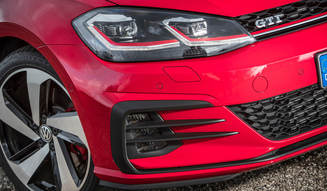
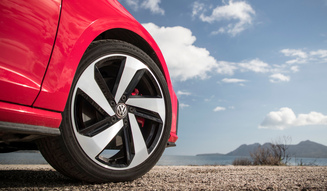
However, both the MT and DSG versions maintain the same practicality as the base grade while achieving comparable comfort, offering exhilarating speed and driving pleasure – a fact that remains unchanged from before. I was particularly reminded of how enjoyable the MT version is, with its excellent shift feel, even though it now lags behind the DSG version in acceleration and fuel efficiency.
In fact, an even more efficient unit, employing the Miller cycle and a variable geometry turbocharger, is already on standby as an "evolutionary" version of the new 1.5-liter engine introduced earlier.
It has also been decided that the DSG, which remains a 6-speed type for the GTI and 4WD models, will be sequentially upgraded to 7-speed in the future.
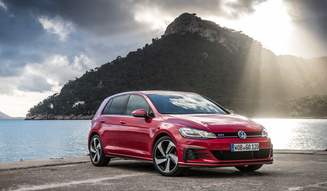
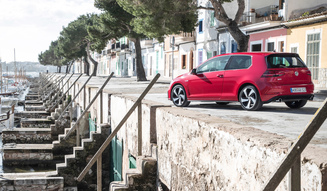
Thus, this latest model, with its significant advancement in digital equipment, holds the promise of further heightening anticipation for the "Golf 8" expected to debut in a few years.
This commitment to evolution, rather than resting on its laurels, is surely the greatest reason for the Golf's enduring popularity.
Editor's Note: According to Volkswagen Group Japan, the existing 1.4-liter and 1.2-liter engines will be introduced first for this new Golf, and the introduction of the 1.5-liter model is undecided.

Volkswagen Golf 1.5TSI BlueMotionTechnology
Volkswagen Golf 1.5TSI BlueMotionTechnology
Body Dimensions | Length 4,258 x Width 1,790 x Height 1,492 mm
Wheelbase | 2,620 mm
Tread Front/Rear | 1,533-1,549 / 1,504-1,521 mm
Minimum Ground Clearance | 142 mm
Minimum Turning Radius | 5.45 meters
Weight | (6MT) 1,294 kg (7DSG) 1,317 kg
Engine | 1,498 cc Inline 4-cylinder Turbo
Maximum Output | 110 kW (150 ps) / 5,000-6,000 rpm
Maximum Torque | 250 Nm (25.5 kgm) / 1,500-3,500 rpm
Transmission | 6-speed MT / 7-speed AT (7DSG)
Drivetrain | FF
0-100 km/h Acceleration | 8.3 seconds
Maximum Speed | 216 km/h
Fuel Economy | (6MT) 5.1-5.0 L/100km (19.6-20.0 km/L) (7DSG) 5.0-4.9 L/100km (20.0-20.4 km/L)
CO2 Emissions | (6MT) 116-114 g/km (7DSG) 114-112 g/km
Trunk Capacity | 380-1,270 liters
Tires Front/Rear | (Test car equipped with 225/45 R17)
Volkswagen Golf GTI
Body Dimensions | Length 4,258-4,351 x Width 1,790-1,799 x Height 1,492 mm
Wheelbase | 2,626 mm
Tread Front/Rear | 1,533-1,549 / 1,504-1,521 mm
Minimum Ground Clearance | 133 mm
Minimum Turning Radius | 5.45 meters
Weight | (6MT) 1,364 kg (6DSG) 1,386 kg
Engine | 1,984 cc Inline 4-cylinder Turbo
Maximum Output | 169 kW (230 ps) / 4,700-6,200 rpm
Maximum Torque | 350 Nm / 1,500-4,600 rpm
Transmission | 6-speed MT / 6-speed AT (6DSG)
Drivetrain | FF
0-100 km/h Acceleration | 6.4 seconds
Maximum Speed | (6MT) 250 km/h (6DSG) 248 km/h
Fuel Economy | (6MT) 6.4 L/100km (15.6 km/L) (6DSG) 6.4-6.3 L/100km (15.6-15.9 km/L)
CO2 Emissions | (6MT) 148 g/km (6DSG) 148-145 g/km
Trunk Capacity | 380-1,270 liters
Tires Front/Rear | (Test car equipped with 225/40 R18)