Test Drive: The Limited Edition Porsche 911 R (991 Units Only)
Porsche 911 R | The Porsche 911 R
Test Drive: The Limited Edition Porsche 911 R (991 Units Only)
A GT3 RS in Carrera's Clothing
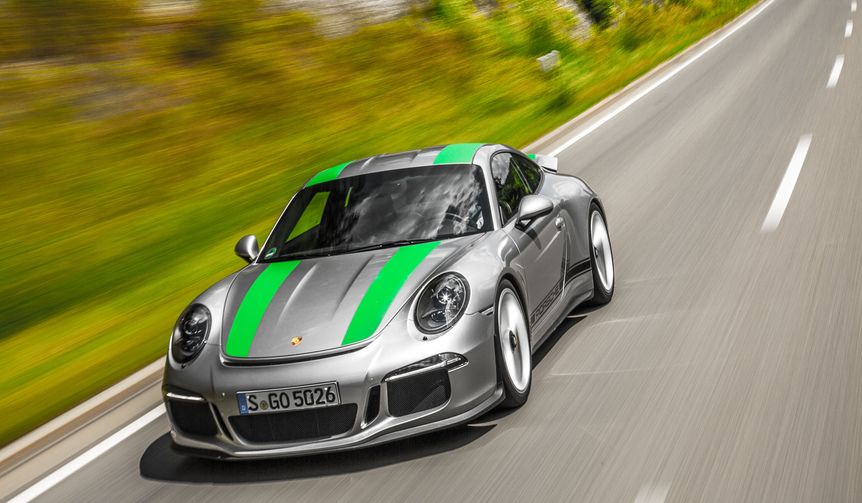
This March, Porsche released a limited edition 911, with only 991 units produced. It is the "GT3 RS in Carrera's Clothing."911 RWhile its exterior shows little change from the 911 Carrera, its interior boasts a 4-liter 6-cylinder engine inherited from the 911 GT3 RS, along with standard carbon brakes and rear-axle steering. Further performance enhancements include the removal of the rear seats and the use of polycarbonate for the side windows, all in pursuit of ultimate performance. Yasuhiko Kawamura shares his impressions of this modern-day "wolf in sheep's clothing."
Text by KAWAMURA Yasuhiko
The Ultimate 911
When you hear the term "sports car," Porsche is likely the first brand that comes to mind for many.—It's safe to say that a great many people fall into this category.
Of course, this esteemed status hasn't been achieved without good reason.
Porsche has a long history of embodying its ideal sports car, and an undeniable track record of consistently leading the competition. In either case, the phrase "born to be" perfectly describes the reputation Porsche commands today.
On the other hand, it's also easy to imagine that the sports car image that springs to mind when hearing the name Porsche isn't theBoxsterorCayman, but rather, the 911.
Of course, Porsche hasn't exclusively produced the 911 throughout its history. In fact, its best-selling model in recent times is theCayenne——as some might say. The reality is that SUVs, rather than sports cars, now account for the majority of the brand's revenue.
That said, it's clear that every model in the lineup consciously respects the 911 and strives to inherit its DNA, as evidenced by the recently unveilednew Panamera, whose styling more strongly evokes the 911 than previous models.
Having evolved over more than half a century since the debut of its first generation, the latest iteration continues to be recognized worldwide as a cutting-edge, top-tier sports car.—Among the 911 series, the "911 R" we are focusing on here can, in a sense, be described as the ultimate model.
Porsche 911 R | Porsche 911 R
Test Drive: The Limited Edition Porsche 911 R (991 Units Only)
A GT3 RS in Carrera's Clothing (2)
Lightweight, Refined, Rare
The "R" at the end of the model name traditionally stands for Racing. However, in this case, it is said to also encompass three additional meanings: Reduce, Refine, and Rare.
Based on the hottest model to date, the911 GT3 RS, this model extensively utilizes advanced lightweight materials. This includes carbon fiber (CFRP) for the front hood and fenders, a magnesium roof, and polycarbonate windows for the rear and rear sides. The ability to employ such materials, which come with a significant cost increase over standard components, without hesitation, is undoubtedly a major factor enabling this weight reduction.
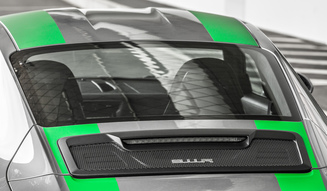
Furthermore, the adoption of a 6-speed manual transmission—with a case identical to the 7-speed PDK but a specially designed internal structure—contributes to a further weight reduction of 50kg compared to the GT3 RS.
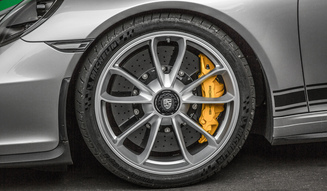
It's understandable that high-tech features related to driving, such as the Ceramic Composite Brakes (PCCB) and the limited-slip differential with torque vectoring, are standard. However, some may question the decision to include the rear-axle steering system, given the intense focus on weight reduction.
This electronically controlled system, with its phase-inversion mechanism, inevitably adds considerable weight due to its complex structure. In fact, the system weighs approximately 7kg. For a model that has undergone such rigorous weight reduction, including the removal of rear seats and the use of plastic windows, this added weight could be considered a significant compromise.
Porsche 911 R | Porsche 911 R
Test Drive: The Limited Edition Porsche 911 R (991 Units Only)
A GT3 RS in Carrera's Clothing (3)
On-Road Focused Setup
The reason for deliberately adopting the rear-axle steering system, despite the potential compromise to the weight reduction efforts,—was explained by the engineer accompanying us from Porsche's Stuttgart headquarters as: "Because we determined it was worth the value."
The 911 R features a wider body than the Carrera models and is equipped with the 4-liter naturally aspirated engine producing 500ps, first introduced in the GT3 RS. It also incorporates mechanical components honed in the GT3 series, such as the aforementioned PCCB and the rear-axle steering system.
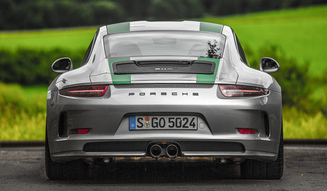
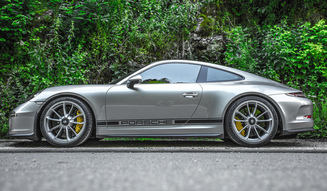
Interestingly, the engineer also stated that this model is "not focused on circuit driving."
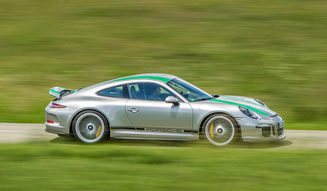
They mentioned that lap times on the Nürburgring Nordschleife, often announced by Porsche for new model launches, were "not measured for this model." The large, fixed rear wing, an iconic feature of the GT3 series, was described as "unnecessary for the 911 R, which prioritizes on-road agility, as its purpose is to enhance stability at high speeds and reduce lap times on the circuit."
In fact, the retention of the rear-axle steering system is also a result of prioritizing this "agility."
This mechanism, which in a sense functions as a "variable wheelbase system," has been specially tuned differently from the GT3 series. The engineer explained, "It varies depending on driving conditions, so it's impossible to simply state how it operates at a specific speed."
Regardless, the judgment is that this plays a significant role in achieving "the ultimate driving pleasure."
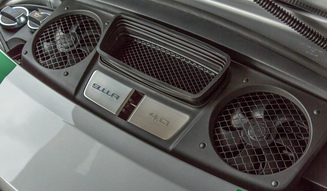
Porsche 911 R | Porsche 911 R
Test Drive: The Limited Edition Porsche 911 R (991 Units Only)
A GT3 RS in Carrera's Clothing (4)
A Competitive World Exceeding the GT3 Series
Although the interior features deep bucket seats made of carbon fiber for weight reduction and the rear seats have been omitted, there is no roll cage. Furthermore, the test car was equipped with the optional navigation system, giving the interior the feel of a "very ordinary 911."
However, this atmosphere changed dramatically when the key was turned in the cylinder located on the door side of the dashboard, in true 911 fashion, to ignite the engine.
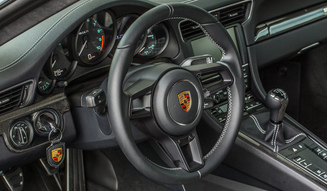
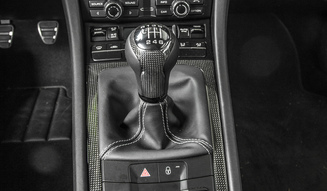
In addition to the omission of sound insulation, the bearing noise amplified by the single-mass flywheel, chosen for its responsiveness, fills the cabin along with the engine's natural sound. As a result, even at idle, a competitive atmosphere that surpasses that of the GT3 series is created.
However, when you press the clutch pedal to start moving, the pedal feel and stroke are similar to the Carrera models, and the bearing noise disappears. The cabin then returns to a state of tranquility.
Engaging first gear with a slightly firm but short-throw shift, and carefully releasing the clutch pedal, the torque from the "large displacement unit" of 4 liters is already substantial even at idle. Without even touching the accelerator, the 911 R begins to move smoothly and without any fuss.
Porsche 911 R | Porsche 911 R
Test Drive: The Limited Edition Porsche 911 R (991 Units Only)
A GT3 RS in Carrera's Clothing (5)
Immensely Powerful and Evocative
As speed increases, the sound of small stones being picked up by the tires becomes prominently audible. This is also due to the omission of the inner liners inside the fenders, which would normally be installed for sound insulation.
At the same time, what is also surprising is the high level of comfort.
Despite riding on stiff, high-grip 20-inch tires (Michelin Pilot Sport Cup 2) with a low aspect ratio of 35% in the front and 30% in the rear, the ride remains so flat that one can take notes while driving. It can only be described as "unexpectedly comfortable."
Simultaneously, the car's behavior, where "every driver's input is directly reflected as the car's movement without amplification or damping," is the true essence of this model.
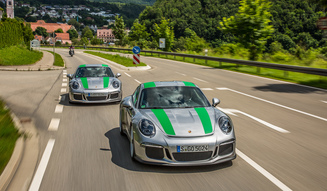
The power output, generated by the heart inherited from the GT3 RS and delivered through the manually operated MT, is both "immensely powerful" and "utterly evocative." The fact that the engine's power and sound become sharper above 5,000 rpm, despite the friction that would normally hinder performance at higher revs, is a precious asset unique to this model.
Another characteristic of this engine is its extremely sharp throttle response, both on acceleration and deceleration. Therefore, the throttle blip function, which perfectly matches engine revs during downshifts, is a welcome aid. One might even wish for this function to be available in normal mode, not just sport mode.
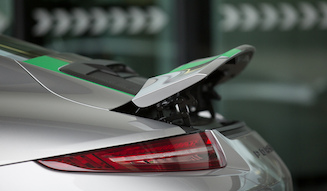
Admittedly, in terms of absolute acceleration, it cannot compete with two-pedal configurations that offer seamless shifting. And on the track, it will likely be slower than the GT3 series, which uses its massive wing to forcefully press the body onto the road.
However, it is an undeniable fact that this model offers a more profound sense of "being driven by a human," including the "negative aspects" that, logically speaking, should be drawbacks, such as mistakes in shifting or clutch engagement directly affecting the car's behavior.
Given this, one can't help but think,—"Why limit this to a special edition?" This is the sentiment the 911 R evokes.

Porsche 911 R | Porsche 911 R
Body Dimensions | Length 4,532 x Width 1,852 x Height 1,276 mm
Wheelbase | 2,475 mm
Tread Front/Rear | 1,551 / 1,555 mm
Vehicle Weight | 1,370 kg
Engine | 3,996 cc Horizontally opposed 6-cylinder
Bore x Stroke | 102.0 x 81.5 mm
Compression Ratio | 13.2
Maximum Output | 368 kW (500 ps) / 8,250 rpm
Maximum Torque | 460 Nm / 6,250 rpm
Transmission | 6-speed MT
Drivetrain | RR
Minimum Turning Radius | 5.55 meters
Brakes Front | φ410×36mm Porsche Ceramic Composite Brakes (PCCB)
Brakes Rear | φ390×32mm Porsche Ceramic Composite Brakes (PCCB)
Suspension Front | MacPherson Strut
Suspension Rear | Multi-link
Tires Front/Rear | 245/35R20 / 305/30R20
Maximum Speed | 323 km/h
0-100 km/h Acceleration | 3.8 seconds
0-200 km/h Acceleration | 11.6 seconds
Fuel Consumption (NEDC) | 13.3 ℓ/100km (approx. 7.5 km/ℓ)
CO2 Emissions | 308 g/km
Trunk Capacity | 125 liters
Limited Production | 991 units
Price | ¥26,290,000