Test Drive: Porsche 718 Boxster | Porsche
Porsche 718 Boxster | Porsche
Porsche 718 Boxster S | Porsche
Its Status as a Sports Car Remains Unshaken
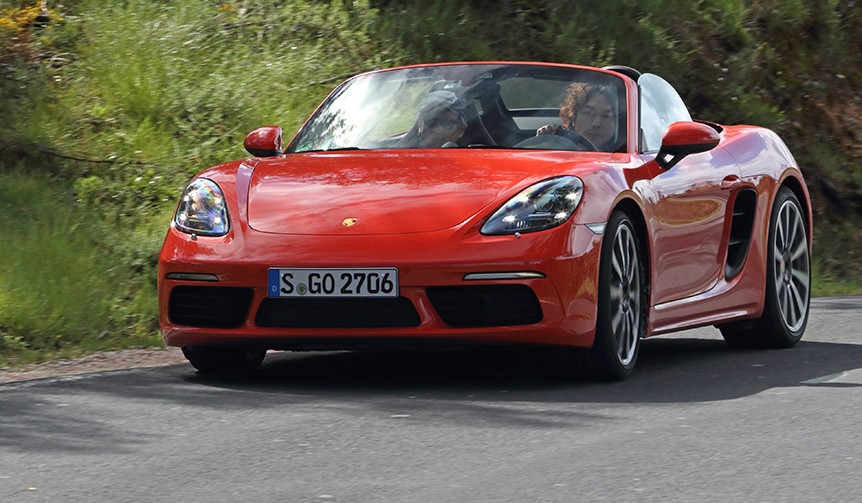
The latest Boxster, the "718 Boxster," has been newly equipped with a 4-cylinder turbo engine. Motor journalist Yasuhisa Shimashita test drove the model, which is soon to be delivered in Japan.
Text by YASUHISA SHIMASHITA
Nearly All Exterior Body Panels Have Been Changed
At the 20-year mark since its debut, the "Boxster" has reached a major turning point. The engine has been changed from the conventional naturally aspirated 6-cylinder to a 4-cylinder turbo, and simultaneously, the car's name has been changed to "718 Boxster."718 BoxsterThe "718" designation is derived from the name of a mid-engined, 4-cylinder racing sports car that achieved great success in world endurance races and hill climbs from the late 1950s to the 1960s.
I had heard whispers that Porsche was developing a 4-cylinder turbo engine, but I never imagined they would go as far as changing the car's name. However, to imbue the switch to a 4-cylinder engine with genuine significance, this was likely inevitable. Fortunately, Porsche, with its wealth of historical context, could make such a move.
Boxster S
Boxster S
The flat-four turbo engine in the 718 Boxster has a displacement of 2 liters, producing a maximum output of 300 ps and a peak torque of 380 Nm. The "718 Boxster S" has a displacement of 2.5 liters and employs a variable geometry turbine with flow rate control, similar to the 911 Turbo. It boasts a maximum output of 350 ps and a peak torque of 420 Nm.
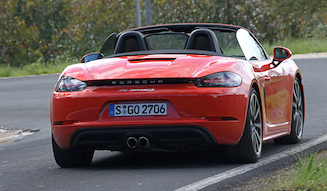
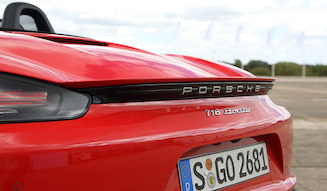
The engine isn't the only thing that has changed. As you can see, the 718 Boxster has undergone significant revisions to both its exterior and interior. The exterior features changes to almost all of the outer body panels. Details like the "PORSCHE" logo etched between the taillights offer a glimpse of reinterpreted tradition.
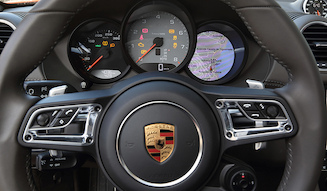
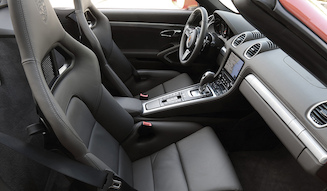
The interior also features a redesigned dashboard, including the adoption of circular air vents. Furthermore, following the 911, the new PCM (Porsche Communication Management) infotainment system has been installed. The good news is that this is finally available as an option for the Japanese specification. We can finally say goodbye to the previous, cumbersome, almost aftermarket navigation system.
Porsche 718 Boxster | Porsche
Porsche 718 Boxster S | Porsche
Its Status as a Sports Car Remains Unshaken (2)
The Best Choice: The 718 Boxster S with a Manual Transmission
The first vehicle I test drove was the 718 Boxster S with PDK, equipped with the sports exhaust. The dominant impression was the strong, pulsating, and deep rumble of the exhaust note. Unlike the conventional 6-cylinder, the sound was entirely different, conveying a sense of raw aggression.
Thanks to the turbocharging, the torque in the practical range is significantly enhanced, making it feel "fast" from the moment you start driving. After all, its 0-100 km/h acceleration of 4.2 seconds is on par with the 996 Turbo. The torque curve is flat, which might mean it lacks a certain excitement in some aspects, but as the revs climb, the pulses become more defined, compelling you to hold onto gears longer when using the paddles in manual mode.
Boxster
Boxster
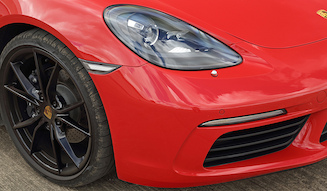
The basic feel of the engine in the 718 Boxster is similar. The response to accelerator input is sufficiently sharp, and you don't notice any drawbacks typical of a turbo. In terms of performance, this might be just right for enjoying the Boxster by revving the engine to its limit. Regardless, it's certain that this sound and vibration will be polarizing for many.
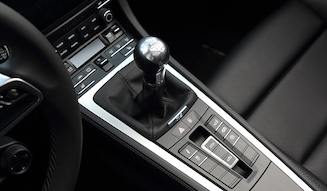
However, my impression completely changed after driving the 718 Boxster S with a manual transmission, specifically without the sports exhaust. The exhaust note, which didn't overemphasize low frequencies, made the engine feel lighter and more responsive all the way to the redline. Perhaps because it was a manual, I unconsciously held the gears longer, allowing me to fully savor the inherent smoothness of the boxer engine.
This felt like the more appropriate setup, but especially with the 2-liter 718 Boxster, the torque at very low speeds is quite limited, and I nearly stalled multiple times with the manual transmission. That's the only point that needs improvement.
Porsche 718 Boxster | Porsche
Porsche 718 Boxster S | Porsche
Its Status as a Sports Car Remains Unshaken (3)
The Chassis Has Also Evolved Significantly
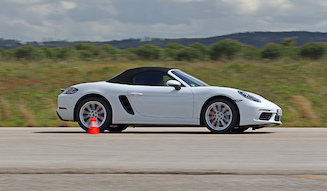
While it's easy to focus solely on the engine, the chassis of the 718 Boxster has also evolved considerably. The suspension has been slightly firmed up, and the steering gear ratio has been quickened, further refining the sharp turn-in and the sensation of rotating around oneself that is characteristic of a mid-engined car.
Despite these changes, the ride comfort has actually increased in refinement. The damping is smoother, and even when engaging SPORT or SPORT PLUS modes on the PASM adaptive suspension system, while the damping force increases, it never delivers a harsh jolt. Even though the fundamental mechanics remain the same, the improvements are so noticeable in the driving experience that it's truly impressive.
Boxster S
Boxster S
What was regrettable this time was not being able to experience the newly introduced PSM Sport mode. This mode, which not only allows for a certain degree of slide but also assists in maintaining drifts by skillfully controlling throttle input, undoubtedly allows more people to experience the joy of precise control.
I suspect many people harbor complex feelings about a 4-cylinder turbo engine, both in terms of its actual driving feel and its image. At least, initially. However, when considering the overall completeness as a sports car, I can confidently say that its position remains unshaken. Personally, I find the engine acceptable, especially without the sports exhaust and, ideally, with a manual transmission.
Boxster S
Boxster S
With this update, the mid-engined models have been unified under the 718 series, and the Cayman has already been announced as the new "718 Cayman." Unlike the relationship between the two models in the past, there is no difference in engine specifications between them. Furthermore, looking at the announced prices, the 718 Cayman is set at a lower price than the 718 Boxster.
In that sense, the 718 Boxster may be seen as having shed its traditional role as Porsche's entry-level model and transformed into a model with a distinct personality. It's a car that makes one even more eager to see the market's reaction.

Porsche 718 Boxster | Porsche
Body Dimensions | Length 4,379 x Width 1,801 x Height 1,281 mm
Wheelbase | 2,475 mm
Tread Front/Rear | 1,515 / 1,532 mm
Vehicle Weight | 1,335 kg
Engine | 1,988cc Flat-four Turbo
Bore x Stroke | 91.0 x 76.4 mm
Compression Ratio | 9.5
Max. Output | 220 kW (300 ps) / 6,500 rpm
Max. Torque | 280 Nm / 1,950-4,500 rpm
Transmission | 7-speed Dual Clutch (PDK) / 6-speed Manual
Drivetrain | MR
Min. Turning Radius | 5.49 meters
Brakes Front | φ330×28mm Ventilated Discs
Brakes Rear | φ299×20mm Ventilated Discs
Suspension Front | MacPherson Struts
Suspension Rear | MacPherson Struts
Tires Front/Rear | 235/35R18 / 265/45R18
Max. Speed | 275 km/h
0-100 km/h Acceleration | (7-speed PDK) 4.9 sec (4.7 sec in Sport+) (6-speed Manual) 5.1 sec
0-200 km/h Acceleration | (7-speed PDK) 18.1 sec (17.8 sec in Sport+) (6-speed Manual) 18.3 sec
Fuel Economy (NEDC) | (7-speed PDK) 6.9 L/100km (approx. 14.5 km/L) (6-speed Manual) 7.4 L/100km (approx. 13.5 km/L)
CO2 Emissions | (7-speed PDK) 158 g/km (6-speed Manual) 168 g/km
Price | (7-speed PDK) ¥7,104,000 (6-speed Manual) ¥6,580,000
Porsche 718 Boxster S | Porsche
Body Dimensions | Length 4,379 x Width 1,801 x Height 1,280 mm
Wheelbase | 2,475 mm
Tread Front/Rear | 1,515 / 1,540 mm
Vehicle Weight | 1,355 kg
Engine | 2,497cc Flat-four Turbo
Bore x Stroke | 102.0 x 76.4 mm
Compression Ratio | 9.5
Max. Output | 257 kW (350 ps) / 6,500 rpm
Max. Torque | 420 Nm / 1,900-4,500 rpm
Transmission | 7-speed Dual Clutch (PDK) / 6-speed Manual
Drivetrain | MR
Min. Turning Radius | 5.49 meters
Brakes Front | φ330×34mm Ventilated Discs
Brakes Rear | φ299×20mm Ventilated Discs
Suspension Front | MacPherson Struts
Suspension Rear | MacPherson Struts
Tires Front/Rear | 235/35R18 / 265/45R18
Max. Speed | 285 km/h
0-100 km/h Acceleration | (7-speed PDK) 4.4 sec (4.2 sec in Sport+) (6-speed Manual) 4.6 sec
0-200 km/h Acceleration | (7-speed PDK) 15.0 sec (14.7 sec in Sport+) (6-speed Manual) 15.2 sec
Fuel Economy (NEDC) | (7-speed PDK) 7.3 L/100km (approx. 13.7 km/L) (6-speed Manual) 8.1 L/100km (approx. 12.3 km/L)
CO2 Emissions | (7-speed PDK) 167 g/km (6-speed Manual) 184 g/km
Price | (7-speed PDK) ¥9,044,000 (6-speed Manual) ¥8,520,000
Porsche Customer Care Center
0120-846-911
http://www.porsche.com/japan/jp/