Test Drive the Latest Porsche 911 Turbo | Porsche
Porsche 911 Turbo | Porsche 911 Turbo
Test Drive: The Latest Porsche 911 Turbo
The World's Best Bargain Supercar
Last December, the Porsche "911 Turbo" evolved into a revised version of the 991 model, along with the rest of the 911 family. With the announcement of the 991 II, most of the 911 series, excluding models like the "911 Carrera," adopted turbocharged engines. In this context, what is the pride behind the "Turbo" designation, historically reserved for the top model? Yasuhiko Kawamura takes to a South African circuit and public roads to find the answer.
Text by KAWAMURA Yasuhiko
The Ever-Evolving Porsche 911
With its horizontally opposed engine design and rear-engine layout,—Porsche's "911" maintains its position as a world-class sports car by adhering to and meticulously refining these unique technologies.
Over its more than half-century history,the model has offered a remarkable array of variations to cater to the diverse tastes of its users.
Looking back at its history, the 911 has consistently undergone refinements that anticipate the times. The "Carrera Series Adopts Turbocharging" which we've already detailed on this site, represents just one milestone in the ongoing growth and development of the 911.
Porsche 911 Turbo S
Porsche 911 Turbo S
However, with most 911s now featuring turbocharged engines, the position of the Turbo models, which have historically reigned as the flagship grade, becomes somewhat delicate.
New Generation Power Unit with Turbocharger for Carrera Modelswas introduced, and precisely at this juncture, news emerged of further refinements to the Turbo models.Refined Turbo ModelsAn international test drive event was held.
The primary venue was the Kyalami Circuit, located near Johannesburg, the largest city in South Africa, far in the Southern Hemisphere.
This circuit, which once hosted Formula 1 races, is now owned by the operator of Porsche South Africa and is undergoing extensive renovations, including the addition of a convention center. While hospitality areas above the pit lane are not yet fully revealed, the track itself is complete. This event took place on the newly resurfaced course.
Porsche 911 Turbo | Porsche 911 Turbo
Test Drive: The Latest Porsche 911 Turbo
The World's Best Bargain Supercar (Part 2)
Maximum Output Increased by 20 PS
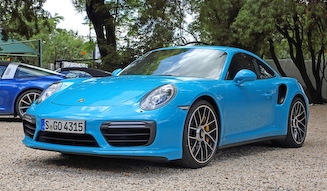
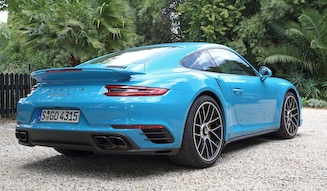
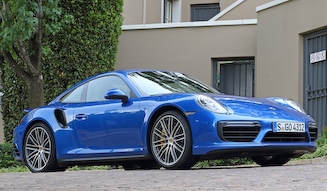
The refined Turbo and Turbo S models feature several new cosmetic touches. These include a redesigned front apron, door handles with a cleaner, bezel-less finish, and a rear engine lid with newly added vertical slits in the air intake, similar to the turbocharged Carrera models, and a new central split cover ostensibly for optimizing airflow.
However, beyond the visual updates, what truly defines a "Porsche minor change" are the numerous new mechanical components. Both the coupe and cabriolet body styles of these two grades now boast an array of the latest performance-enhancing features, befitting their flagship status.
Porsche 911 Turbo
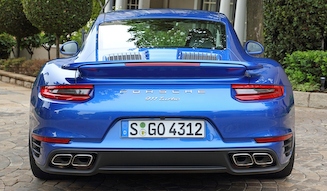
Porsche 911 Turbo
Among these, the most significant highlight is the flat-six engine, now producing 540 PS for the "Turbo" and 580 PS for the "Turbo S," an increase of 20 PS for both compared to the previous models.
While the 3.8-liter displacement remains unchanged, numerous refinements have been made, including increasing the maximum injection pressure from 140 bar to 200 bar. The variable turbine geometry, unique to gasoline engines, is retained, but a notable new development is the use of different turbocharger specifications for each grade: a larger unit for the "Turbo S."
The standard Sport Chrono Package, controllable via a rotary switch on the new steering wheel, now includes an "Individual" mode allowing users to preset their preferred settings for various electronic systems.
Furthermore, a new "Sport Response" function has been added. By pressing the central button, the engine and DCT maps are switched to a sportier configuration for 20 seconds, while simultaneously achieving an "anti-lag" effect through adjustments to turbine geometry and ignition timing.
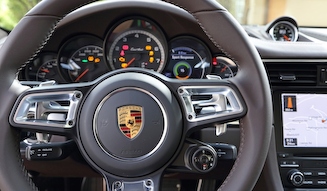
Porsche 911 Turbo
Incidentally, with this update, the shift selector's sequential operation direction has been reversed: pull for "+" (upshift) and push for "-" (downshift). This logic, derived from racing, mirrors the change made in the previously updated Carrera models.
Porsche 911 Turbo | Porsche 911 Turbo
Test Drive: The Latest Porsche 911 Turbo
The World's Best Bargain Supercar (Part 3)
Effortless Drive Meets Blistering Speed
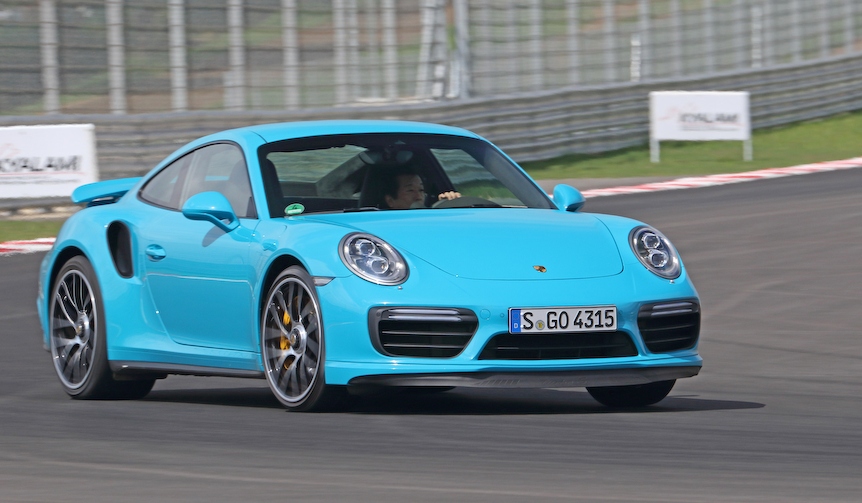
Our test drive primarily focused on the Turbo S coupe at the aforementioned Kyalami circuit. As the flagship of the entire 911 series, this model is designed to offer peak performance alongside the character of the "most luxurious 911."
Features like the PDCC active stabilizer and PCCB ceramic composite brakes, optional on the Turbo grade, are standard here. The wheels, fitted with wide, low-profile tires (245/35 front, 305/30 rear), are also the more race-oriented center-lock type for the Turbo S.
With a weight of 1.6 tons, a heart producing 580 PS and 750 Nm of torque, and this immense power distributed across all four wheels via electronic control systems – it's no surprise that this results in breathtaking speed.
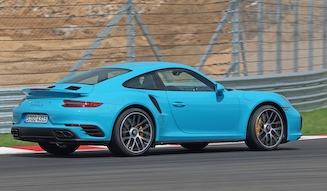
Porsche 911 Turbo S
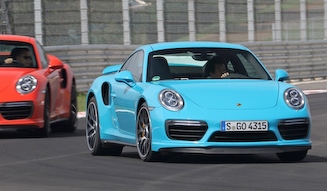
Porsche 911 Turbo S
The Turbo S grade shaves a tenth of a second off the Turbo's time, achieving 0-100 km/h in a mere 2.9 seconds, finally breaking the 3-second barrier. For comparison, the "GT3 RS" takes 3.3 seconds. This alone clearly indicates its "extraordinary speed."
Indeed, pressing the accelerator deep in the Turbo S instantly pins you back into the seat. For most, this is a "terrifyingly immense acceleration." Simply keeping the pedal floored requires a certain level of "resolve" due to the model's overwhelming speed.
Yet, maintaining composure and steering precisely allowed us to navigate Kyalami's high-speed corners with surprising ease, further highlighting the meticulously engineered driving character of this model.
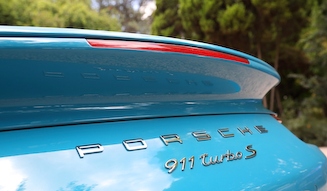
Porsche 911 Turbo S
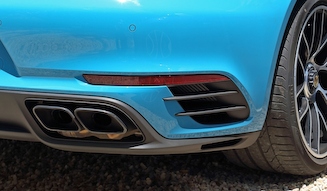
Porsche 911 Turbo S
Here, various cutting-edge devices, undoubtedly refined through extensive testing, play a crucial supporting role. These include the exquisite aerodynamic balance provided by the active front and rear aero systems, which adjust according to driving conditions, and the GT3-derived active rear-steer system. To put it plainly, the coexistence of such "effortlessness" and "blistering speed" defines the driving prowess of this model.
Even with continuous track driving, the PCCB, renowned for its immense braking power and fade resistance, eventually showed a slight change in pedal feel.
Nevertheless, the fact that we could push the limits on a high-speed circuit we'd never visited before without significant anxiety truly revealed the model's profound and seemingly bottomless potential.
Porsche 911 Turbo | Porsche 911 Turbo
Test Drive: The Latest Porsche 911 Turbo
The World's Best Bargain Supercar (Part 4)
Completely Stress-Free Even in City Driving
Transitioning from the track to public roads in the Turbo S reveals another facet of this model: its "exceptionally comfortable and luxurious GT car" persona.
Thanks in part to the new system, the engine exhibits virtually no perceptible turbo lag, and the "PDK" (7-speed dual-clutch transmission) offers smooth operation even at very low speeds. This combination makes it remarkably stress-free for city driving.
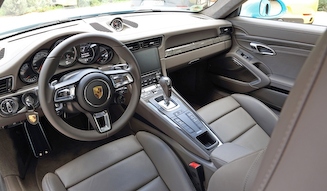
Porsche 911 Turbo S
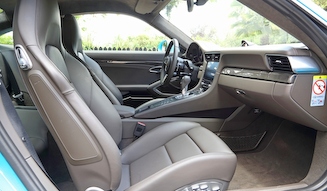
Porsche 911 Turbo S
Furthermore, with excellent visibility, a quiet cabin, and impressive maneuverability thanks to the active rear-steer system's counter-phase control, this model offers surprisingly high practicality. Add to this the optional lift system for instantly increasing the approach angle and the introduction of the "PCM" telematics system, which links with smartphones, to the Japanese specifications, and the new Turbo models offer significantly improved usability in daily life.
The price, exceeding 25 million yen for the Turbo S coupe, is undeniably high in absolute terms. However, when confronted with the reality of its "exceptional performance in every scenario," it's not unreasonable to consider it "the world's best bargain supercar." This latest flagship 911 truly embodies that notion.

Porsche 911 Turbo S
Body Dimensions | Length 4,507 x Width 1,880 x Height 1,297 mm
Tread Front/Rear | 1,541 / 1,590 mm
Vehicle Weight | 1,600 kg
Engine | 3,800cc Horizontally Opposed 6-Cylinder Twin-Turbo
Bore x Stroke | 102.0 x 77.5 mm
Compression Ratio | 9.8
Maximum Output | 427 kW (580 PS) / 6,750 rpm
Maximum Torque | 750 Nm / 2,250-4000 rpm
Transmission | 7-Speed Dual-Clutch (PDK)
Drivetrain | 4WD
Brakes Front | φ410x36mm Porsche Ceramic Composite (PCCB)
Brakes Rear | φ390x32mm Porsche Ceramic Composite (PCCB)
Tires Front/Rear | 245/35R20 / 305/30R20
0-100 km/h Acceleration | 2.9 seconds
0-200 km/h Acceleration | 9.9 seconds
Maximum Speed | 330 km/h
Suspension Front | MacPherson Strut Type
Suspension Rear | 5-Link Type
Trunk Capacity | Front 115 L / Rear 260 L
Fuel Economy (NEDC Combined) | 9.1 L/100km (approx. 11.0 km/L)
CO2 Emissions | 212 g/km
Porsche 911 Turbo
Body Dimensions | Length 4,507 x Width 1,880 x Height 1,297 mm
Vehicle Weight | 1,595 kg
Engine | 3,800cc Horizontally Opposed 6-Cylinder Twin-Turbo
Bore x Stroke | 102 x 77.5 mm
Compression Ratio | 9.8
Maximum Output | 397 kW (540 PS) / 6,400 rpm
Maximum Torque | 710 Nm / 2,250-4000 rpm
Transmission | 7-Speed Dual-Clutch (PDK)
Drivetrain | 4WD
Brakes Front | φ380x34mm Ventilated Discs
Brakes Rear | φ380x30mm Ventilated Discs
Tires Front/Rear | 245/35R20 / 295/35R20
0-100 km/h Acceleration | 3.0 seconds
0-200 km/h Acceleration | 10.4 seconds
Maximum Speed | 320 km/h
Suspension Front | MacPherson Strut Type
Suspension Rear | 5-Link Type
Trunk Capacity | Front 115 L / Rear 260 L
Fuel Economy (NEDC Combined) | 9.1 L/100km (approx. 11.0 km/L)
CO2 Emissions | 212 g/km