First Drive of the New SL in Japan | Mercedes-Benz
Mercedes-Benz SL-Class
Fast, Safe, and Comfortable
Test Drive of the Mercedes-Benz SL
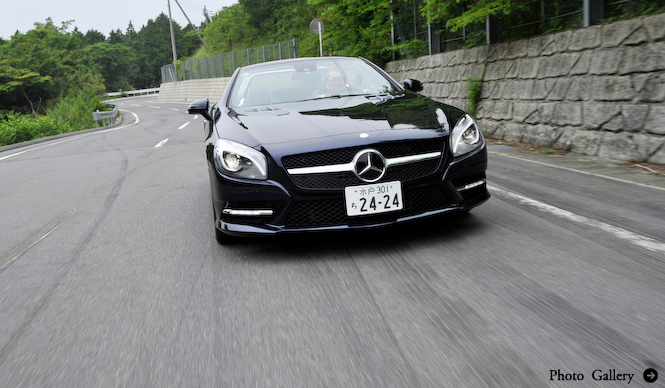
This March,Announced in Japanthe sixth-generation "SL-Class" was unveiled. Notably, with its all-aluminum body shell, it has significantly shifted towards being a "lightweight sports car," true to the "SL" (Sport Light) name. In mid-June, just before deliveries began, Toshifumi Watanabe test drove this "SL-Class" on the mountain roads and highways of Gotemba.
Text by WATANABE Toshifumi
Photographs by KOGAHARA Mitomu
The "SL" Automobile
The SL-Class is undoubtedly not only a representative model of Mercedes-Benz but also a benchmark for luxury convertibles worldwide. However, it's surprisingly little known that its origins lie in a hardcore racing model.
Developed to win on the race track and achieving numerous victories, the W194 model (300SL prototype) debuted in 1952. This means that tracing back to its origins, the SL-Class celebrates its 60th anniversary this year. The W198 model (300SL), a road-going refinement of the W194, was released to the public in 1954. Since then, across five generations, the most emphasized aspect has been to be faster, safer, and more comfortable than any other car.
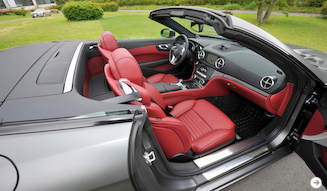
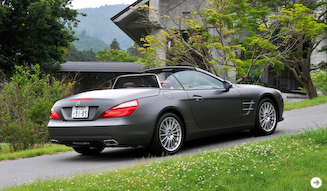
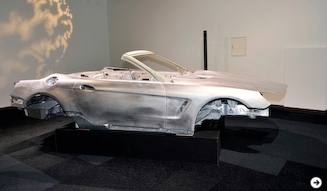
And this year, the R231 model "SL," now in its sixth generation after a full model change, arrives. Its technical highlights strongly suggest Mercedes' future engineering direction: significantly improving both environmental and dynamic performance through bold weight reduction. The new SL's body construction is 90 percent aluminum. Advanced casting techniques are actively employed even for large components like strut housings and side members, and a new friction-bonding method is used for the main floor, joining two aluminum sheets. Meanwhile, recycled materials are used for the rear floor. The monocoque, constructed with "appropriate materials for appropriate places," is so thoroughly transformed that, at first glance, only the A-pillar and roll bar appear to be steel. The result is a weight reduction of 110 kg for the white body alone. The white body weight, coming in at just over 200 kg, is comparable to that of an Audi "R8" or similar.
With further weight reduction in other components based on this body, the new SL has achieved a total weight saving of up to 140 kg.
This technology will undoubtedly be applied to the next "S-Class" and "CL-Class," and with further refinement, replacements with carbon composite or resin materials can be expected. True to its name, derived from the German for "Sport Leicht" (lightweight sport), the new SL is poised to be remembered as the model that initiated the significant weight reduction efforts for the next generation of Mercedes vehicles.
Mercedes-Benz SL-Class
Fast, Safe, and Comfortable
Test Drive of the Mercedes-Benz SL (2)
The Benefits of Weight Reduction
The new SL will initially be offered with two engine options: a 3.5-liter V6 and a 4.6-liter V8 twin-turbo, both equipped with a start-stop system. Combined with the aforementioned weight reduction and excellent aerodynamics with a Cd value of 0.27, fuel efficiency for the V6 "SL350" is 6.8 L/100km (EU measurement, approximately 14.7 km/L), a 30% improvement over the previous model. Meanwhile, its 0-100 km/h acceleration, an indicator of its power, is 5.9 seconds, a 0.3-second reduction from the previous model, clearly demonstrating the effect of the weight saving. For the "SL550," it achieves 4.6 seconds, an 0.8-second reduction from the previous model, delivering performance that rivals even the "Porsche 911".
In actual test drives, the SL350 proved to be an open-top sports car that completely lived up to the expectations set by its specifications. The sense of lightness, in particular, felt more significant than the numbers suggest, especially compared to the SL550. The perfectly balanced 50:50 weight distribution, as indicated on the vehicle registration, likely contributes to its agile handling in corners, which felt astonishingly light even to someone who has experienced several previous models.
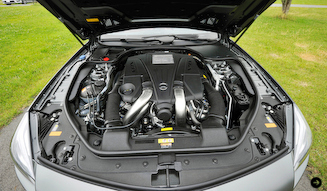
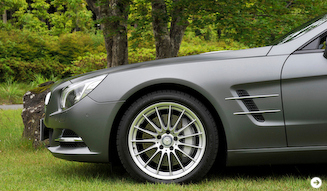
The SL550, on the other hand, possesses the classic SL character, with a refined driving experience and powerful yet easily manageable performance. Its ride comfort is superb, largely due to the "ABC (Active Body Control)" active suspension standard on the SL550. This system constantly applies hydraulic control to the suspension to keep the vehicle level, virtually eliminating any awkwardness during cornering and providing an exquisite smoothness from startup to high-speed cruising. While tuning ride comfort can be challenging with aluminum bodies compared to steel, few would find fault with the ride quality of the new SL. Incidentally, this "ABC" system is also available as an option for the SL350 (included in the "AMG Sports Package," costing an additional 900,000 yen).
Mercedes-Benz SL-Class
Fast, Safe, and Comfortable
Test Drive of the Mercedes-Benz SL (3)
The "SL Ride" Inherited
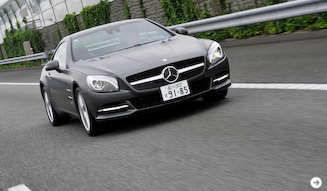
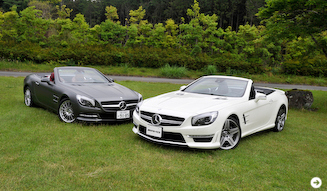
As mentioned, the SL's concept of being fast, safe, and comfortable has been faithfully carried over to this new generation. While the immediate, obvious excitement might be less pronounced, the source of its charm, which gradually unfolds over time, lies in the chassis where dynamics and comfort are exquisitely balanced. At this spring's international press event, Mercedes provided an opportunity to compare all SL models from the first generation to the new one. What was surprising was that all the historical models shared a remarkably similar driving philosophy. A linear handling that gradually increases steering gain, allowing precise cornering as you turn the wheel further. A calm response to minor inputs, yet an absolute sense of tire contact that remains unfazed even over large bumps. If this constitutes the "SL Ride," then the new SL embodies it with what is currently considered perfection.
Click here for Yasuhiko Kawamura's overseas test drive review of the "SL63 AMG"
Click here for Yasuhisa Shimashita's overseas test drive review of the "SL-Class"

Mercedes-Benz SL350 BlueEFFICIENCY
Overall Length x Width x Height | 4,615 × 1,875 × 1,315<1,305> mm
Wheelbase | 2,585 mm
Tread Front/Rear | 1,610 / 1,635 mm
Minimum Ground Clearance | 125<115> mm
Vehicle Weight | 1,710<1,780> kg
Minimum Turning Radius | 5.5 m
Engine Type | 276
Engine | V6 DOHC
Displacement | 3,497 cc
Bore x Stroke | 92.9 × 86.0 mm
Maximum Output | 225 kW (306 ps) / 6,500 rpm
Maximum Torque | 370 Nm (37.5 kgm) / 3,500-5,250 rpm
0-100 km/h Acceleration | 5.9 seconds
Trunk Capacity | 364 liters (roof retracted) / 504 liters
Tires Front | 255/40R18 <255/35R19>
Tires Rear | 285/35R18 <285/30R19>
Fuel Economy (JC08 mode) | 12.8 km / L
CO2 Emissions | 176–159g/km (Domestic figures)
Vehicle Base Price | 11.9 million yen
* Figures in <> are for the AMG Sports Package specification
Mercedes-Benz SL550 BlueEFFICIENCY
Overall Length x Width x Height | 4,615 × 1,875 × 1,305 mm
Wheelbase | 2,585 mm
Tread Front/Rear | 1,610 / 1,635 mm
Minimum Ground Clearance | 115 mm
Vehicle Weight | 1,860<1,870> kg
Minimum Turning Radius | 5.5 m
Engine Type | 278
Engine | V8 DOHC with Turbocharger
Displacement | 4,663 cc
Bore x Stroke | 92.9 × 86.0 mm
Maximum Output | 320 kW (435 ps) / 5,250 rpm
Maximum Torque | 700 Nm (71.4 kgm) / 1,800-3,500 rpm
0-100 km/h Acceleration | 4.6 seconds
Trunk Capacity | 364 liters (roof retracted) / 504 liters
Tires Front | 255/40R18 <255/35R19>
Tires Rear | 285/35R18 <285/30R19>
Fuel Economy (JC08 mode) | 9.6 km / L
CO2 Emissions | 214–212g/km (Domestic figures)
Vehicle Base Price | 15.6 million yen
* Figures in <> are for the AMG Sports Package specification