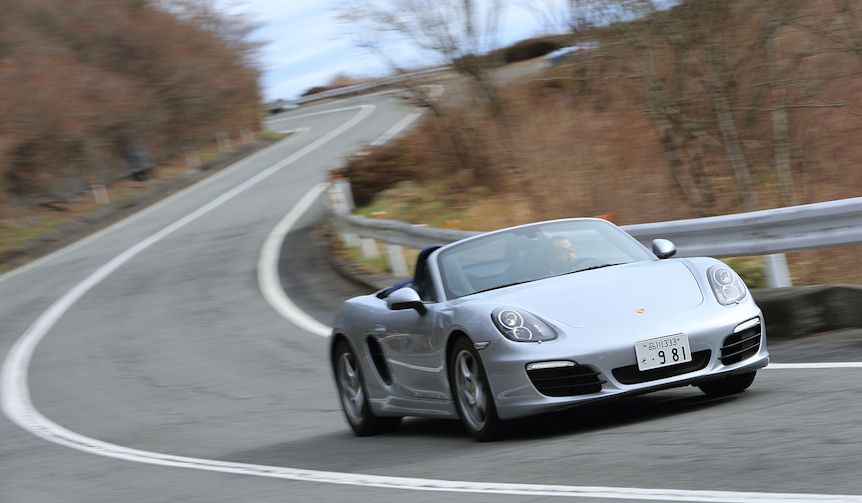
A Drive in the Last Six-Cylinder Boxster
Porsche Boxster | Porsche Boxster
Test Drive: The Last 6-Cylinder Boxster
A Sports Car You'll Want to Drive Every Day
Like the Porsche "911," the "Boxster" is being turbocharged and downsized for improved environmental performance. 718 BoxsterThe new engine, introduced under the name "718 Boxster & Cayman," is a 2-liter 4-cylinder turbo. This means the current model is, in effect, the last to feature a 6-cylinder engine. To confirm the true value of the naturally aspirated flat-six, automotive journalist Fumio Ogawa test drove the most basic current Boxster, equipped with a 2.7-liter engine.
Text by OGAWA FumioPhotographs by ARAKAWA Masayuki
The Standard Model: A Complete Form
One of the most appealing sports cars. Porsche's two-seater open-top sports car, the "Boxster," has always held immense charm. Its nimble handling, powerful engine, and beautiful styling are all in perfect balance. Recently, with an expanded lineup including the "Boxster Spyder," Boxster Spyderthe standard model represents a complete form.
The basic model, simply named "Boxster," is equipped with a 2.7-liter horizontally opposed 6-cylinder engine. It produces a maximum output of 195 kW (265 ps) and a maximum torque of 280 Nm. In comparison, the "Boxster S" positioned above it features a 3.2-liter engine, delivering 232 kW (315 ps) and 360 Nm. While the numbers show a significant difference,
does this mean the Boxster is merely a basic model? Absolutely not. It is (more than) sufficiently fun to drive.
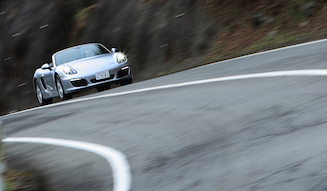
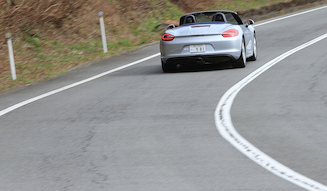
The Boxster debuted in 1996. Compared to the "911," which had been growing in body size, its simple styling and clear packaging were revolutionary. Its appeal grew even more with subsequent model changes.The current Boxster, the third generationhas established its unique character with sharp handling and a nimble style. It is about to be succeeded by a fourth generation. According to Porsche's announcement, the current third generation will be the last model equipped with a 6-cylinder engine.
Losing the 6-cylinder engine would be a true shame. Driving it, one truly feels this. Its ability to rev freely to the top end, combined with its incredibly sensitive response to accelerator pedal inputs within the band where maximum torque is delivered (4,500 to 6,500 rpm), is simply superb. Weighing in at a light 1.35 tons, with the engine and other heavy components concentrated in the center of the vehicle, its body's reaction to steering inputs and its agile footwork demonstrate that the charm that defined a new era remains intact.
The Boxster I test drove had another secret weapon.
Porsche Boxster | Porsche Boxster
Test Drive: The Last 6-Cylinder Boxster
A Sports Car You'll Want to Drive Every Day (2)
The 6-Speed Manual: A Remarkable Secret Weapon
Two models of the Boxster are available: the 7-speed PDK (a dual-clutch, two-pedal model) and a 6-speed manual transmission.
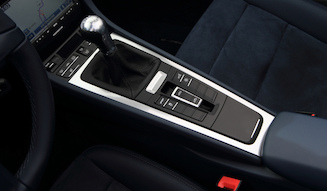
It was when I test drove the manual transmission model that I rediscovered its appeal. The short-throw, precise gear selector is so enjoyable to operate that it's a pleasure just to move it. And when you start driving, it provides immense joy. While the two-pedal version offers quick and easy shifts, there's nothing quite like the manual for fully savoring the Boxster as a sports car. I thought, this is a remarkable secret weapon.
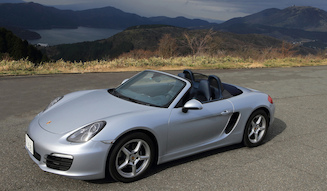
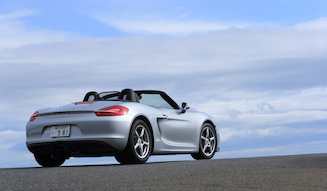
The fact that I was driving a left-hand drive model doubled the enjoyment. When precise operation of the manual gear selector is required, using the dominant hand offers greater certainty. Of course, it's also a matter of habit; with constant practice of wrist movements, operating with the left hand should pose no problem. Indeed, in Japan and the UK, left-hand operation is standard. For me, who hadn't practiced, my right hand was perfect for operating the slightly stiff selector.
In lower gears, relying on the exhaust note from behind and the information from the glancing tachometer, I'd accelerate and then, at the opportune moment, shift into second with just a flick of the wrist. Then accelerate again. And into third. At that point, you've already reached the legal speed limit on Japanese highways. The exhilaration you feel then is something hard to find elsewhere.
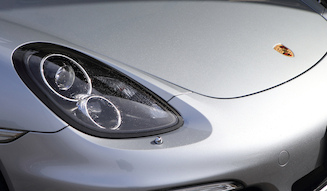
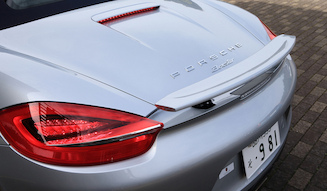
The steering wheel's rigidity, the suspension's supple movement, the accelerator pedal's exquisite speed control——even without conscious effort, the meticulous engineering creates a sense of magnificent harmony. For those who openly declare driving as their hobby, I was profoundly convinced that Porsche is the ultimate "tool."
The Boxster can be fully opened. This brings not only a sense of exhilaration but also another benefit.
Porsche Boxster | Porsche Boxster
Test Drive: The Last 6-Cylinder Boxster
A Sports Car You'll Want to Drive Every Day (3)
A Balanced Style from Every Angle
At 4.38 meters in length, the Boxster's style is balanced from every perspective. The 911, with its relatively short wheelbase and long rear section housing the engine, cannot be praised unconditionally for its aesthetics. The Boxster, however, is rational yet appropriately emotional. This rational design is another underpinning of its rare value as a mid-ship sports car, available in the early 6 million yen range.
The cockpit offers ample space, likely designed for larger Western physiques. For Japanese drivers, the lateral space is more than sufficient. Furthermore, with color-keyed interiors, it exudes a decidedly luxurious atmosphere. I recalled that Porsche was the brand that changed the perception that German cars pursued quality solely through black interiors.
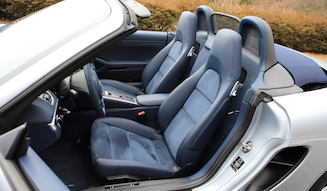
The power-retractable soft top, which can be opened and closed while driving up to 50 km/h, is a major attraction of the Boxster. When driving at speed with the top down, the sensation is wonderfully exhilarating. Even in mid-winter, wearing a thick sports coat and a scarf is the "correct" way to enjoy an open-top sports car. If you dislike that, raising the side windows (and optionally fitting a wind deflector) prevents wind from entering the cabin, allowing for a comfortable drive with a vast expanse of sky above.
Going fully open offers another practical benefit. With the soft top up, the Boxster allows various sounds from the engine bay behind the cockpit to be heard clearly. In a closed coupe, interior noise can be "managed" through acoustic treatments like resonance control, sound insulation, and absorption. However, this is difficult in an open-top model. But when you open the top, all the noise escapes into the open air.
A nimble sports car you'll want to drive every day. Even with a 4-cylinder turbo engine, it will surely be fun. Nevertheless, experiencing the way the accelerator pedal and engine naturally respond to each other in the current model is worthwhile. It's definitely worthwhile. I find myself wanting to say it again and again.
Porsche Customer Care Center
0120-846-911
http://www.porsche.com/japan/jp/