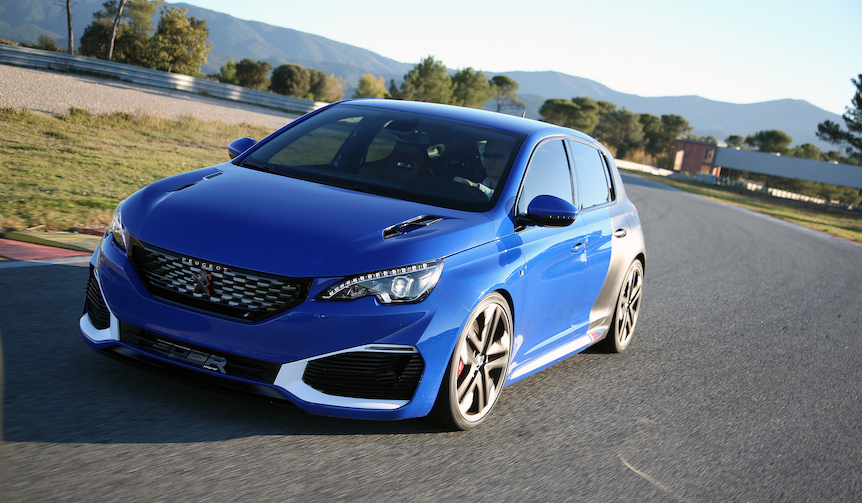
Driving Impressions: Peugeot 308 GTi and 308 R HYBrid
Peugeot 308 GTi
Peugeot 308 R HYbrid
Test Drive: Peugeot 308 GTi and 308 R HYbrid
A Super PHEV Boasting 500ps
The "308 R HYbrid," the star of the Peugeot booth at the 2015 Frankfurt Motor Show. Motor journalist Kazuhiro Nanyo immediately test drove this 500ps super PHEV in France. This report also covers the 308 GTi, which he drove concurrently.
Text by Kazuhiro Nanyo
Pure Driving Enjoyment: Steering, Cornering, Braking
When I first saw the Peugeot "308 R HYbrid" at last autumn's Frankfurt Motor Show, boasting a combined output of 500ps and maximum torque of 730Nm, I was quite surprised. Even with PSA's latest EMP2 platform, the base is merely a C-segment FF compact. The plug-in hybrid (hereafter PHEV), combining an internal combustion engine with two electric motors on each axle, officially achieves 500ps (270ps + 115ps x 2) or 730Nm (330Nm + 200Nm x 2), a beautiful figure on paper. But was it too much? I couldn't help but wonder if it was engineered beyond its limits.
Peugeot 308 GTi
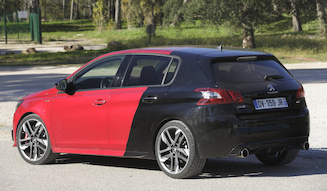
So, to be able to drive it on a circuit just a few months later, and to such a degree of completion for a prototype, was even more surprising. Fortunately, the car provided for the drive to the circuit where I would test the 308 R HYbrid was the production model, the "308 GTi," scheduled to arrive in Japan in spring 2016. Therefore, I'd like to present test drive reports for both cars.
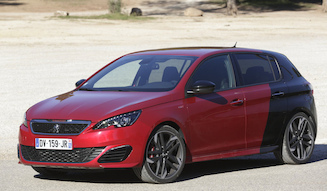
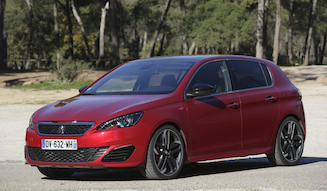
The most distinctive exterior feature of the 308 GTi is its "coupé franche" (clean cut) two-tone paint scheme, dividing the body into a 2:1 ratio of red and black. The body, initially fully painted, is then stripped back by hand on the rear third and repainted, a process that requires considerable effort. The springs and dampers are reinforced, lowering the ride height by 11mm compared to the standard model. Additionally, the front grille, which is horizontal on the normal model, is replaced with a dedicated blacked-out, horizontally oriented damier (checkerboard) pattern part. Aside from the muffler tips, these are the main exterior differences.
Peugeot 308 GTi
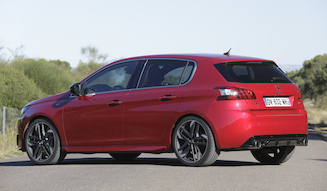
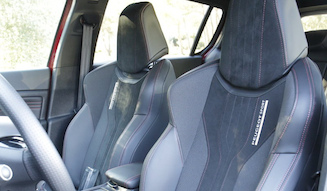
Immediately upon driving, one notices the exceptionally high level of basic operational touch and feel. First and foremost, the seat's hold is superb, preventing shoulder movement and ensuring precise steering. The steering and brake pedals feel smooth, and the moderate tactile feedback and rigidity of the 6-speed manual transmission are also impeccable. Even when engaging the clutch, there's no vibration transmitted to the shift lever. As a pure manual transmission car, the 308 GTi is a vehicle that can be enjoyed simply through the operations of driving, cornering, and braking.
The ride comfort is also surprisingly good, considering the tires are sized 235/35R19. While the high lateral rigidity of the suspension can cause the steering to be slightly pulled and the body to jolt on uneven surfaces at speeds around 50 km/h in town, the ride becomes smoother as the speed increases on the open road.
Peugeot 308 GTi
Peugeot 308 R HYbrid
Test Drive: Peugeot 308 GTi and 308 R HYbrid
A Super PHEV Boasting 500ps (2)
One of the Best Manual Transmission Cars Available
In fact, at 1205kg, the 308 GTi is over 100-200kg lighter than its rivals, the Golf 7 R and GTi, and even lighter than the Polo GTi. This is thanks to PSA's latest EMP2 platform. With its low center of gravity and minimal body roll, combined with the lightness and rigidity of the upper structure, and the suppleness and agility of the suspension, the suspension stroke feels abundant. Regardless of its ultimate limits, the wealth of information conveyed to the driver regarding load transfer and road holding of all four wheels is impressive. In essence, it's a remarkably communicative chassis.
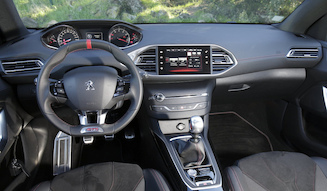
Peugeot 308 GTi
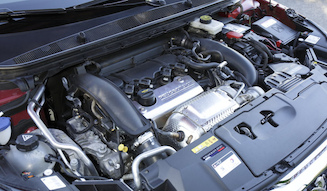
The 1.6L turbo THP270 unit has specs similar to the RCZ R's THP275ps, but it's a different beast altogether, featuring revamped injectors and mapping, a reinforced crankshaft, and an intercooler for the turbo intake air. It's incredibly smooth even at town speeds, but perhaps due to the control that maintains a gentle torque curve, even light acceleration can sometimes display high boost pressures of 2.3-2.5 bar, reminiscent of tuned cars from a bygone era. The background control seems busy. However, unlike the previous THP units that lacked punch, the 270ps version of the 308 GTi offers a sense of high-rpm extension and power. Switching to Sport mode via the button makes the throttle response more agile and unleashes a more spirited exhaust note.
Incidentally, when accelerating in second gear from a sharp turn, there is some torque steer. However, combined with the small steering wheel and the level of assistance, the feeling of easily controlling it outweighs the sensation of the steering wheel fighting back.

Peugeot 308 GTi
The 308 GTi comes in 250ps and 270ps versions; only the latter is equipped with a Torsen limited-slip differential, but its effect was felt less on the circuit and more as a sensation of the rear wheels kicking away bumps during acceleration on uneven mountain roads.
Ultimately, the 308 GTi, leveraging its light weight, competes not with agility but with tenacious road holding, and in terms of driving pleasure, it can be considered one of the best manual transmission cars available, not just among front-wheel-drive vehicles.
Conversely, it is precisely because the 308 GTi, a master of the three-pedal setup, has been entrusted with the role of an extreme hatchback, that the 308 R HYbrid's significance as a two-pedal, extreme AWD hatchback stands out.
Peugeot 308 GTi
Peugeot 308 R HYbrid
Test Drive: Peugeot 308 GTi and 308 R HYbrid
A Super PHEV Boasting 500ps (3)
An Ambitious Machine as an "Anti-German Car"
Now, let me share my impressions of the 308 R HYbrid. Its weight is 1550kg, a substantial increase of 345kg over the 308 GTi's 1205kg. This is comparable to the Mercedes-AMG A45, BMW M2, and Audi RS3. However, with a combined maximum output and torque of 500ps and 730Nm, and being a PHEV, it's clear that even as a prototype, it holds an advantage in power-to-weight ratio and environmental performance. It's a highly ambitious machine, positioned as an "anti-German car."
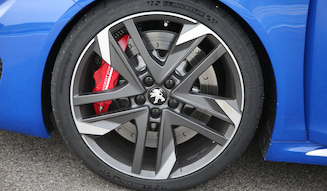
Regarding the geometry, the front track has been widened by 80mm and the rear by 86mm compared to the GTi. The tire choice has also changed from Michelin Pilot Super Sport to Pilot Sport Cup 2. However, the tire size remains the same as the GTi's, 235/35ZR19. The dampers and springs are also from the same supplier as the GTi, but with a stiffer specification. The brake disc sizes are also identical to the GTi's: 380mm front and 268mm rear, with 4-piston calipers.
This is partly because a portion of the braking force is provided by the regenerative braking of the front and rear electric motors, which generate inertial resistance. In fact, upon lifting off the accelerator, there's significant braking resistance, though not as pronounced as in the BMW i3. This resistance also helps to mitigate the shift shock from the paddle shifters.
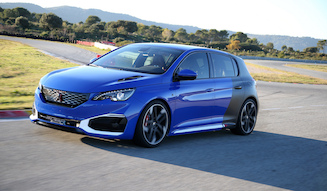
Peugeot 308 R HYbrid
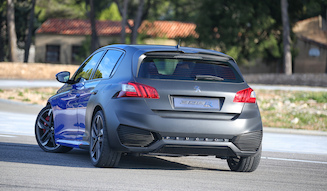
The energy regenerated during deceleration is converted into electricity and stored in a Delphi lithium-ion battery. This secondary battery, housed between the wheelbases, has a small capacity of 3kWh to minimize weight increase. Even with normal driving alone, its charge level easily returns to near full.
The 308 R HYbrid can also be charged via a plug, but its hybrid nature lies in its ability to frequently deliver additional torque and power from the electric motors during acceleration, akin to KERS.
However, on this particular test drive, the front axle motor was largely absent, limiting the output to approximately 400ps. Of the four selectable driving modes, the most powerful mode, "HOT LAP," which utilizes the THP270 engine and both front and rear electric motors at full capacity, could not be tested that day due to the clutch and transmission needing protection after a series of test drives. The 2-pedal transmission is based on PSA's 6-speed single-clutch system, and it's said that the clutch capacity is insufficient to handle the combined torque of 330Nm + 200Nm, even on the front axle alone.
Peugeot 308 GTi
Peugeot 308 R HYbrid
Test Drive: Peugeot 308 GTi and 308 R HYbrid
A Super PHEV Boasting 500ps (4)
Acceleration Comparable to a Porsche 911
With that cockpit drill behind me, I entered the course with slightly dampened spirits. First, I selected "ZEV mode," which allows for approximately 15km of electric-only driving when fully charged, followed by "ROAD" for fuel-efficient hybrid driving in city conditions like stop-and-go traffic, and then "SPORT," selected via the drive mode switch located in front of the shift lever. Gear changes are done via paddles.
In SPORT mode, not only the THP270 engine but also the rear electric motor delivers torque with sharp responsiveness according to throttle input. This sensation of the rear wheels propelling the car forward is something previously unimaginable in a hot hatch.
However, what is most striking is not the gradual power delivery of the internal combustion engine after pressing the accelerator, but the sharp, electric-like torque response. The rear load shifts as if propelled, and the next corner approaches with terrifying speed. The traction and corner exit speeds are immense, far beyond what a front-wheel-drive hot hatch can achieve.
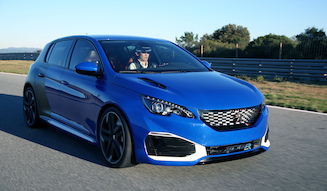
Peugeot 308 R HYbrid
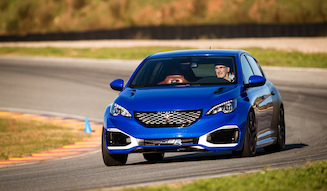
As the engine reaches its upper limit on the straight, the front axle motor intervenes, maintaining the same speed while the exhaust note deepens by one level. At this point, I realized that the total output and torque are not limited by the driving mode. While maximum output and torque are fully utilized in situations like top-speed runs or launch starts, the torque response can be unleashed at any time during acceleration. And after a cool-down lap on the roughly 2km circuit, the battery is quickly recharged, allowing the electric motor to be utilized again at corner exits.
Despite the increased weight and wider track, the 308 R HYbrid's steering feel from corner entry to apex is surprisingly similar to that of the 308 GTi. While the tire contact patch is similar, the slightly reduced body roll, the low center of gravity providing tenacious grip, and the precise tracing of the cornering line are common traits.
However, as the accelerator is applied towards the corner exit, a metallic motor drive sound emanates from the trunk floor, where sound insulation has been reduced and the road is visible, intruding relentlessly. This is an unfinished detail, characteristic of a prototype. Nevertheless, the sensation of the rear end digging in and surging towards the next corner is comparable to a Porsche 911, offering an intense thrill that transcends the definition of a hot hatch.
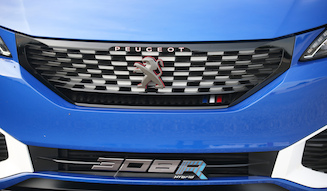
Peugeot 308 R HYbrid
Even more surprisingly, the engineers at Peugeot Sport, who developed this car, are convinced that the EMP2 platform can handle even more power – that 500ps is insufficient. They want to distribute more torque and power to the rear axle on surfaces like wet roads. This means that without a system to adjust front-rear torque distribution, the rear axle's performance is currently dependent on the default motor output. The 115ps/200Nm specification is the most powerful available from the supplier at present.
Even with 400ps, the 308 R HYbrid is sufficiently stimulating and holds an advantage over its German rivals in terms of power-to-weight ratio. Even if produced in limited numbers, the technical hurdles for mass production are not insurmountable. If realized, it would be a fascinating mutation, condensing the essence of Peugeot, regardless of its PHEV status.