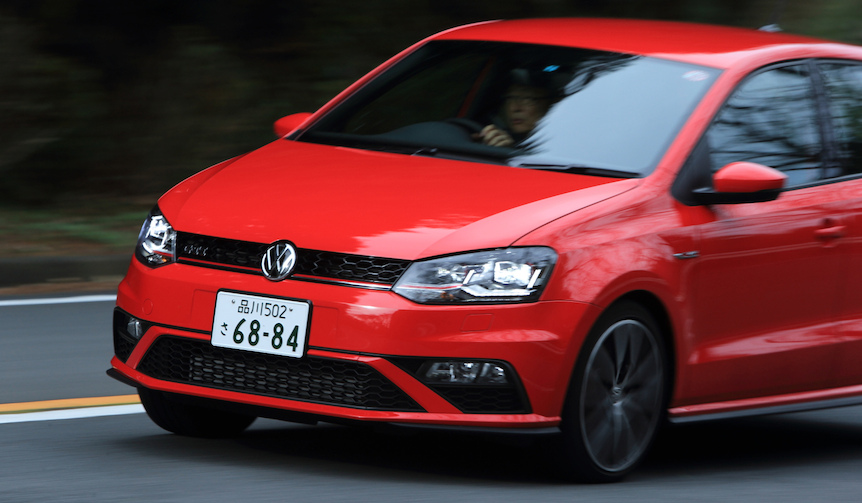
Test Drive the New Polo GTI with a Manual Transmission | Volkswagen
Volkswagen Polo GTI | Volkswagen Polo GTI
Test Drive: The New Polo GTI with a Manual Transmission
A Model That Defies Volkswagen's Conventional Wisdom
DCT (Dual-Clutch Transmission) is now commonplace. Volkswagen, a pioneer in this innovative mechanism, has added a 6-speed manual transmission model to its three sports models: the Golf R, Golf GTI, and Polo GTI. Tatsuya Otani, who test drove the 6-speed manual Polo GTI, deciphers the carmaker's vision.
Text by Tatsuya OtaniPhotographs by Masayuki Arakawa
Upsizing, Not Downsizing
DCT (Dual-Clutch Transmission) is now widely adopted, from supercars to compact cars. Its popularity stems from its direct feel, high efficiency, and smooth, rapid shifts, all thanks to its manual gearbox roots.
Did you know that the Volkswagen Group was the first in the world to adopt DCT for a mass-produced car? I vividly recall test driving the Audi TT 3.2 quattro DSG in Nice in 2003 (later renamed S tronic, but Audi also called DCTs DSG back then) and being impressed by its superior sportiness and smoothness. A secondary benefit of DCT is that it eliminates the need for the H-pattern shift common in manual gearboxes, making it easier to add more gears.
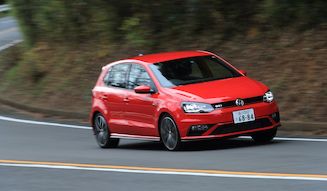
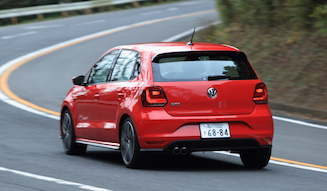
Indeed, most of Volkswagen's current DSG models have seven speeds. The multi-gearbox approach has been highly effective in improving the efficiency of their other key technology, the downsizing engine. As you know, the combination of a downsizing engine and DCT has become the de facto standard for European compact cars.
Now, a model that overturns this Volkswagen convention has arrived: the latest Polo GTI.
The GTI was added to the current fifth-generation Polo in 2010. The Polo GTI introduced at that time featured a 1.4-liter direct-injection gasoline engine with a twin-charging system (turbocharger and supercharger) producing 179ps, paired with a 7-speed DSG, perfectly embodying the downsizing concept.
However, in the minor model change in February 2015, the Polo GTI's engine was replaced with a 1.8-liter direct-injection gasoline engine producing 192ps, using only a turbocharger. In other words, it underwent upsizing, not downsizing. In response, a 6-speed manual model was launched in June, alongside the DSG model. Thus, a specification that goes against the trend of downsizing – a small-displacement direct-injection turbocharged engine with a multi-gearbox – was born.
Volkswagen Polo GTI | Volkswagen Polo GTI
Test Drive: The New Polo GTI with a Manual Transmission
A Model That Defies Volkswagen's Conventional Wisdom (2)
Fuel Economy: 15.9 km/ℓ vs. 17.2 km/ℓ for DSG
Why did Volkswagen deliberately create a model that goes against its own policy? One reason is that 'it was more efficient.' Incidentally, the JC08 mode fuel economy improved by approximately 4 percent, from 16.6 km/ℓ for the previous model to 17.2 km/ℓ.
This doesn't negate the principle of downsizing, however. It's more accurate to say that combining a 1.8-liter engine with a larger displacement and a simpler single turbocharger system results in less energy loss than combining a 1.4-liter small-displacement engine with a complex twin-charging system (turbocharger + supercharger).
Furthermore, the 17.2 km/ℓ figure mentioned above is for the DSG model. This was cited for comparison with the previous model, which was only available with DSG. The JC08 mode fuel economy for the 6-speed manual model is 15.9 km/ℓ.
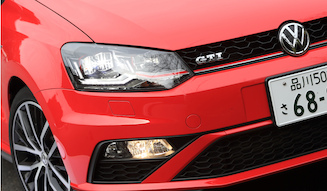
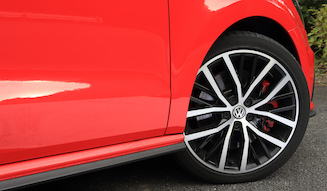
Another advantage of the new engine, as highlighted by Volkswagen, is its 'sporty performance.' While both the previous and new models have the same maximum torque of 250 Nm, the torque is delivered from 1250 rpm, a reduction from the previous 2000 rpm. This results in a 'powerful start from a standstill,' according to the company. This change in engine characteristics also favorably impacts the match with the 6-speed manual transmission introduced here.
Regarding the decision to introduce a manual transmission in an era dominated by DCTs, Volkswagen explains that 'many customers desire the return of the MT model for the joy and pleasure of driving the car themselves' and that they aim 'to deliver 'delightful' driving pleasure to as many customers as possible.'
Volkswagen Polo GTI | Volkswagen Polo GTI
Test Drive: The New Polo GTI with a Manual Transmission
A Model That Defies Volkswagen's Conventional Wisdom (3)
Car Manufacturing Focused on Human Sensation
Upon starting to drive the new Polo GTI with its 1.8-liter direct-injection turbo engine and 6-speed manual transmission, the first thing you notice is the softer ride. The previous model was more solid, and at times, you could clearly feel shocks from the road. The new model, however, has a stronger sense of smoother suspension travel, making it far more comfortable than one might expect from a model named GTI.
As a result, the sharp steering response that immediately turned the nose, characteristic of the previous model, has subsided. However, this doesn't mean it's sluggish; it offers a stable, Volkswagen-esque handling.
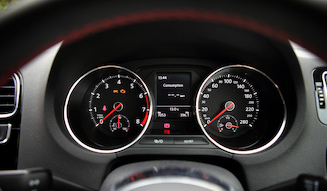
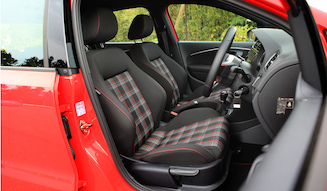
The engine characteristics also match this suspension tuning well. Unlike the razor-sharp throttle response of the previous model, the new one has a milder feel, which pairs exceptionally well with the 6-speed manual transmission.
As exemplified by Formula 1, most modern racing cars now use paddle shifters with a two-pedal system. The reason is simple: engine response has improved to the point where even F1 drivers cannot fully utilize the car's performance with manual shifting.
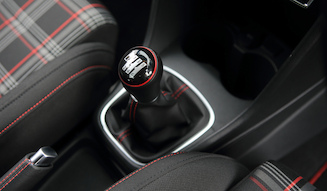
Furthermore, paddle shifters allow for instantaneous gear changes, enabling drivers to stay within the narrow power band of the engine. This ability to utilize a specific RPM range is another reason for the prevalence of paddle shifters.
Conversely, this implies that a more tractable engine characteristic is desirable for a manual transmission model. In this regard, the combination with the 1.8-liter direct-injection turbo engine is spot on.
What's truly gratifying is that Volkswagen, which seemed solely focused on efficiency, has now embraced a car manufacturing approach that prioritizes human sensation, such as the 'driving pleasure of a manual transmission.' In fact, manual transmission models are not only available for the Polo GTI but also for the Golf GTI and Golf R. Despite the turmoil surrounding emissions issues, we sincerely hope Volkswagen will make a strong comeback through user-centric product development.

Volkswagen Polo GTI 6MT | Volkswagen Polo GTI 6MT
Body Dimensions | Length 3,995 × Width 1,685 × Height 1,445 mm
Wheelbase | 2,470 mm
Tread Front/Rear | 1,440 / 1,435 mm
Weight | 1,240 kg
Minimum Ground Clearance | 115 mm
Engine | 1,798 cc Inline 4-cylinder Direct Injection DOHC Intercooled Turbo
Bore x Stroke | 82.5 x 84.1 mm
Maximum Output | 141 kW (192 ps) / 5,400-6,200 rpm
Maximum Torque | 320 Nm (32.6 kgm) / 1,450-4,200 rpm
Transmission | 6-speed Manual
Drivetrain | FF
Brakes Front/Rear | Ventilated Discs / Discs
Suspension Front/Rear | MacPherson Strut / Trailing Arm
Tires Front/Rear | 215/40R17
Minimum Turning Radius | 4.9 m
Fuel Economy (JC08 Mode) | 15.9 km/ℓ
CO2 Emissions | 146 g/km (Equivalent to JC08 mode fuel consumption)
Steering Position | Right
Price | 3,275,000 Yen
Volkswagen Customer Center
0120-993-199