Test Drive: The New Mercedes-Benz V-Class | Mercedes-Benz
Mercedes-Benz V Class
Test Drive: The New Mercedes-Benz V-Class
A One-Box Limousine with Greatly Enhanced Qualities
The Mercedes-Benz V-Class, a minivan that underwent a full model change in 2015, evolving into its third generation. Motor journalist Tatsuya Otani recently test drove the model, which has just begun its rollout in Japan.
Text by OTANI TatsuyaPhotographs by ARAKAWA Masayuki
Weaknesses Overcome
When attending international press events abroad, the Mercedes-Benz V-Class is often the vehicle that picks us up from the airport. As a tall, large, one-box car, its interior is spacious even with three rows of seats. While the depth of the luggage space is somewhat limited, its utility in easily accommodating four suitcases (carry-on size, mind you) is reassuring. It's known as one of the "strongest German minivans," alongside the Volkswagen Transporter, which is not available in Japan.
However, it wasn't without its flaws. The large body and large opening, combined with other unfavorable conditions, meant the body rigidity was somewhat lacking, which undeniably had a negative impact on ride comfort. To put it bluntly, it struggled to handle sharp impacts from the road, often resulting in a jarring shock followed by a brief but noticeable lingering vibration.
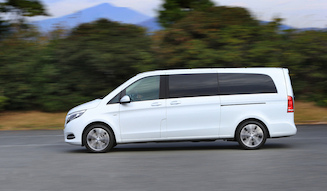
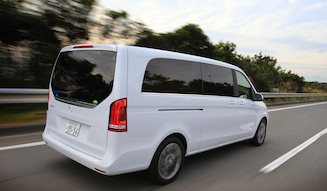
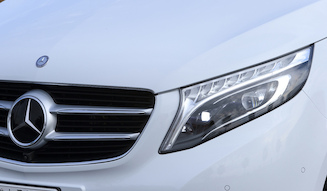
Furthermore, since Gordon Wagener took the helm as chief designer, Mercedes' interior and exterior quality has significantly improved. However, the previous generation, which was still in production until recently, did not quite meet the latest standards in this regard, and there was a tendency for it to feel "less luxurious than expected for a Mercedes."
The V-Class was reborn into its third generation in Germany in 2014. Since then, I've had the opportunity to experience it several times in Europe, and even just by sitting in the second or third row, it was clear that the body rigidity had significantly increased, greatly improving the ride comfort. The design and sense of quality have also been updated in line with Wagener's direction, making it a model I eagerly awaited for its Japanese launch.
Mercedes-Benz V Class
Test Drive: The New Mercedes-Benz V-Class
A One-Box Limousine with Greatly Enhanced Qualities (2)
Quieter Than the C220d
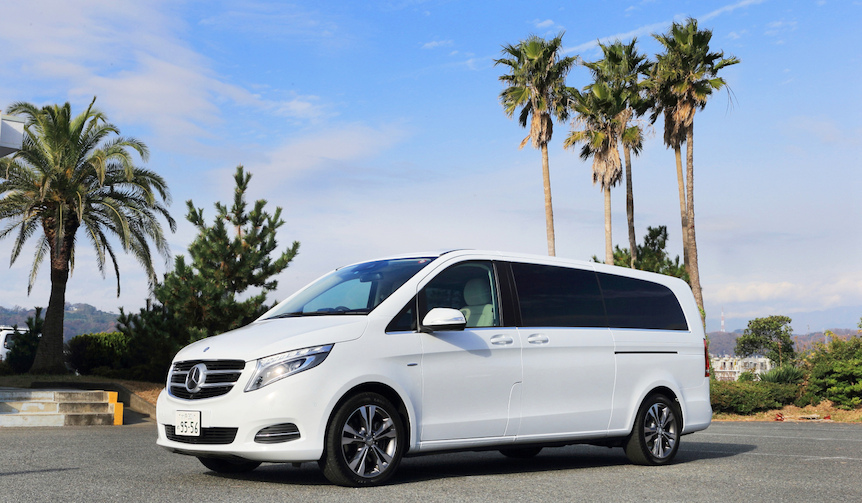
Finally, I had the chance to test drive the new V-Class. For OPENERS, the V220d AVANTGARDE Extra-long, the most luxurious in the series, was prepared. The new V-Class is available in three body types: standard, long, and extra-long. The long version extends the rear overhang by 245mm compared to the standard, and the extra-long version extends the wheelbase by an additional 230mm over the long. This means the extra-long version is a full 475mm longer than the standard. In S-Class terms, it's like a Maybach stretched even further from a long-wheelbase version.
As the model name suggests, the engine is a 2.2-liter turbo diesel. While three power outputs are available in its home market—136ps, 163ps, and 190ps—the Japanese specification is exclusively 163ps. You might naturally wonder, "Can that really move a 2.5-ton (2,490kg to be precise) body?" But surprisingly, it performs quite well.
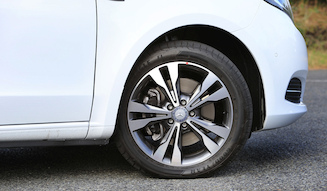
Although I was the sole occupant during the test drive, its initial acceleration was brisk, and it possessed ample power to accelerate at a considerable pace even on gradients exceeding 10 percent. What was particularly surprising was how quiet it was, with the characteristic diesel clatter barely audible. In fact, it felt so quiet that I wondered if it was quieter than the C220d, which shares the same engine. Given that cab-over designs, with the engine positioned close to the driver, are inherently at a disadvantage in terms of engine noise compared to sedans, this speaks volumes about the V-Class's excellent sound insulation.
Regarding ride comfort, my experience as a passenger in Europe was confirmed. The increased body rigidity allows the suspension to move more freely and compliantly, which appears to significantly enhance comfort. Even so, when passing over bumps larger than minor road imperfections at speed, the entire body exhibits a slight, brief vibration. However, considering this is a minivan with a wheelbase exceeding 3.4 meters (!), this might be unavoidable.
Mercedes-Benz V Class
Test Drive: The New Mercedes-Benz V-Class
A One-Box Limousine with Greatly Enhanced Qualities (3)
No Top-Heavy Feeling on Winding Roads
The improved body rigidity also had a positive impact on handling. Even at high speeds, the car tracks straight with just a light touch on the steering wheel. I particularly appreciated the absence of any vagueness around the steering's neutral position. Furthermore, it was surprising how little top-heavy sensation was felt, even when driving at a considerable pace on winding roads.
It goes without saying that the ultra-long wheelbase provides ample space for rear passengers to relax. Moreover, the fact that the second and third rows are equipped with the same substantial seats as the front row is a distinct advantage of European cars, which is less common in Japanese vehicles. These well-crafted seats not only offer excellent comfort but should also positively impact safety in the event of a crash. This is an approach I wish Japanese car manufacturers would emulate.
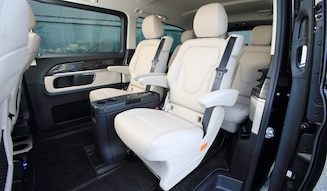
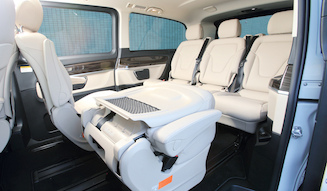
Additionally, thanks to the 245mm extension of the rear overhang, the luggage space has been expanded to the point where not only small suitcases but even medium-sized ones can be stacked vertically. For airport transfers, this utility of space is of great significance.
The improvement in interior and exterior quality seems to be due not only to the design changes but also to the fact that, although still produced at the same Lithuanian plant for commercial vehicles, the production line has been separated from that for commercial vehicles. The new V-Class, with its significantly enhanced qualities as a one-box style limousine, is also attractively priced, with even the top-of-the-line V220d AVANTGARDE Extra-long costing a reasonable 7.3 million yen.

Mercedes-Benz V 220 d AVANTGARDE Extra-long
メルセデス・ベンツ V 220 d アヴァンギャルド・エクストラロング
Body Dimensions | Length 5,380 x Width 1,930 x Height 1,480 mm
Wheelbase | 3,430 mm
Tread Front/Rear | 1,665 / 1,645 mm
Weight | 2,490 kg
Minimum Ground Clearance | 105 mm
Engine | 2,142 cc Inline 4-cylinder Direct Injection DOHC Turbo Diesel
Bore x Stroke | 83.0 x 99.0 mm
Maximum Output | 120 kW (163 ps) / 3,800 rpm
Maximum Torque | 380 Nm (38.7 kgm) / 1,400-2,400 rpm
Transmission | 7-speed AT (7G-TRONIC PLUS)
Drivetrain | FR
Brakes Front/Rear | Ventilated Discs / Discs
Tires Front/Rear | 245/45R18
Minimum Turning Radius | 6.0 m
Fuel Economy (JC08 Mode) | 15.3 km/ℓ
Trunk Capacity | 1,410-5,500 ℓ
Steering Position | Right
Price | 7.3 million yen
Mercedes Call
0120-190-610
http://www.mercedes-benz.co.jp/