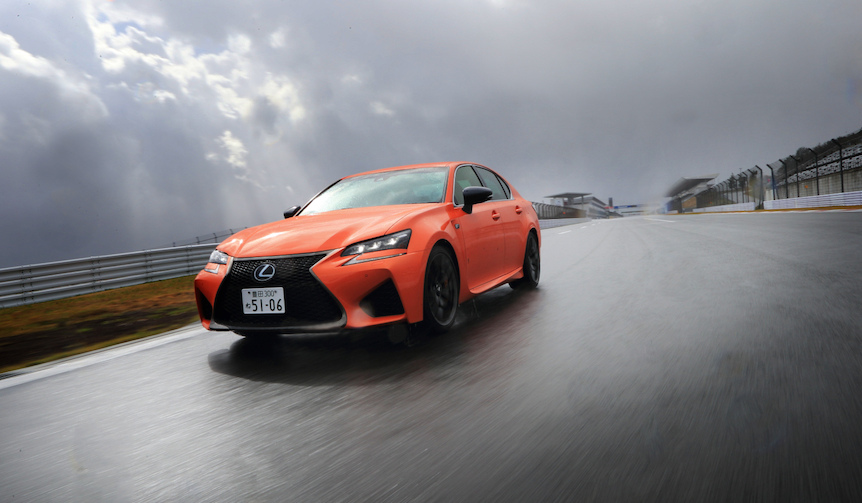
A Test Drive of the Lexus GS F | LEXUS
LEXUS GS F | LEXUS GS F
Test Drive: LEXUS GS F
A Car Symbolizing the Future of LEXUS
Bearing the "F" designation, the mark of Lexus's high-performance models, it was first unveiled in Detroit in January 2015 as the newest F series sports sedan, the GS F.The "GS F" Debuts at the Detroit Motor ShowIn November,it was released in Japan.Automotive journalist Tatsuya Otani test drove the vehicle at Fuji Speedway.
Text by OTANI TatsuyaPhotographs by ARAKAWA Masayuki
As Toyota Transforms, So Does LEXUS
To be blunt, I've rarely been impressed by Lexus's driving dynamics. For a premium brand, the body rigidity wasn't particularly high, and while it excelled at quietness and managing harshness, the suspension settings seemed geared for low speeds, making it difficult to feel connected to the drive through the steering. Consequently, I couldn't shake the impression that it was merely a "slightly more luxurious Toyota."
Amidst this, the only model that could be considered an exception for me was the "IS F" which debuted in 2007. This model, bearing the "F" – an acronym for Fuji Speedway – was a high-powered version of the "IS," a rear-wheel-drive D-segment car akin to the BMW "3 Series." It was equipped with a 5.0-liter V8 engine and featured a body and suspension as robust as its European rivals, making it a truly rewarding car to drive.
To be clear, I'm not saying it was good simply because it was high-performance. Regardless of its performance level, it was honed with an ambition comparable to European cars. It was this spirit that truly moved me.
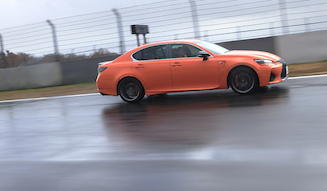
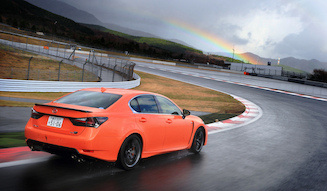
The second model that evoked a similar feeling was the one that debuted in 2014,the "RC" and "RC F."Both boasted high body rigidity and a well-tuned, firm suspension, providing a strong sense of security. Furthermore, by this time, the tangible results of President Akio Toyoda's persistent advocacy for "building great cars" were beginning to appear in Toyota-brand new models. Thus, I interpreted the RC and RC F as milestone models suggesting a similar shift was occurring within Lexus.
Now, after test driving the newly released "GS F," my conviction is solidifying. As Toyota transforms, so too is Lexus undergoing a significant metamorphosis. The sheer completeness of the GS F is, I believe, the most compelling evidence of this.
LEXUS GS F | LEXUS GS F
Test Drive: LEXUS GS F
A Car Symbolizing the Future of LEXUS (2)
A Can Packed Tight with Substance
The venue for this test drive was Fuji Speedway. We were permitted to drive not only on the circuit's handling course but also on the main track and public roads outside the facility. However, due to time constraints, I was unable to test it on public roads. Therefore, please note that my impressions of its comfort are based on the circuit driving experience.
Regarding comfort, the road noise was significantly reduced compared to the second-generation "GS" at its debut, and the sense of luxury felt further enhanced. Personally, I had perceived a substantial increase in body rigidity with the second-generation GS. However, to use a crude analogy, it felt somewhat like an "empty can" – strong, yes, but with vibrations from the suspension resonating directly through the body.
Yet, perhaps due to the minor changes implemented across the entire GS lineup coinciding with the GS F's debut, the road noise no longer echoed jarringly through the body. Instead, it was muffled, with a weighty, subdued sound. The transformation was so profound it felt as if the body had changed from an "empty can" to one "packed tight with substance."
A similar change was evident in the ride quality. While this was the GS F's debut and I hadn't driven the pre-minor-change GS, which was the hybrid "GS450h," direct comparison is difficult. Nevertheless, to absorb the shocks from the Michelin "Pilot Super Sport" tires – 255/35R19 front and 275/35R19 rear – required not just a stiff body, but also exceptional damping capability to suppress body vibrations. The GS F excels in this regard; even when encountering bumps, there was no jarring impact. It absorbed and instantly quelled vibrations—that was the sensation of its ride.
Next, we moved to the main course at Fuji Speedway. The track was initially damp, gradually drying as we proceeded. The GS F navigated both low-speed and high-speed corners with a remarkable balance that belied its sedan body. Its stability in high-speed corners was particularly impressive. I had previously driven the RC F at the same circuit, and the GS F felt more composed and reassuring in its behavior. This might be attributed to the GS F's 120mm longer wheelbase compared to the RC F. In low-speed corners like B corner, understeer was minimal. By effectively shifting weight and executing steering and throttle inputs with care, surprisingly compact cornering was achievable.
LEXUS GS F | LEXUS GS F
Test Drive: LEXUS GS F
A Car Symbolizing the Future of LEXUS (3)
Exquisitely Tuned Stability Program
Another surprising aspect during circuit driving was the stability program. Although we were not permitted to deactivate it due to the wet conditions, I was able to intentionally slide the rear end out on corner entry and maintain that slide through the corner by keeping the throttle applied. While the stability program was likely intervening, its tuning was exquisite, making the driver feel in control. It neither reduced engine output nor used the brakes to counteract the rear slip angle; it simply allowed the driver to manage the car. Repeatedly driving on the circuit with this stability program would undoubtedly enhance a driver's skills.
Furthermore, the TVD (Torque Vectoring Differential), which was an option on the RC F, is standard equipment on the GS F. This system, which controls the distribution of torque between the left and right rear wheels to manage the car's attitude, is presumed to have played a crucial role in allowing us to maintain a controlled oversteer with throttle application.
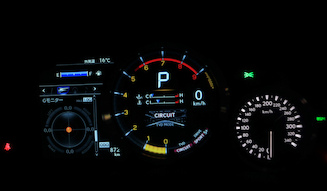
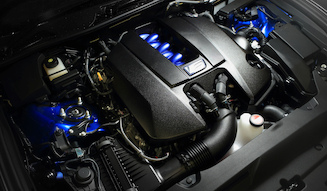
The 5.0-liter V8 engine, producing a maximum output of 477 ps, undergoes a meticulous process where each unit's rotational balance is measured after assembly, and counterweights are added to the crankshaft pulley to eliminate imbalance. This attention to detail results in exceptionally smooth operation. The power delivery is natural, characteristic of a naturally aspirated engine, which is highly commendable. While one might argue it lacks a certain edge, akin to pure mineral water, that would be an overly critical assessment. Personally, I find the engine to be a perfect match for the GS F's natural character.
As mentioned, I have yet to drive the updated GS. However, I am convinced that this GS F symbolizes the current state of the GS and, more importantly, the future direction of Lexus. It represents a crucial first step towards Lexus being able to compete head-on with European premium brands.

LEXUS GS F | LEXUS GS F
Body Dimensions | Length 4,915 x Width 1,855 x Height 1,440 mm
Wheelbase | 2,850 mm
Tread Front/Rear | 1,555 / 1,560 mm
Weight | 1,830 kg
Minimum Ground Clearance | 130 mm
Engine | 4,968 cc V8 Direct Injection DOHC
Maximum Output | 351 kW (477 ps) / 7,100 rpm
Maximum Torque | 530 Nm (54.0 kgm) / 4,800-5,600 rpm
Transmission | 8-Speed AT (8-Speed SPDS)
Drivetrain | FR
Tires Front/Rear | 255/35R19 / 275/35R19
Suspension Front/Rear | Double Wishbone / Multi-link
Brakes Front/Rear | Ventilated Discs / Ventilated Discs
Fuel Economy (JC08 Mode) | 8.2 km/ℓ
Minimum Turning Radius | 5.61 m
Price | ¥11,000,000
Lexus Information Desk
0800-500-5577 (9:00-18:00, Open Year-Round)