November 30, 2015
Test Drive: The New Boxster Spyder
Porsche Boxster Spyder
Test Drive: The New Boxster Spyder
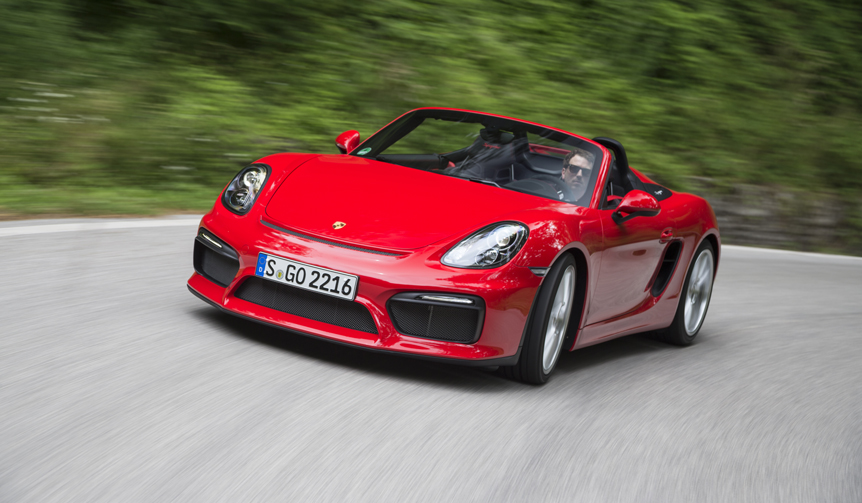
Yasuhiko Kawamura test drives the "Boxster Spyder," a more sport-oriented version based on the Porsche "Boxster (Type 981)." This article delves into the driving experience of the Boxster, which has undergone thorough weight reduction and features a more powerful engine, exploring its appeal.
Text by YASUHIKO KAWAMURA
A Model Change After Five and a Half Years
The Open State is its True Form—Based on this philosophy, it first adopts a new design for the soft top, prioritizing lightweight construction by omitting the power-opening mechanism. Furthermore, it achieves thorough weight reduction by making the rear window out of resin and reducing sound insulation, while equipping this "lightest in the series" body with a more powerful engine.
Additionally, dedicated tuning of the suspension and other components further refines it into the most sport-oriented model.—This is the fundamental approach to car manufacturing for the newest current Boxster, which Porsche itself describes as "standing at the pinnacle of the series."Boxster SpyderThis is the fundamental approach to car manufacturing for the newest current Boxster, which Porsche itself describes as "standing at the pinnacle of the series."
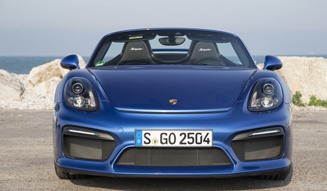
This is actually the second generation of the Boxster to bear this grade name.Previous model debuted at the end of 2009Therefore, this new model, which had its world premiere this spring, is a "Spyder that underwent a model change after five and a half years."
Indeed, the appearance of this new Spyder is sportier and more dynamic than the original Boxster.
The combination of a specially designed soft top, with its ends pulled back towards the rear, and a large aluminum lid with two bulges covering the engine and rear trunk area is now a "Spyder-exclusive icon," inheriting the characteristics of the previous model.
At the same time, the large openings in the front air dam and the air outlets at the front of the hood, sharing a design with the "Cayman GT4" which debuted earlier, also express a powerful presence unique to this hotter version, setting it apart from the original model.
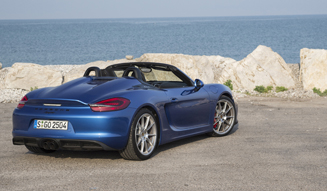
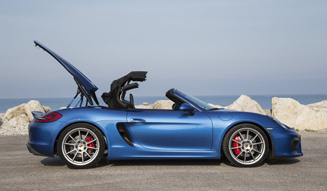
Reflecting the focus on weight reduction, the rear spoiler, which is fixed rather than the power-retractable type found on the base model, is small but slightly raised, forming a "ducktail" shape. The担当 engineer explained this as a "refinement to balance the increased downforce generated at the front."
While the "benefit" of this may be non-existent in Japan, the change in the recommended speed for closing the roof from "up to 200 km/h" to "no limit up to the maximum speed of 290 km/h" suggests an improvement in aerodynamic performance along with structural evolution.
Porsche Boxster Spyder
Test Drive: The New Boxster Spyder (2)
Speed on Par with Super Sports Cars
The source of the aforementioned "more powerful engine" is the 3.8-liter unit from the "911 Carrera S," which was also seen in the Cayman GT4. Replacing the 3.4-liter unit from the "GTS" grade, previously the most powerful in the Boxster series, this engine naturally results in a significant increase in power and torque.
Perhaps due to subtle positioning within the mid-engine range, its specifications are 10 PS lower in maximum output than the Cayman GT4's. Nevertheless, compared to the GTS, the maximum output is increased by 45 PS, and the maximum torque of 420 Nm is boosted by a substantial 50 Nm. As a result, the power-to-weight ratio is a mere 3.5 kg/ps.
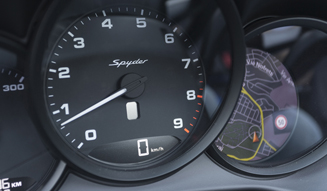
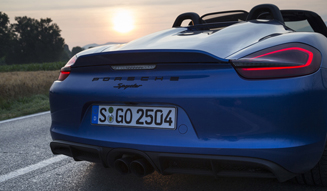
The transmission is limited to a 6-speed manual, similar to the Cayman GT4, which might be a significant point that "chooses its driver" in the Japanese market. Even so, with 0-100 km/h acceleration in 4.5 seconds, this is undeniably a car with speed on par with super sports cars.
In reality, the performance is undeniably "beyond reproach." Even if you neglect frequent shifting in city driving and the engine speed drops lower than expected, the "large displacement" compensates, and the strong torque quickly restores speed.
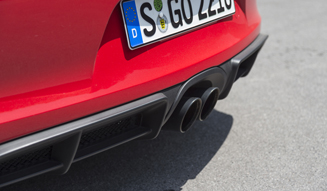
On the other hand, when the engine speed rises, you are impressed by the sharpness and power of a true "sports heart." Interestingly, although the exhaust system layout is the same as the Cayman GT4, the "exhaust note in Sport Plus mode, which is a dedicated sound that includes a flashy afterfire-like popping sound when the accelerator is released," is unique because "the sound was specially tuned for this model, as it is an open-top car where sound is emphasized more than in the Cayman GT4."
Porsche Boxster Spyder
Test Drive: The New Boxster Spyder (3)
A Gift from the 911 Carrera S
To cope with the significantly enhanced engine output and aim for a more stoic open-top sports car, the suspension deliberately omits the electronically controlled variable damping system "PASM," which is now standard on many recent Porsches. At low speeds, particularly around 60 km/h, the suspension feels quite firm.
However, at higher speeds, the flatness definitely increases. Moreover, the Boxster's body possesses an unparalleled rigidity for an open-top model, so input vibrations are immediately dampened, resulting in a remarkably dry feel. Sport-oriented drivers who choose this type of car are unlikely to ever complain that it is "too stiff."
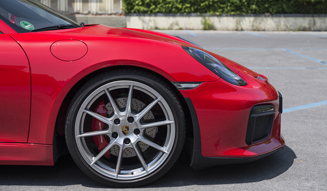
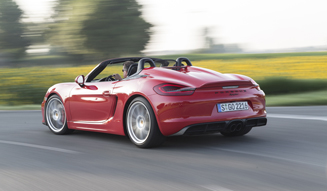
Incidentally, the suspension settings are described as "an arrangement based on the GTS specifications, considering differences in tire sizes." While the tire sizes are the same for the GTS and Spyder, both models are equipped with 20-inch wheels, with a one-size-larger rim width front and rear.
In addition to this sporty suspension, the adoption of a variable-ratio steering system, described as "based on the 911 Turbo's," which enables "quick movements" around the neutral position, results in overall handling that is agile and low-slung, typical of a mid-engine car, with an impressive "lack of excessive body movement."
Like other grades, the highly effective ceramic composite brakes "PCCB" are available as an option, but the model tested this time was the standard specification.
However, the remarkably strong braking feel and the rigid pedal touch experienced were not "imagination." The Boxster Spyder's brake system, including its calipers and rotors, is also a "gift from the 911 Carrera S."
Porsche Boxster Spyder
Test Drive: The New Boxster Spyder (4)
The Most "Boxster-like" Boxster
The Most Spartan and Sporty—This Spyder is a Boxster that is fittingly described with such phrases. Given that "Porsche" is a pure sports car brand, many people would likely perceive this as the "most 'Boxster-like' Boxster."
On the other hand, it's also noteworthy that it is "not as circuit-focused" as the Cayman GT4, with which it shares components like the 3.8-liter engine.
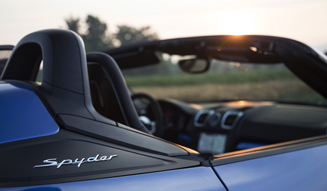
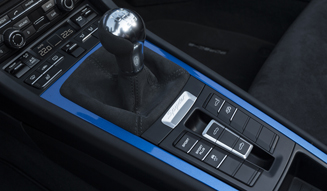
While weight reduction has been pursued, it has not been so extreme as to significantly compromise comfort. Air conditioning is not standard but can be fitted free of charge upon request. Furthermore, the soft top, which was difficult to operate in the previous model due to its partially detachable and retractable structure, has undergone a "complete model change" in the new version, making its operation remarkably easy.
In other words, even when directly compared to the original model, this Spyder allows you to enjoy more stoic and powerful open-air motoring without significant compromises or inconveniences. It is true that this is the only Boxster that exceeds the 10 million yen mark within the series.
However, considering that the "911 Carrera S Cabriolet," which shares the same "basic" 3.8-liter engine, costs over 18 million yen, many people will likely agree that this car offers content that can reasonably be described as a "good value."

Porsche Boxster Spyder
Body Dimensions | Length 4,414 x Width 1,801 x Height 1,262 mm
Wheelbase | 2,475 mm
Engine | 3,799 cc Horizontally opposed 6-cylinder Direct Injection DOHC
Maximum Output | 276 kW (375 PS) / 6,700 rpm
Maximum Torque | 420 Nm / 4,750 - 6,000 rpm
Compression Ratio | 12.5
Transmission | 6-speed Manual
Drivetrain | MR
0-100 km/h Acceleration | 4.5 seconds
Maximum Speed | 290 km/h
Fuel Consumption (NEDC) | 9.9 L/100km (approx. 10.1km/L)
Steering Position | Left / Right
Price | 10,120,000 yen
Contact
Porsche Customer Care Center
0120-846-911