July 10, 2015
Test Drive: Ford Mustang 50 Years Edition | Ford
Ford Mustang 50 Years Edition
The 6th Generation Model, Forging a New History
Test Drive: Ford Mustang 50 Years Edition
To commemorate 50 years since its birth, Ford Japan launched the "50 Years Edition" in April. It sold out its planned 350 units in just under a month, necessitating an additional import of 200 units due to overwhelming popularity. The 6th generation model, redesigned with the debut 1964 original as a motif, reinterprets the classic with a modern flair. Its transformed exterior is striking, and the powertrain and chassis have been completely revamped. Kenichi Sakurai test drives Ford's uniquely evolved FR sports car.
Text by SAKURAI KenichiPhotographs by TSUKAHARA Takaaki
A Bespoke Design for the Mustang
When the first "Mustang" debuted in 1964, it was a so-called "specialty car," stylishly finished using Ford's existing chassis and powertrains, and adopting a two-door coupe body.
The Ford "Falcon" served as its base. Consequently, the Mustang was launched at a relatively low price while maintaining its stylishness, becoming a massive hit, especially among young people, and a driving force in its category. Its success spawned followers like the Chevrolet "Camaro" and Pontiac "Firebird (Trans Am)," igniting a worldwide boom in two-door coupes.
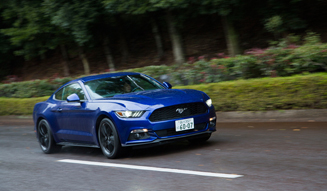
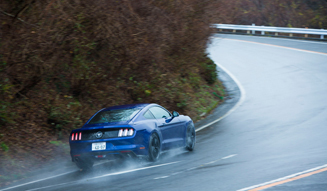
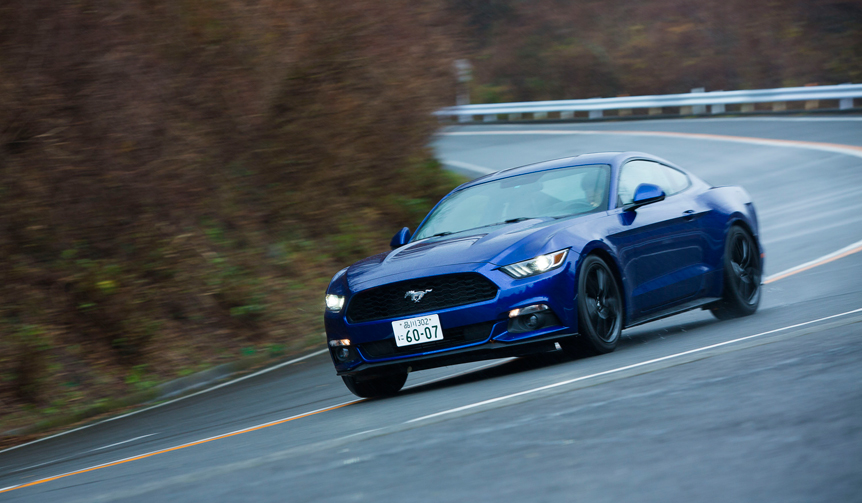
Fifty years later, in 2014.Celebrating 50 Years Since Its DebutThe Mustang evolved into the 6th generation, featuring a more stylish body, the latest powertrains, and a dedicated chassis. While Ford's other passenger car lineups have shifted to front-wheel drive, the Mustang remains rear-wheel drive. Unlike its debut, the chassis is now exclusive to the Mustang, signifying an evolution so distinct that calling it merely a "specialty car" feels inadequate.
In the 2000s, citing changes in fuel economy and lifestyles, American brands and Japanese rivals in the two-door specialty car segment were forced to cease production. Amidst this, the Mustang fought on alone, continuing its legacy without a single production halt to this day. Its rivals, the Chevrolet "Camaro," ceased production in 2002, and the Dodge "Challenger" even earlier in 1983, having long withdrawn from this market.
The model immediately preceding the current one, which we are all familiar with,The 5th Generation Modelwas, as you know, a huge hit in the North American market and was produced for a long period from 2005 to 2014. Spurred by this, Chrysler revived the Challenger in 2008, and Chevrolet brought back the Camaro in 2009. Although the Camaro had a prominent role in the movie "Transformers," its return after ceasing production in 2002 took seven years.
It is, in fact, quite recent that these three traditional "Pony Cars" have once again appeared together.

Ford Mustang 50 Years Edition
The 6th Generation Model, Forging a New History
Test Drive: Ford Mustang 50 Years Edition (2)
Inspired by the Original Model
Setting aside the circumstances of its rivals, the Mustang, an icon of American sporty cars with fans worldwide, began official import to Japan in 1994 (by Ford Sales Japan at the time). 2014 also marked the 20th anniversary of the Mustang's import to Japan. With cumulative sales exceeding 17,000 units in Japan, this is one reason why the Mustang is synonymous with American sports cars.
Now, regarding the evolved 6th generation model, its dimensions are: length 4,790mm, width 1,920mm, and height 1,380mm. Compared to the previous model, it is 25mm shorter, 35mm lower, and 40mm wider. The wheelbase remains the same at 2,720mm as the 5th generation model. Consequently, the car visually emphasizes a wider and lower stance.
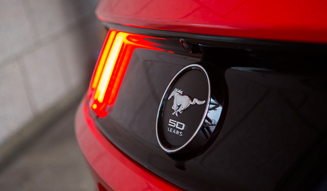
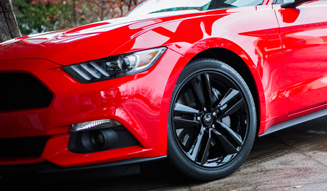
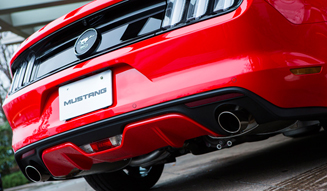
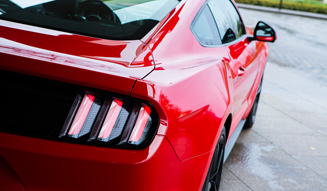
As mentioned earlier, the distinctive exterior design is inspired by the original model. The reverse-slanting "shark nose" front face, the trapezoidal grille within it, and the three-part taillight design are elements that make the Mustang unmistakably a Mustang. While incorporating these traditional design cues, the updated form is instantly recognizable as a Mustang.
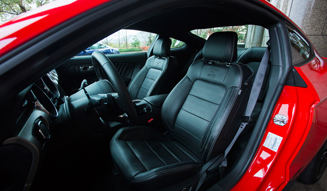
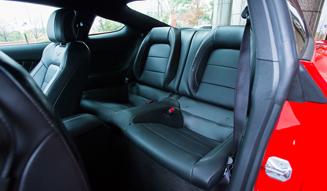
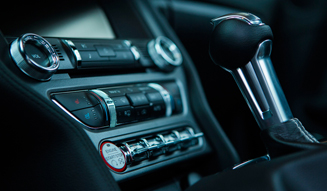
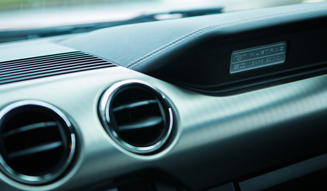
The interior also adheres to Mustang tradition, featuring a horizontally oriented, symmetrical dashboard. The dashboard, with its "twin eyebrow" design reminiscent of small visors, echoes a design element found in the original 1964 model. However, its quality has been significantly upgraded. The slightly tight design that emphasizes its sports car nature, the precisely integrated panels and switches, and the feel of the steering wheel and shift knob are more refined than ever.
Furthermore, the "50 Years Edition" models initially introduced to Japan with left-hand drive are equipped with heated and cooled front seats. They also feature the latest driver connectivity technology, "MyFord Touch," which allows for intuitive operation via an 8-inch touchscreen or voice commands (in English) for various in-car functions like climate control, audio, hands-free calling, and vehicle settings, similar to smartphone usage.
The automatic climate control offers dual-zone temperature adjustment, providing the comfort expected of a modern sports car.
Ford Mustang 50 Years Edition
The 6th Generation Model, Forging a New History
Test Drive: Ford Mustang 50 Years Edition (3)
Multi-link Suspension Adopted for the First Time
However, the chassis and powertrain have evolved even more significantly than the interior and exterior. Tracing the lineage of the previous model's chassis leads back to the 3rd generation model, which adopted the FOX frame in 1979. Its early iteration, featuring a rigid rear suspension—rarely seen in passenger cars today—while sounding like a traditional FR sports car, had a somewhat harsh ride and required considerable skill to control, let alone recover from, rear-end slides.
Nevertheless, this chassis, used for many years, was perfected in the 5th generation model. Its straight-line stability and FR-like handling and behavior captivated fans. The combination with the V8 engine reached a state of completion, and the electric power steering adopted in later models was so widely accepted that no one complained about the electric assist; most people wouldn't even realize it was electric unless told.
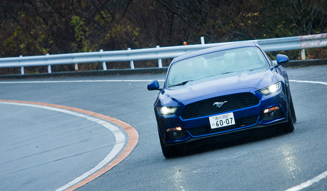
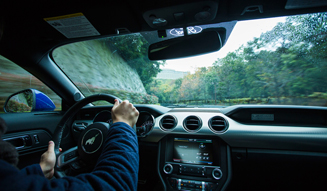
Indeed, the ride quality provided by the refined chassis earned a solid reputation, leading to the Mustang being known in North America as "the drift machine, the drift machine is the Mustang." Its frequent appearance in tuner-focused movies is also due to this driving potential. Beyond just looking cool, its abundant tuning parts and the ability for professionals to perform spectacular maneuvers made the Mustang a popular choice. This indicates the high level of perfection achieved by the 5th generation.
The 6th generation model marks the first time in Mustang history that a multi-link rear suspension has been adopted. Before the test drive, I had two major concerns, knowing the strengths of the 5th generation, and this was one of them. However, the fear of losing the Mustang's characteristic feel due to the introduction of multi-link suspension proved unfounded. The car's behavior is very predictable, and road information is transmitted more directly to the driver through the steering.
While it might be an oversimplification to call it beginner-friendly, the biggest difference is its behavior in high-speed corners. Rear grip has significantly improved, and on winding roads, there are almost no instances where the rear begins to slide. The rear holds its line so tenaciously, ensuring body stability, making it set up for anyone to drive easily.
Ford Mustang 50 Years Edition
The 6th Generation Model, Forging a New History
Test Drive: Ford Mustang 50 Years Edition (4)
The Performance of the Inline-4 Turbo
The high-performance Pirelli "P Zero" tires fitted to the 50 Years Edition undoubtedly play a significant role in this. In short, they offer excellent grip and are easy to control. Anyone driving it should rediscover the joy of handling a powerful rear-wheel-drive car. The chassis has considerable potential, but conversely, it's no longer as easy to initiate rear slides with a tap of the accelerator for aggressive driving. To achieve that, one must reach considerably higher speeds.
While discussing powerful rear-wheel-drive cars, the initial models introduced to Japan in the 6th generation do not feature the familiar V8 engine. This was the other major concern. The newly installed engine is a downsized 2.3-liter inline-4 DOHC direct-injection turbocharged unit, the "2.3-liter EcoBoost." Its output of 231kW (314ps) at 5500rpm and 434Nm (44.3kgm) of torque at 3000rpm actually surpasses the previous 3.7-liter V6's 223.6kW (304ps).
Some might question an inline-4 turbo engine in a Mustang. I was among them. However, looking back at history, the 3rd generation model, which debuted in 1979, already featured a 2.3-liter inline-4 turbo engine as Ford's first turbo. Much like the exterior design, the adoption of the 2.3-liter EcoBoost power unit is an homage to the past.
The 2.3-liter EcoBoost generates ample torque from low RPMs. There's no perceptible turbo lag or abrupt power delivery as one might expect. Without being told, much like the electric power steering, it offers a light, rev-happy feel, making one think it's a naturally aspirated engine. The tuning here is exceptionally well done. The immediate torque response to a pressed accelerator and the seamless acceleration feel are unlike any turbo engine. While I was initially skeptical about whether a mere 2.3-liter displacement was fitting for a Mustang, this performance leaves no room for complaint, including from myself.
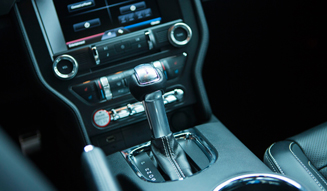
Using the 6-speed automatic transmission with paddle shifters—a first for the Mustang—I downshifted. The lighter nose, thanks to the inline-4 engine, responds linearly to steering inputs. With a satisfying heft, the nose tucks in sharply, a solid response that seems to be a positive inheritance from previous Mustangs. From there, pressing the accelerator sends power to the rear wheels, allowing for a dynamic and exhilarating drive, often described as "accelerating through the turn."
Ford Mustang 50 Years Edition
The 6th Generation Model, Forging a New History
Test Drive: Ford Mustang 50 Years Edition (5)
Right-Hand Drive Models Available
The assessment of "American cars being only straight-line specialists for highways" unfortunately does not apply to the Mustang. It lacks the simple image of an American muscle car, and I would introduce the Mustang as a handling car, without fear of misinterpretation.
A solid body and chassis, grippy tires and suspension, and an engine that responds linearly to the accelerator—it possesses all the elements of a sports car. If there's any negative to mention, it's perhaps only the somewhat large body size for enjoying winding roads. Of course, if one can accept this size, it poses no problem.
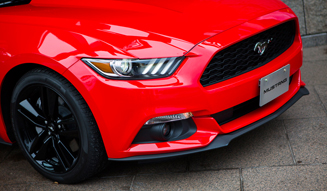
The "50 Years Edition" comes standard with a performance package, featuring suspension tuned for winding roads, larger brake rotors and calipers, and an AdvanceTrac (stability control) program optimized for sporty driving.
It also includes a "drift compensation function" that supports steering adjustments against strong crosswinds or road undulations by monitoring road surface irregularities and changes in direction. The electric power steering features an "active nibble control function" that detects and seamlessly cancels out minor steering wheel vibrations. These advanced electronic devices subtly support the driver without them even realizing it.
The initial launch of the 6th generation in Japan is limited to the left-hand drive 50 Years Edition. Although initially planned as a limited run of 350 units, it sold out in less than a month, leading to an additional import of 200 units. Following this, convertible models and the V8 unit, boasting its customary overwhelming power of 223.6kW (441ps), will be introduced to Japan. At that time, both the 2.3-liter EcoBoost and the V8 will be available in right-hand drive configurations. This marks the first time in Mustang history that a right-hand drive model will be offered.
The development of right-hand drive models for markets like Japan and other left-hand traffic regions is part of Ford's "One Ford" strategy. Indeed, the Mustang, previously a North American exclusive, is now making a significant shift towards becoming a global model, much like the "Fiesta" and "Focus", and "Kuga" (known as Escape in North America)."
If you wish to enjoy the original left-hand drive model, in true American muscle car fashion, now is your chance. However, in that case, the powertrain is limited to the 2.3-liter inline-4 EcoBoost. The new 6th generation Mustang will not offer the popular combination of V8 and left-hand drive that everyone previously took for granted.
Will you choose the original left-hand drive model, or wait for the V8? It's a difficult choice for fans, but I will add just one final remark: the 2.3-liter EcoBoost delivers performance beyond expectations and provides a driving experience that feels perfectly natural even in a sports car like the Mustang.
Ford Mustang 50 Years Edition
Ford Mustang 50 Years Edition
Body Size | Length 4,790 x Width 1,920 x Height 1,380 mm
Wheelbase | 2,720 mm
Tread Front/Rear | 1,580 / 1,645 mm
Weight | 1,660 kg
Engine | Inline-4 Direct Injection Turbo
Total Displacement | 2,260 cc
Bore x Stroke | 87.5 x 94.0 mm
Max. Output | 231kW (314 ps) / 5,500 rpm
Max. Torque | 434Nm (44.3 kgm) / 3,000 rpm
Transmission | 6-speed AT
Drivetrain | FR
Suspension Front/Rear | MacPherson Strut / Multi-link
Brakes Front/Rear | Ventilated Disc
Tires Front/Rear | 255/40 ZR19
Price | 4,650,000 yen
Ford Customer Service
0120-125-175