Mercedes-Benz E 63 AMG: The True Value of a Downsized Sports Sedan
Mercedes-Benz E 63 AMG
The True Value of an AMG Sports Sedan with a New Heart (1)
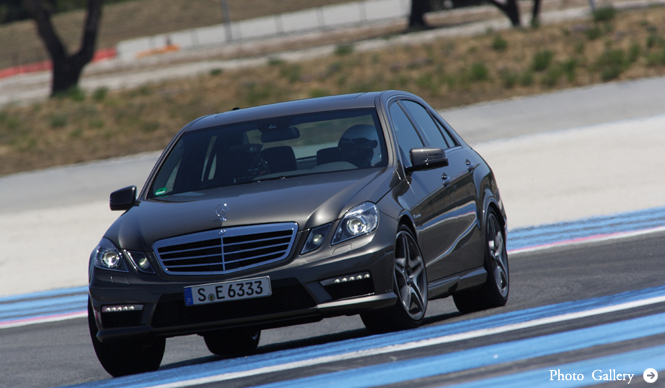
Mercedes-Benzhas changed the engine in the E 63 AMG. The 6.2-liter engine, which gave the model its name, has been discontinued, and the displacement has been reduced to 5.5 liters. By mounting two turbochargers, they have achieved both increased power and improved environmental performance. Are there any downsides to this minor change that relies on forced induction? Automotive journalist Yasuhiko Kawamura test drove the sedan model in Paul Ricard, Southern France, to ascertain its true value.
By Yasuhiko Kawamura
Equipped with a Completely New 5.5-liter V8 Engine
BMW M5andPorsche Panamera Turboor Jaguar XFR are considered direct rivals to Mercedes-Benz's super sports sedan & station wagon, the 'E 63 AMG,' which has undergone a model change. "But wasn't the E 63 AMG updated not too long ago...?" This is a very sharp observation.
Following the full model change of the base E-Class sedan from the 'W211' to the 'W212' generation, the E 63 AMG also saw a generational shift at the end of August 2009 in Japan. The station wagon version, which debuted later, only arrived in Japan in February of last year.
At this point, even those who haven't purchased the model might feel uneasy. "Surely, a model change at this timing is impossible!?"
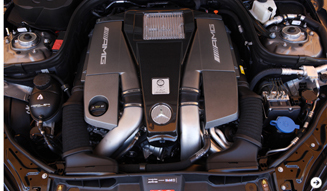
To put it simply, this model change primarily involves "an engine swap." The E 63 AMG has replaced its previous naturally aspirated engine, exceeding 6 liters and giving the model its name, with a completely new 5.5-liter engine that, while retaining the V8 design that is in a sense the "soul" of the AMG brand, now benefits from the assistance of two turbochargers. This is the story behind the engine replacement.
Mercedes-Benz E 63 AMG
The True Value of an AMG Sports Sedan with a New Heart (2)
CO2 Emissions Down 22% to 230g/km!
It sounds like a convincing story: "Ah, they changed the old engine for the latest unit." However, for those in the know, another question might arise. That's because the previous naturally aspirated engine was developed in 2006, which is not particularly "old." In fact, considering that engines are typically used for a decade or more with modifications, this naturally aspirated engine could even be described as "still young."
The reason for replacing such an engine, developing a completely new successor unit,—is likely due to the increasingly strict regulations on CO2 emissions in Europe, which come with penalties.
CO2 Emissions = Prestige?
The EU regulation states that if the average CO2 emissions for the entire brand do not meet the target, a penalty must be paid, calculated by multiplying the excess amount by the number of vehicles. While the previous naturally aspirated engine, which was AMG's first 100% original development, was highly praised for its performance, including its high revving nature and thrilling sound, its high CO2 emissions – indicative of poor fuel economy – were deemed unsuitable for the times.
Measured under the European "NEDC" testing cycle, CO2 emissions are 22% lower than the previous model.—This is what the catalog claims for the new E 63 AMG. Comparing this specific figure of 230g/km for the sedan with other models equipped with similar 500ps engines, the M5 emits 344g/km, the XFR 292g/km, and even the latest Panamera Turbo 270g/km. The new E 63 AMG's figure is indeed outstanding.
Incidentally, the next M5, which has announced a switch from its V10 engine to a new turbocharged V8, will achieve 232g/km, a significant reduction. European high-performance models now clearly promote low CO2 emissions and good fuel economy as one of the indicators of prestige.
Mercedes-Benz E 63 AMG
The True Value of an AMG Sports Sedan with a New Heart (3)
Performance Package Enhances Potential Even Further
Even so, if the driving performance were to decrease in exchange for these improvements, it would be a case of "losing the forest for the trees." In reality, the new E 63 AMG maintains the same maximum output as the previous model while boasting over 10% more peak torque. Furthermore, the optional "Performance Package," which increases the maximum boost pressure by 30% to 1.3 bar, reportedly adds over 30 hp and an additional 100 Nm (!) of torque. The car tested on the circuit of Paul Ricard in Southern France, which once hosted the F1 Grand Prix, and its surrounding roads, was the sedan model equipped with this "Performance Package."
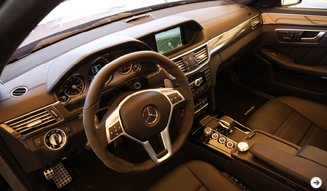
As we began to drive slowly, the first thing that provided "reassurance" was the natural feel of the power steering (EPS), which has been made fully electric for improved efficiency along with the engine change, similar to the conventional hydraulic system.
While many current models using similar systems exhibit an artificial feel with a lack of road contact, this model's EPS achieves a natural operating feel that "you wouldn't notice unless told."
At the same time, we confirmed that the new "AMG Speedshift MCT" transmission, adopted along with the new engine, operates as smoothly as a conventional torque converter automatic even at very low speeds. This unit, which uses a multi-plate wet clutch instead of a torque converter for the start clutch, also boasts higher efficiency. In this way, the new model is tackling CO2 reduction not just with the engine alone, but with a "total effort."
Mercedes-Benz E 63 AMG
The True Value of an AMG Sports Sedan with a New Heart (4)
Engine Sound That Conveys "Liveliness"
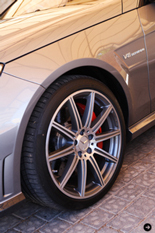
Despite riding on 19-inch wheels, one inch larger than the standard specification, the new E 63 AMG offered a surprisingly supple ride in urban driving. However, this gentleness is cast aside when you press the accelerator pedal deeply after having treated it with restraint.
Beyond the absolute acceleration, which is described as "pressing you back into the seat" and surpasses the previous model, what truly "resonates" with the sports driver's heart is the sound. The roar that shakes the surrounding air, "Bari bari bari," is a "liveliness" that makes you forget it's equipped with a turbocharger, a device that recovers exhaust gas energy. Such a sound, undoubtedly the result of painstaking tuning, evokes the historical background of the AMG brand, which has always walked hand-in-hand with V8 engines.
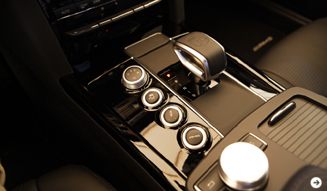
As with the previous model, the shift mode of the AT can be changed using a dial next to the newly designed shift selector. Although there is a slight delay compared to paddle shifters, when "M" mode is selected, the driver is in control of the 7-speed transmission's shifts, and upshifts and downshifts generally do not occur automatically.
While enjoying such shifting, when driving at racing speeds on a full-fledged circuit where speeds can exceed 200 km/h, understeer does appear in certain situations. Even in such circumstances, the intimate road feel and consistently stable setup allow you to drive at a pace "unbecoming of a sedan" with confidence, which is noteworthy.
Nevertheless, it is astonishing that such tremendous speed performance and the gentleness shown in urban driving are both present in a single model.
With its diverse talents and even its obsession with improving fuel economy, the new E 63 AMG is a model that presents a truly "super" finish.