PEUGEOT 508 | Test Drive of the New Sedan / SW
PEUGEOT 508
A New Flagship Showcasing the Mastery of a Time-Honored Brand (1)
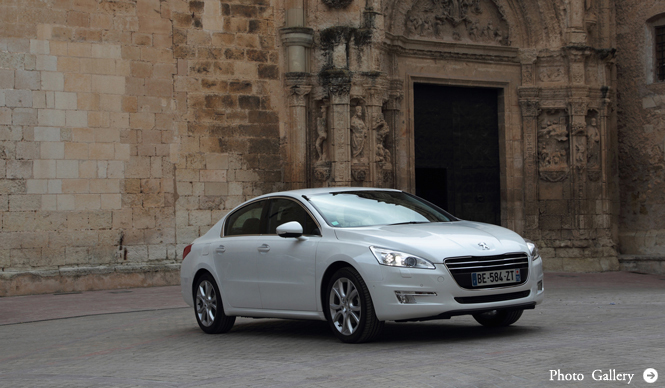
Peugeot has launched the "508," the successor to the "407." Unlike recent Peugeot models, its new face features less aggressive, almond-shaped headlights. However, with its revised suspension, a spacious and practical luggage compartment, and a comfortable ride, it's a car that reveals the craftsmanship of a time-honored brand, subtly woven with a sense of premium quality, rather than ostentatious decoration.
By Masayuki MoriguchiPhotos by Peugeot Citroën Japon
A Face Inspired by the SR1 Concept
Unveiled at last autumn's Paris Motor Show, the Peugeot 508 is the successor to the 407. The last time the first digit of a three-digit model number changed from 4 to 5 was with the transition from the 404 to the 504 in the 1960s. However, in this case, the prior existence of a model named 408 likely influenced the decision to use the number 508.
In essence, Peugeot is offering two models in the D-segment. The 408, built on the 308's platform 2, is aimed at emerging markets, while the 508, using the same platform 3 as the 407, is intended for developed markets.
This likely reflects the growing demand in emerging markets. China, in particular, will be the only market where both the 408 and 508 are sold, underscoring the depth of that market.
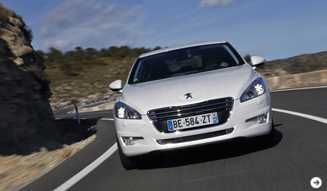
The 508's changes extend beyond its name to its design. Upon seeing the car for the first time at its international launch in Alicante, Spain, the difference in its face was immediately apparent. Compared to the traditional Peugeot face found on the 407 and 408, the 508's headlights are less angled, the grille is more angular, and the trim around the emblem has been removed.
A year ago, Peugeot unveiled theSR1 hybrid sports concept carto commemorate its 200th anniversary. At that time, it was revealed that the SR1 would showcase the next generation of Peugeot design. The 508 is the first production car to adopt this new face.
The side profile also differs from the 407. The 508 is longer than the 407 by 101mm (sedan) / 48mm (SW) and has a 92mm longer wheelbase. However, the front overhang is 43mm shorter. Compared to the 407's dynamic, coupe-like stance, the 508 exudes a sense of calm. It appears to recapture the spirit of Peugeot's mid-size models of the past, such as the 406, 405, and 505. The rear combination lamps on the sedan, with their diagonal lines, likely draw inspiration from the 504 coupe. The styling evokes a sense of returning to its roots.
Discontinuation of V6 Engines Due to Downsizing
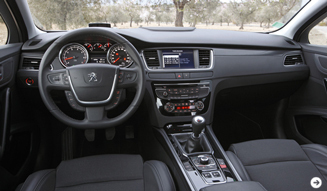
The cramped rear seats were one of the few drawbacks of the 407, but the 508, aided by its extended wheelbase, now offers space appropriate for its class. While the front seats felt firm, thanks to the excellent suspension, which will be discussed later, I experienced no dissatisfaction even after driving for two to three hours.
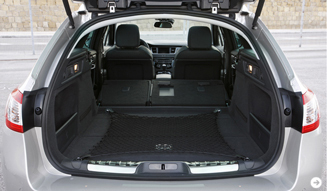
The improved quality is also noticeable. Perhaps the pursuit of premium feel was made possible by the existence of the more practicality-focused 408. The level of amenities is high, with features like a four-zone automatic climate control. Naturally, the luggage capacity has also increased; the sedan's trunk volume grows from 407 to 545 liters, and with the rear seats folded down in the SW, it offers a cavernous 1,865 liters of space.
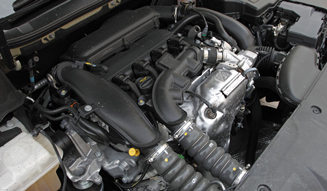
The engine lineup available in Europe includes gasoline options of a naturally aspirated 1.6-liter and a turbocharged 1.6-liter, and HDi (turbodiesel) engines in 1.6, 2.0, and 2.2-liter displacements. All are four-cylinder units, and the V6 engines, previously offered in both gasoline and diesel for the 407, have been discontinued. This is downsizing. The model to be introduced in Japan this June will be theRCZand3008, paired with a six-speed automatic transmission.
PEUGEOT 508
A New Flagship Showcasing the Mastery of a Time-Honored Brand (2)
Suspension Tuning That Delivers Driving Pleasure
During the test drive event, I experienced the 1.6-liter turbo paired with a six-speed manual transmission. This engine, capable of propelling the similarly sized Citroën C5 with ease, provided ample acceleration on highways and winding mountain roads. Its characteristic of delivering smooth torque from low revs, as low as 2,000 rpm, is unusual for a turbo and contributes to its ease of handling.
A point of concern was the revision of the suspension format to match the engine downsizing. While the rear multi-link suspension remains the same as the 407's, the front suspension has been replaced with MacPherson struts, except for the GT grade equipped with the 2.2-liter HDi, which retains its double wishbones.
As a result, the front suspension alone achieved a weight reduction of 12kg, and despite the larger body, the sedan is reportedly 25kg lighter, and the SW 45kg lighter. Given that this change could be seen as a downgrade in terms of suspension type, I harbored some reservations before driving. However, as I left the streets of Alicante and navigated the highways towards the mountain roads, my concerns transformed into pure delight.
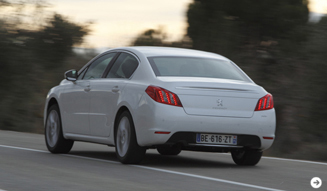
A Ride Quality That Can Only Be Described as Exhilarating
The handling is so agile that you forget the car's size. The electro-hydraulic power steering, with its pleasingly smooth feedback, guides the car precisely as the slightly shortened nose tucks into the corner. Furthermore, even with the adoption of struts, the traditional 'cat's feet' suspension remains. The road holding is surprisingly high; corners that I thought might be taken too fast were navigated with ease.
The ride comfort is also excellent. Even at city speeds, the suspension effectively absorbs shocks with ample travel, and as the speed increases, the car achieves a greater sense of flatness. The weight of the body and the extended wheelbase work in its favor, providing a far more composed ride than the 207 or 308, with significantly less vertical movement. It was a driving experience so pleasant that the word 'exhilarating' comes to mind.
During the test drive, I also drove a model equipped with the HDi engine. While the 2.2-liter version, designated GT, offered superior straight-line acceleration, the gasoline variant felt more nimble due to its lighter engine.
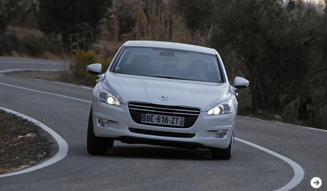
Including the 2.0-liter, these engines, with their strong torque, seem well-suited for long-distance touring. I only drove the 1.6-liter version with e-HDi (an idling stop system) in the city, but its response during stop-and-go traffic was satisfactory.
It's not always about flashy designs or complex mechanics to create a great car. The 508 has taught me this lesson from Peugeot. The time-honored brand's ability to achieve superior ride quality using a simple engine and chassis reaffirms its status as a marque worthy of deep respect.