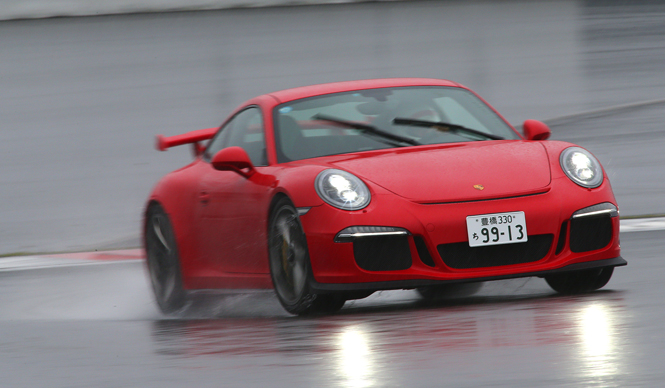
Testing the latest 911 GT3 on a wet Fuji Speedway | Porsche
Porsche 911 GT3 | Porsche 911 GT3
Testing the Latest 911 GT3 on a Rainy Fuji Speedway
Developed for owners who want to enjoy motorsport, the Porsche 911 GT3 is a special model within the 911 family, inheriting racing technology honed on the circuit. Jun Nishikawa tested this high-performance, rear-engine, rear-wheel-drive model with 475 horsepower and a 0-100 km/h acceleration of 3.5 seconds, on a rainy Fuji Speedway.
Text by NISHIKAWA JunPhotographs by NAITO Takahito
Discovering True Limits in Wet Conditions
If this isn't a "perk of the job," what is?
To drive Porsche's latest model, especially one with strong Rennsport (RS, Racing Sport) lineage, to its limits on a Grand Prix circuit. Without worrying about tire wear or putting excessive stress on the car. As automotive journalists, we are sometimes entrusted with the extraordinary experience that only owners who have invested heavily in high-performance models can normally have.
For me, this is a career born from a lifelong obsession with cars. Rain or shine, no matter how far Fuji Speedway is from my home in Kyoto, if I hear about a chance to drive a Porsche on the circuit, I'll rush there the moment I'm called.
And, as expected, it rained.
Disappointing? No, it's all a matter of perspective.
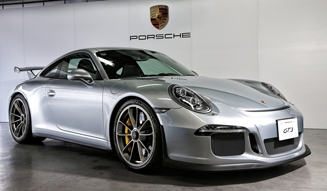
Imagine you've finally acquired Porsche's latest high-performance model, the 911 GT3, and on the day you've eagerly awaited for a track day, it's pouring rain. What would you do?
Most people would give up on driving. They'd cancel the trip to Fuji. Few would be brave enough to rush out, excited by the rain. Therefore, an opportunity to test the latest 911 GT3 on a wet circuit should be seen as a rare chance. Moreover, wet conditions allow you to ascertain the car's true capabilities without pushing it to excessively high, and therefore dangerous, speeds.
I gladly climbed into the 911 GT3 lined up in the pit lane, amidst the rain.
Porsche 911 GT3 | Porsche 911 GT3
Testing the Latest 911 GT3 on a Rainy Fuji Speedway (2)
An Inspiring, Modern Porsche Cockpit
Just recently, the even higher-performance 4-liter GT3 RS was announced. Nevertheless, the 3.8-liter GT3 remains an object of admiration for Porsche fans, 911 enthusiasts, and sports car aficionados worldwide.
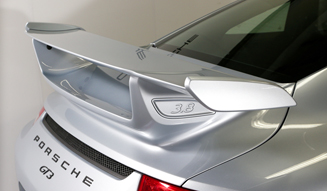
Its aggressive styling, particularly striking among the 911 lineup, captivates the driver from the first glance. The nose hugs the road, incredibly low, while the wide rear section firmly grips the asphalt. And a large rear wing balances the overall design. It's the very image of a racing Porsche.
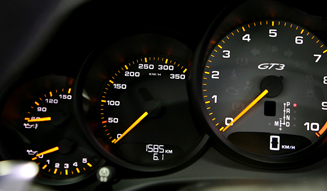
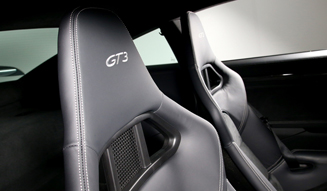
Once inside, it's the familiar, modern Porsche cockpit, yet in my mind, an unspoken "Alright, let's do this!" takes hold. The low driving position, the sporty interior ambiance, and the feel of the steering wheel likely contribute to this.
I'd like to say the specially tuned 3.8-liter flat-six engine roared to life, but when you're settled in the cockpit with the doors and windows closed and start the engine, you don't hear the kind of sound that makes your heart skip a beat. Heard from outside, it's a wild roar, but from inside the cockpit, it's more like a powerful engine sound.
I started rolling out of the pit lane, the tires splashing through the water on the track. The transmission is the 7-speed PDK with paddle shifters on the steering wheel, a notable feature of the new GT3.
This is because, until now, the GT3 was conventionally equipped with a 3-pedal manual gearbox. While this broadened its appeal, it also disappointed some enthusiasts, and considering this aspect is likely part of the test's objective.
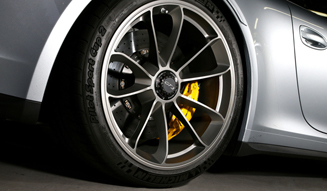
Porsche 911 GT3 | Porsche 911 GT3
Testing the Latest 911 GT3 on a Rainy Fuji Speedway (3)
The Priceless Value of the GT3
First, I drove a slow lap to check the water conditions on the track. There were places where water had formed rivers. If they crossed the track at a right angle, it might be manageable, but they mostly flowed diagonally, making it dangerous. You could spin out even on a straight. Even with the latest electronic controls, this is a very dangerous situation for a high-performance rear-engine, rear-wheel-drive sports car.
Keeping the locations of these "rivers" firmly in mind, I gradually increased the pace from the second lap. What surprised me before I even started pushing was the stability of the rear and the precise, albeit light, response of the front suspension. Gaining confidence from the car's ability to handle the wet conditions with little disadvantage, I pushed the pace further.
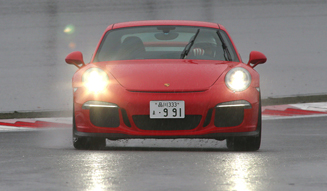
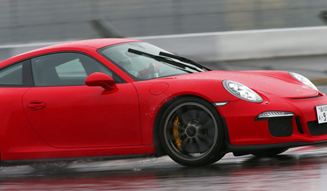
Regardless of whether it was a sharp turn or a high-speed corner, as long as you read the racing line correctly and steer appropriately, the GT3 navigates each difficult section with surprising ease and smoothness. While the electronic systems provide subtle corrections to mask driver errors, potentially hindering skill development, I was able to enjoy a spirited drive on the wet circuit.
I set all the switches at the base of the center shift lever to their sportiest settings to test the performance and feel of the 3.8-liter engine. The way power builds under your right foot in sync with the revs, typical of a naturally aspirated engine, is incredibly satisfying.
From around 4,000 rpm, the power clearly increases, becoming ferocious beyond 5,000 rpm, reaching its peak after 6,000. Yet, there's no sense of power dropping off; instead, the brute force gives way to a continuous forward thrust, pulling you towards the horizon. As the revs climb past 8,000, and just before reaching 9,000 rpm, the engine lets out a primal roar from its core. Then, a lightning-fast upshift.
In that moment, I knew this car was worth over 20 million yen.

Porsche 911 GT3 | Porsche 911 GT3
Body Dimensions | Length 4,545 × Width 1,870 × Height 1,270 mm
Wheelbase | 2,455 mm
Tread Front/Rear | 1,551 / 1,555 mm
Weight | 1,430 kg
Engine | 3,799 cc Flat-six
Bore x Stroke | 102.0 x 77.5 mm
Compression Ratio | 12.9:1
Max. Output | 350 kW (475 ps) / 8,250 rpm
Max. Torque | 440 Nm / 6,250 rpm
Transmission | 7-speed Automatic PDK
Drivetrain | RR
Suspension Front | MacPherson Strut
Suspension Rear | Multi-link
Brakes Front | Ventilated Discs
Brakes Rear | Ventilated Discs
Tires Front/Rear | 245/35 ZR 20 / 305/30 ZR 20
0-100 km/h Acceleration | 3.5 seconds
Max. Speed | 315 km/h
Fuel Consumption (NEDC) | 12.4 L/100km (approx. 8 km/L)
CO2 Emissions | 289 g/km
Trunk Capacity Front/Rear | 125 L / 260 L
Price | ¥19,120,000
Porsche Customer Care Center
0120-846-911
(9:00-18:00, Open Year-Round)