A Celebration of Classic Maseratis: The "Maserati Centennial Gathering" Held | Maserati
The Maserati Centennial Gathering
A Celebration of Classic Maseratis Held in Italy
Maserati at 100: A World of Its Own
Born in Bologna, a city in central Italy, in 1914, the sports car brand "Maserati" celebrates its 100th anniversary this year. To mark this milestone year, our magazine has featured various articles. This is the final installment. Motor journalist Fumio Ogawa reports on the "Maserati Centennial Gathering," a festival of classic Maseratis held in September.
Text & Photographs by OGAWA Fumio
A Gathering of 167 Rare Maseratis
In September 2014, the "Maserati Centennial Gathering," a celebration of classic Maseratis, was held in central Italy. It was a spectacle to see 167 rare Maseratis traverse over 400km of public roads.
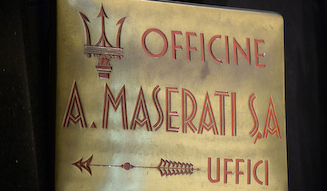
Maserati marks its 100th anniversary in 2014. It began in a workshop in a backstreet of Bologna. Alfieri Maserati started building cars there, with the support of his brothers Ettore and Ernesto.
The emblem, too, is the brothers' creation. It's a well-known story that the trident held by Neptune, the sea god in Bologna's symbol, the Fountain of Neptune, served as the inspiration. Mario, the most artistic of the brothers, designed it to suit the cars.
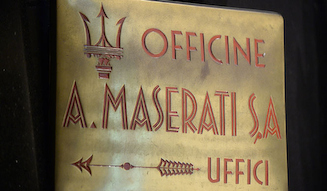
The flat design, unlike typical radiator mascots, was likely because racing car manufacturing was Maserati's true calling. Radiator mascots are unnecessary for racing machines.
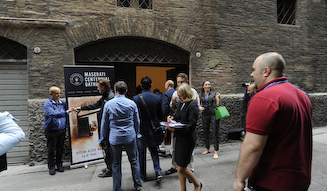
This Centennial (100th anniversary) Gathering started in Bologna, a city of memories for the company, and proceeded through Modena, where the company's headquarters are now located, then Cremona, and finally to Turin. The impressive lineup of rare post-war models was breathtaking.
The Maserati Centennial Gathering
A Celebration of Classic Maseratis Held in Italy
Maserati at 100: A World of Its Own (Part 2)
The Boomerang Concept Car from 1971 Also Roared to Life
"At that time, we were building racing cars at the Bologna factory. When the cars left the factory, all the windows in the neighborhood houses would rattle violently." Carlo Maserati (born 1930), the seventh son, who appeared at the starting point in Bologna for this event, shared his memories of those days.
Racing cars back then had no silencers on their exhaust pipes. Their mother reportedly watched them leave for tests and races with great sorrow. "She only told them to come back safely." Racing was akin to a battlefield.
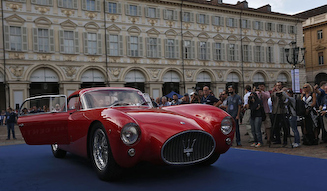
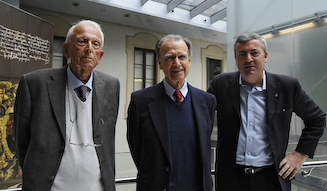
This rally did not include the racing cars that made Maserati's name famous worldwide from the 1930s to the 1950s. However, it featured almost all of the sports cars and GTs they produced from the 1950s onwards.
The most eye-catching were the "A6GCS" from 1953, with bodywork by Pininfarina, and the "Boomerang," a 1971 concept car with a large Trident logo emblazoned on the hood. Both are privately owned. It's easy to imagine the applause they received wherever they went as they sped along the autostrada.
The Maserati Centennial Gathering
A Celebration of Classic Maseratis Held in Italy
Maserati at 100: A World of Its Own (Part 3)
Our Great Heritage
"Maserati has actively organized events worldwide this year," said a Maserati representative in charge of planning the Centennial Gathering.
"Maserati is on an upward trajectory right now. Sales are growing, and brand recognition is increasing in new markets. We exhibited many rare historical models at Pebble Beach in the US, and the Kyoto event (the 100th Anniversary Relay in July 2014) was also a success. With the rising popularity of classic Maseratis, we saw this as a great opportunity to showcase our heritage to the public," they explained regarding the planning of the Centennial Gathering.
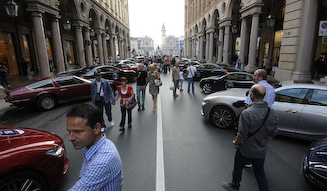
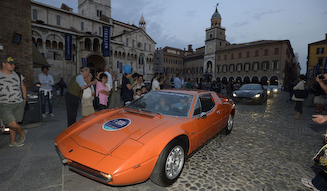
The participating cars were diverse. In addition to the aforementioned A6GCS (1953), models familiar to fans of the supercar era like the "Bora" (1971) and "Merak" (1972), as well as sporty models with wedge-shaped styling such as the "Ghibli" (1967), "Indy" (1969), and "Kamsin" (1974), and even the "3500GT" (1957), "5000GT" (1959), "Quattroporte" (1963), and "Mistral" (same year) were present, making for a covetable lineup.
Participants came from various countries, with many from central Italy, but also plates from Switzerland, France, and the UK were seen. Maserati's appeal is said to lie in its balanced blend of functional beauty and elegance, rather than ostentation. It was impressive to see the owners exuding an aura of genuine car enthusiasts, rather than being flashy.
The Maserati Centennial Gathering
A Celebration of Classic Maseratis Held in Italy
Maserati at 100: A World of Its Own (Part 4)
Maintaining Value Over 100 Years
For the press, models such as the "Quattroporte," "Ghibli," and "GranTurismo" were made available during the event. A total of 29 such cars. The sight of modern Maseratis speeding along, their exhaust notes echoing with a crisp tone, was also a magnificent spectacle.
The distinctive styling, with its low-slung front grille bearing the traditional Trident, conveys both power and elegance. Its strong presence, standing out in the luxury car market often dominated by German manufacturers, is understandable.
Although there should be ample interior space, the cockpit is intentionally designed to be snug, fitting for a GT that emphasizes sportiness. Settling into it stirs the soul. This is the world of Maserati, which has captivated people for 100 years.
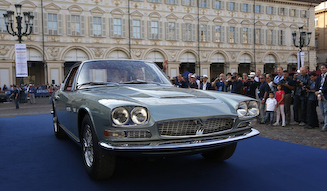
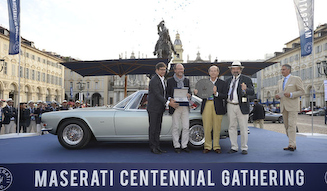
On the third and final day of the Centennial Gathering, a Concours d'Elegance (Concours d'Eleganza in Italian) was held for participating cars in Turin's Piazza San Carlo.
The Grand Prix was awarded to the "Mexico 4200 Prototype (1967)," with bodywork by Pietro Frua, renowned as a top designer in the 1960s.
"The appeal of this car lies in its embodiment of Maserati's strengths: elegance and understatement," said judge Adolfo Orsi. A descendant of the Orsi family, who owned Maserati from 1937 to 1968, he has a deep understanding of classic cars. "Frua's bodywork is truly beautiful. It is also a rare model, and undoubtedly this is the Grand Prix winner."
When one thinks of Maserati, the immediate association is with racing and sports cars, conjuring images of passionate, almost feverish intensity and sensuality.

However, the more one learns, the more one realizes that its charm lies in its elegance and a certain intelligence. Perhaps, without that appeal, it would have been difficult to maintain its value for 100 years.