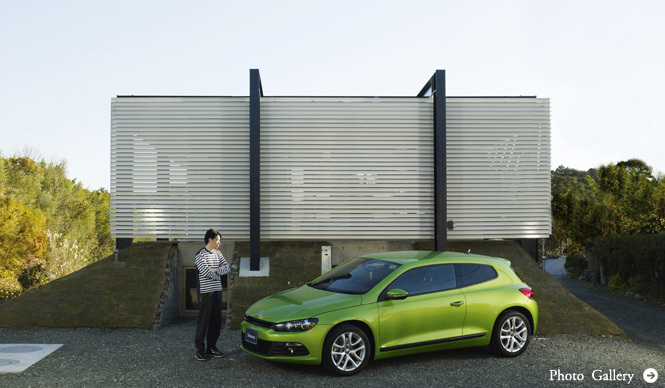
Scirocco | Volkswagen Scirocco: The Car makes Style. Architecture as a creative endeavor, shaping dreams into form.
Volkswagen Scirocco
Scirocco × Architect Makoto Tanijiri
Creative Architecture That Gives Form to Dreams
Architect Makoto Tanijiri is known for his innovative designs, particularly in residential projects. His latest work is a strikingly open single-family home nestled in lush surroundings. The Scirocco and Tanijiri's architecture converge, delivering high quality that seamlessly integrates into daily life.
By Fumio OgawaPhotos by Kenta Yoshizawa
Architectural Yet Dynamic Design
Cars and architecture are inextricably linked. Many architects, from Walter Gropius and Le Corbusier to more recently Renzo Piano, have ventured into car design. A famous French critic even likened cars to Gothic cathedrals. In subculture, too, such as in film, the relationship between cars and buildings has often been depicted.
Exceptional architecture profoundly impacts people and serves as a wellspring of creativity. Volkswagen's personal coupe, the Scirocco, also cultivates a rich inner world for its observers. In this regard, it resonates with great architecture.
In fact, car designers often dislike describing cars as "architectural," perhaps because it implies being rooted to the ground. In Italy, especially, there's a saying that a car must look like it's in motion, even when stationary.
The Scirocco, crafted by Volkswagen's talented designers under an Italian design lead, is a prime example. It possesses a striking beauty even at rest, exuding a muscular tension that suggests imminent motion. It is truly a rare automobile.

Mr. Tanijiri also notes the Scirocco's supple body lines.
His latest project, "House in Hamamatsu," is composed of a semi-basement and a half-story elevation.
The Scirocco's elegance is underpinned by its wheels positioned at the four corners and its taut body surfaces. Its design, reminiscent of the toned physique of an athlete in motion, appeals universally. While a car's performance is often quantified by metrics from top speed to load capacity, the Scirocco consistently reminds us that aesthetic design is also a crucial function.
A key characteristic of the Scirocco is its balanced proportions, as mentioned earlier. It's not just beautiful; its stance, poised to launch forward with its four wheels gripping the ground, is captivating.
From the front grille to the exhaust finishers, every detail is meticulously crafted. Even the lighting elements, both headlamps and rear combination lamps, are seamlessly integrated into the body. Humans intuitively appreciate beauty, and that is the power of the Scirocco's design.
The Finest Design for More People
"People feel far more than they understand; thus they derive knowledge through experience, and in turn understanding," said American architect Frank Lloyd Wright (quoted from 'The Living City: Frank Lloyd Wright and the American Idea' by Olgivanna Lloyd Wright, translated by Rakuro Endo).

This sense of openness is achieved by eliminating corner pillars and supporting the roof with steel beams.
This sentiment seems to apply to the Scirocco's design as well.
Dr. Martin Winterkorn, Chairman of the Board of Management of Volkswagen AG, issued the following statement:
"With the Scirocco, we are bringing the sports car that many have dreamed of into our showrooms. It is a dream sports car, incorporating cutting-edge technology, yet accessible to a very wide range of customers."
Volkswagen has made a reality what ordinary people have always sought in a car without consciously realizing it: beauty, comfort, and driving pleasure. And now, we can enjoy it on the roads of Japan.
Architect Makoto Tanijiri works across a broad spectrum, from private residences to public buildings. His creations are distinctively individual in the best sense, often prompting surprise with their unconventional ideas. Individuality here means faithfully responding to the client's requests.
"I see my role as a filter. My job is to shape the architecture based on the client's vision. When people comment on the diversity of my work, it's simply a result of reflecting the varied ideas of different clients into my buildings."
Volkswagen Scirocco
Scirocco × Architect Makoto Tanijiri
Creative Architecture That Gives Form to Dreams
Modern Aesthetics That Connect with Society
Based in Hiroshima and active nationwide, Makoto Tanijiri's words echo Dr. Martin Winterkorn's description of the Scirocco as "the sports car that many have dreamed of." It is the result of transforming an abstract "dream" into a concrete form through professional expertise.
"The Scirocco has a beautiful design, and its originality is also a major appeal. I believe assertiveness is important when choosing a car. While one could argue for a 'non-assertive' stance, it's preferable for a car's design to allow the driver to express their personal taste. In my own car choices, I prioritize infusing my personal style into the vehicle."

The half-story elevation eliminates the boundary between indoors and outdoors, creating a remarkable sense of openness.
Mr. Tanijiri's unique approach, such as using excavated soil as a screen for buildings, is highly regarded. In an OPENERS interview in 2008, he stated, "We must find solutions where disadvantages become strengths."
His proposal to enhance comfort by reducing, rather than increasing, the number of buildings or floors is also distinctive. Removing a floor creates a space with a high ceiling. This is Mr. Tanijiri's concept of "reduction" rather than "addition" – a truly creative perspective.
When asked about the connection between cars and architecture, Mr. Tanijiri, who admits to liking cars, offered the idea of cars as dwellings. He suggests that if four rooms are needed, one could arrange four cars side-by-side and cover them with a roof.
"When you discard preconceived notions of architecture being expensive or immobile, you discover surprising ideas. Simply put, if you acquire a stationary car, it might cost only tens of thousands of yen. A house could potentially be built at a very low cost."
It Begins with a Sincere Re-examination of Fundamentals
"My motto is to return to the simplest point when thinking about anything. If rooms are the basic unit of a house, then cars could serve as rooms. After all, cars are well-made. They are airtight and don't leak. I find it interesting to discover such connections between architecture and cars."
Creating something new by re-examining the fundamentals – engineers, designers, and planners repeat this process in car manufacturing as well. Masterpieces are sometimes born from this endeavor. The Scirocco is one such example. Beyond driving stability, comfort, and load capacity, the fundamental essence of a car lies in making people happy and contributing to society.

The client's wishes were faithfully and boldly realized.

The concept of the latest project is "connection." The transition from the garden to the half-story elevation is seamless.
In terms of social contribution, its environmental performance is noteworthy. The "Scirocco TSI," equipped with a 1.4-liter 4-cylinder engine combining supercharger and turbocharger technology, clears the 2005 emissions standards by 75% (achieving a 4-star rating). It boasts a fuel efficiency of 15.4 km per liter, meeting the 2010 fuel economy standards with a 15% surplus. It is also eligible for eco-car tax reductions.
Perhaps modern creativity is expected to be outward-looking, considering society as a whole, rather than being self-indulgent. This is true for Makoto Tanijiri's architecture, which consistently keeps society in mind, and for the Scirocco, whose excellent environmental performance and aesthetic beauty enhance urban spaces.
A car that makes us aware of our connection to society is perhaps what is most needed today.
Makoto Tanijiri
Born in Hiroshima in 1974. Went independent in 2000, establishing the architectural design firm "Suppose design office." He has undertaken a series of cutting-edge architectural projects, primarily residential, and received numerous awards, including the "Housing Environment Design Award." His creativity also extends to large-scale installations at Milan Salone, earning him high acclaim across diverse fields.