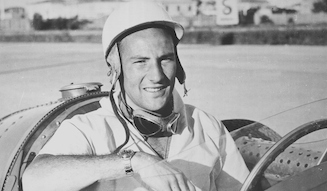
Stirling Moss on Maserati | Maserati
Maserati
Great Heroes Who Competed with Maserati
Stirling Moss on Maserati
The hit movie " RUSH" set in the 1970s F1 era is still fresh in our memories. Before that, one great racing driver who supported the early days of Grand Prix is still alive. That is the British Stirling Moss. I was able to interview him at the Maserati 100th anniversary event.Maserati 100th anniversary eventI was able to interview him at the event.
Text by OGAWA Fumio
Why I Chose the Maserati 250F
──When we talk about you and Maserati, the 250F immediately comes to mind.
Stirling Moss (hereinafter SM)I initially bought this car with my own money and raced it. It was the most well-balanced car I could afford. I struggled because the driving position didn't suit my body, but once the mechanics solved that problem, I experienced a wonderful feeling as if the car and I had become one. For cornering, I steer on entry, but from the middle to the exit, I control the car with throttle input. I love that feeling.
──In '56, you won two Grand Prix races, Monaco and Italy, with this 2.5-liter 6-cylinder engine Grand Prix car.
SMThe 1956 Monaco Grand Prix was a memorable race. I took the lead on the opening lap and was able to lead the race with the "250F." On the other hand, the 1954 Italian Grand Prix is a bittersweet memory. I was running ahead of Fangio in the Mercedes and Ascari in the Ferrari, but the 250F suffered an oil leak just before the finish line and stalled. I jumped out of the cockpit and pushed the car myself, but of course, I couldn't win.
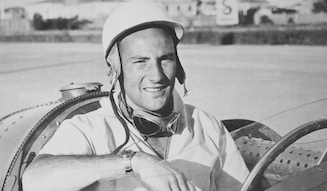
Born in Britain in 1929, Moss in his younger days. Now 84 years old.
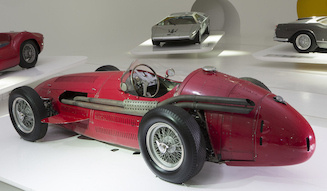
Maserati 250F
──The Maserati 250F was a racing car that achieved excellent results in many races from 1954 to 1958. What was so good about it?
SMIn a word, it was very easy to drive and powerful. At first, I bought one with my own money. I borrowed the money from my dentist father, pretending it was for another purpose. The reason I chose the 250F was its excellent cost performance. It was durable and easy to drive. Nowadays, it's impossible to buy a Grand Prix car personally and aim for the top, but back then, it was possible. The 250F, and the Maserati "300S" that I raced in sports car races like the Nürburgring 1000 km, were wonderful machines.
Maserati
Great Heroes Who Competed with Maserati
Stirling Moss on Maserati (Part 2)
No Time for Fear
──You are also called the "uncrowned king." Although you had few finishes in '54, as you mentioned earlier, there were many races that left a strong impression on people, such as the unfortunate Italian Grand Prix.
SMThat's right. The 250F broke down that time, but it was a machine that opened up great possibilities for me. In that sense, it is an unforgettable car for me. It was after seeing my races in '54 that Herbert Neubauer, who was the director of the Mercedes team, approached me.
──1955 was Stirling Moss's year.
SMThe Mercedes was a superb car. I was able to win the British Grand Prix, beating Fangio. Winning the Mille Miglia with a new average speed record in the Mercedes-Benz "300SLR" is also an unforgettable memory for me. I prefer road races to circuits. I find it more enjoyable mentally to race on public roads than to be cooped up at a circuit all weekend, going around the same course.
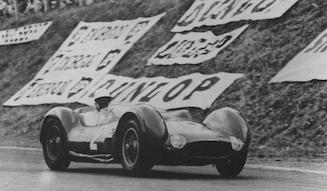
Maserati Tipo 61 Birdcage
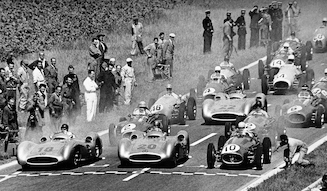
The 1954 French Grand Prix. A Maserati 250F lines up on the starting grid next to two Mercedes-Benz "W196 R" cars.
──In 1955, Mercedes withdrew from racing after a major accident involving spectators at the 24 Hours of Le Mans. You then returned to driving Maseratis, racing the 300S (announced in '55) and the historic "Tipo 60" (1959), nicknamed the Birdcage due to its chassis built with thin steel tubes.
SMWhen I first drove the Birdcage, I thought it was a supercar. Furthermore, the 2.9-liter "Tipo 61" was a machine with even higher performance. Its basic character was the same as the Tipo 60, but the power and torque were greatly increased, and the rigidity was superb. However, for me, the 300S is my favorite car. I really liked its handling, which was reminiscent of the 250F. The Nürburgring 1000 km race is a race I enjoy, and I won it once with the 300S (in '56) and once with the Tipo 61 (in '61).
──You have experienced all sorts of races, but have you never felt fear?
SMI don't think so. It might be better to say that I don't have time to feel fear. Because I am very tense during a race. I don't think about bad things happening. Rainy races are unpleasant, but if you start thinking something might happen, it leads to a bad outcome. That's how it is.
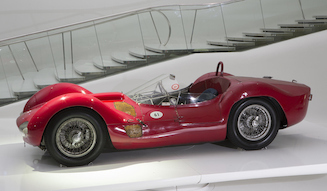
Maserati Tipo 61 Birdcage

Sir Stirling Craufurd Moss
Born in London in 1929, a racing driver. His first recorded race was in 1949. He won his debut in Formula Libre driving a "Cooper." His professional career began in '51, where he made a name for himself in the Jaguar "C-Type." In '54, he won the 12 Hours of Sebring endurance race driving an OSCA "MT4," built by the Maserati brothers after they left Maserati. In the 1950s, Moss, along with Maserati and Mercedes, built a golden era.
Furthermore, he colored the late 1950s with excellent results, driving Coopers in Grand Prix and Aston Martins in sports car races. Entering the 1960s, he drove Lotuses and Ferraris. "Enzo Ferrari was amazing, but he was a difficult man," he recalled in this interview. In '62, he was involved in a racing accident and fell into a coma. This prompted his retirement from racing. However, he remains popular today with historic car races and lectures, leading a busy life.