Anatomy of the Lamborghini Huracán | Lamborghini
Lamborghini Huracan LP610-4
The Pillar of the Next Decade
Anatomy of the Lamborghini Huracan
As the successor to the "Gallardo," nicknamed the "Baby Lambo," the "Huracan" made its world premiere at this year's Geneva Motor Show. Recently,its launch event was held in Japan, and with the delivery start date drawing ever closer, we aim to delve into this new model, expected to carry Lamborghini into its next decade, from a technological perspective. Jun Nishikawa reports from the company's headquarters in Sant'Agata Bolognese, Italy.
Text by NISHIKAWA Jun
A New Model Unveiled to Cap Off the 50th Anniversary
Last year,Lamborghini celebrated its 50th anniversary. Reflecting on half a century of history brings to mind legendary cars like the "Miura" and "Countach," a constellation of stars in the supercar world (incidentally, 2014 marks the 40th anniversary of the Countach).
However, Lamborghini's safe passage to its 50th anniversary can be attributed solely to the strong sales performance of the past decade, that is, since becoming part of the Audi Group. After all, production volume, which totaled 10,000 units over the first 40 years (an average of just 250 units per year), has seen a dramatic leap to 20,000 units in the last decade (at a pace of 2,000 units per year).—.
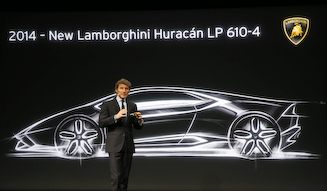
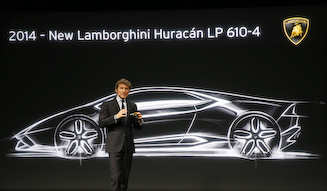
Company CEO Stephan Winkelmann presenting.
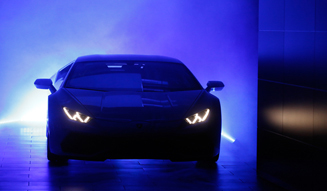
The "Tech Day" event, revealing the Huracan's detailed specifications, was held at the company's headquarters in Sant'Agata, Italy.
The Gallardo, which recorded impressive sales of approximately 14,000 units over the decade, became the pillar of this growth. Succeeding this V10 mid-ship supercar, the new model announced at the end of last year—the culmination of its 50th anniversary—to spearhead the bull's next decade is the "Huracan."
This time, a "Tech Day" was held at the company's headquarters in Sant'Agata Bolognese, Italy, to reveal the detailed specifications of this new supercar to a select group of media and journalists.
As usual, after morning coffee at the museum located in the building to the right after entering the main gate, we walked to the Centro Stile (Design Center) within the premises. The full picture of the Huracan was about to be revealed.
Lamborghini Huracan LP610-4
The Pillar of the Next Decade
Anatomy of the Lamborghini Huracan (2)
A Completely New Transmission
The presentation began with Maurizio Reggiani, head of the development department, discussing the Huracan's engineering topics. First, the powertrain.
The "heart" behind the driver is a 5.2-liter dry-sump V10 engine. Hearing this, enthusiasts might say, "So, it's the same as the Gallardo and Audi R8, right?" However, this is actually the latest updated V10, incorporating the newest dual injection technology.
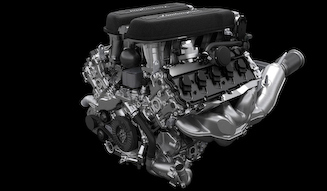
The 5.2-liter V10 engine in the Huracan, producing 610 hp.
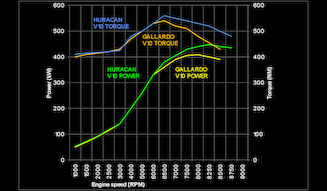
Engine performance curves comparing the Gallardo and Huracan.
This technology, already in practical use in VW vehicles, varies the fuel injection method depending on the engine's condition. During startup and high-load acceleration, fuel is injected directly into the cylinders (direct injection), achieving a relatively high compression ratio of 12.7:1. Conversely, during low-load cruising, port injection is used to reduce fuel consumption and emissions. Naturally, in intermediate driving ranges that fall between these conditions, both injection systems are used efficiently. This also ensures compliance with Euro 6 standards.
The number in the car's name indicates its power output: a maximum of 610 hp (560 Nm of torque). This is a significant increase over the previous Gallardo, and it also boasts flexibility, delivering 75 percent of its torque at just under 1,000 rpm. Furthermore, it's important to note that the engine characteristics provide a more potent performance than the numbers alone suggest, with power above 6,000 rpm and torque above 6,500 rpm surpassing the previous Gallardo's V10. This alone makes one eager to drive it.
The transmission has also been completely revamped. Lamborghini has finally abandoned the e-gear (a 2-pedal single-clutch system) in favor of a 7-speed dual-clutch transmission. This significantly improves efficiency, shortens shift times, and most importantly, will please users (many dislike the jolts of a single-clutch system).
This is a system already adopted by major sports car brands like Ferrari and Porsche, and likely what everyone desired. However, it could also be said that Lamborghini's characteristic direct and powerful shifting feel is now gone. We will reserve final judgment on the overall merits and demerits after a test drive.
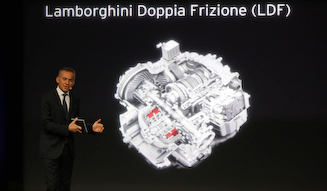
Maurizio Reggiani, head of development, explains the new 7-speed dual-clutch transmission in the Huracan.
Lamborghini Huracan LP610-4
The Pillar of the Next Decade
Anatomy of the Lamborghini Huracan (3)
Outperforming the Gallardo's Most Potent Specification
Following the powertrain, we turn to the chassis. Both front and rear feature double-wishbone suspension made of forged aluminum, and for the first time in a Lamborghini, magnetic ride dampers (magnetorheological fluid damping control) are offered as an option.
The steering system adopts a new electromechanical rack-and-pinion power assist system, achieving an extremely direct steering ratio of 16.2:1. Furthermore, an optional variable gear ratio system using an electric motor is available, allowing for nearly 100 percent variation in the steering ratio.
These chassis components are connected to the latest electronic platform. Accelerometers and gyroscopes are located near the vehicle's center of gravity, capturing all dynamic movements of the car (axis, acceleration, rotation, pitch, yaw rate) during driving. This information is transmitted via a high-speed network to all electronic control systems, ensuring optimal dynamic performance through this advanced setup.
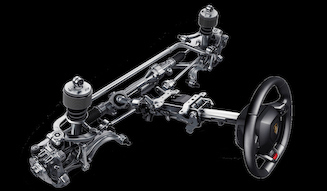
The Huracan's steering system, newly equipped with an electromechanical rack-and-pinion power assist.
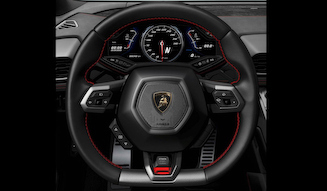
Drive modes—"Strada," "Sport," and "Corsa"—can be selected via a switch below the steering wheel.
Of course, it is also equipped with the popular drive mode selection system (which Lamborghini now calls ANIMA, meaning "soul" in Italian). Similar to the Aventador, drivers can choose from Strada (street), Sport, and Corsa (track) modes according to their preference.
Behind the 20-inch alloy wheels lie powerful brakes with carbon-ceramic discs, and the tires are Pirelli P Zeros specifically tuned for the Huracan.
The highlight of the mechanical presentation was the completely new body structure. Taking another innovative step from the Gallardo's aluminum space frame, it features a hybrid body structure of aluminum and carbon fiber.
At the event, the structure was displayed. Carbon fiber reinforced plastic (CFRP) is used in the driver's area—specifically the floor, center tunnel, side sills, rear bulkhead, and parts of the B-pillar—and bonded and joined to the aluminum body via stainless steel fasteners.
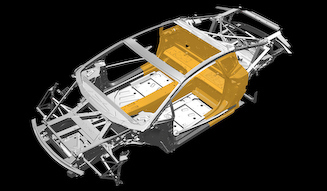
The Huracan's chassis features a hybrid aluminum and carbon structure. The yellow areas indicate carbon components.
This results in a body structure that is 10 percent lighter and 50 percent more rigid than the previous Gallardo's aluminum space frame, which is truly astonishing. Naturally, the partial use of CFRP also contributes to superior impact absorption in side collisions.
The weight reduction leads to a power-to-weight ratio of 2.33 kg/hp. Its performance capabilities include a top speed exceeding 325 km/h and a 0-100 km/h acceleration time of 3.2 seconds, significantly surpassing the performance of the most potent Gallardo models.
Lamborghini Huracan LP610-4
The Pillar of the Next Decade
Anatomy of the Lamborghini Huracan (4)
Interior Quality Surpasses the Aventador
Following Reggiani, Filippo Perini, head of the Centro Stile, presented a "design lesson." According to Perini, the initial approach was to "simply draw a supercar."
Indeed, the styling silhouette is rendered in a single flowing line, which is fresh for a supercar. Unlike the Gallardo's sharp shoulder line, it is enveloped in a soft, sloping form. By adding a powerful front end and rear, Lamborghini's characteristic passion is expressed. The design motifs are inspired by the limited edition "Sesto Elemento." Incidentally, apart from the front and rear bumpers and side sills, the body panels are primarily made of aluminum.
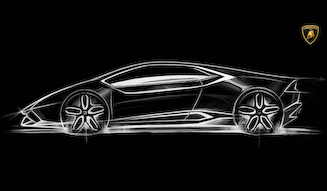
A sketch of the Huracan, designed with a hexagonal motif.
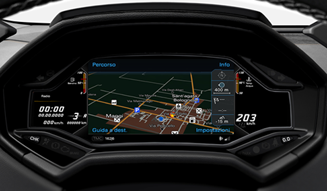
The 12.3-inch TFT LCD panel in the Huracan, featuring three switchable screen modes.
How about the interior finish? In a word, it has become even more luxurious (the interior space is also larger than the Gallardo's, and visibility is excellent). The perceived quality surpasses that of the Aventador. Notably, the 12.3-inch TFT LCD panel visible beyond the steering wheel is impressive in both function and appearance. It offers three switchable screen modes, and the entire screen can be used as a navigation system. A TFT panel is also present on the center console.
The powertrain, consisting of the engine and transmission, along with the hybrid body structure, is shipped from Germany to the Sant'Agata headquarters factory in Italy. Production is set to begin on the final assembly line, comprising 23 workstations. Incidentally, production efficiency is 20 percent higher than that of the Gallardo. The current production plan is 13 units per day, but this can be adjusted based on supply and demand.
Deliveries in Japan are scheduled to begin this autumn. The announced price is 29.7 million yen (including tax).
Road impression by Jun Nishikawa here

Lamborghini Huracan LP 610-4
Body | Length 4,459 x Width 1,924 x Height 1,165 mm
Wheelbase | 2,620 mm
Tread Front/Rear | 1,668 / 1,620 mm
Vehicle Weight | 1,422 kg
Engine | 5,204cc V10
Bore x Stroke | 84.5 x 92.8 mm
Max. Output | 449 kW (610 ps) / 8,250 rpm
Max. Torque | 560 Nm / 6,500 rpm
Transmission | 7-speed LDF (Lamborghini Doppia Frizione)
Drivetrain | 4WD
Suspension Front/Rear | Double Wishbone
Tires Front | 245/30R20 (Pirelli P Zero)
Tires Rear | 305/30R20 (Pirelli P Zero)
Brakes Front | Ventilated Carbon Ceramic Discs φ380 x 38 mm
Brakes Rear | Ventilated Carbon Ceramic Discs φ356 x 32 mm
Top Speed | 325 km/h
0-100 km/h Acceleration | 3.2 seconds
0-200 km/h Acceleration | 9.9 seconds
Fuel Consumption | 12.5 L/100 km (approx. 8.0 km/L)
CO2 Emissions | 290 g/km
Price (incl. tax) | 29.7 million yen
Lamborghini Customer Center
 0120-988-889