Maserati's Centenary × Italian Luxury Sports Cars | Maserati
Maserati
MASERATI 100 - A Century of Pure Italian Luxury Sports Cars
Maserati 100: A Century of Pure Italian Luxury Sports Cars
Founded in Bologna, Italy, in 1914, Maserati has reached its 100th anniversary. While an anniversary event was recently held in Tokyo at Zojoji Temple, a special exhibition titled "Maserati 100: A Century of Pure Italian Luxury Sports Cars" has been running in Italy from June to January 2015. Fumio Ogawa attended the opening reception. We bring you a report, including an interview with Carlo Maserati, a member of the founding family.
Text by OGAWA Fumio
Historic Models Adorning Maserati's 100 Years
2014 marks Maserati's 100th anniversaryTo commemorate this, a special exhibition titled "Maserati 100: A Century of Pure Italian Luxury Sports Cars" is being held at the Enzo Ferrari Museum in Modena, central Italy, from June to January 2015.
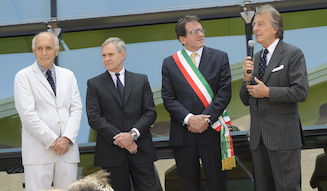
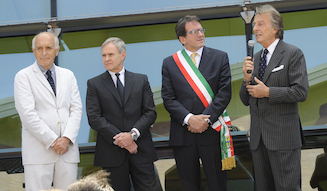
"Maserati's 100th anniversary comes at the best time in our history, because today Maserati is growing significantly, and our new models are highly popular with an ever-increasing number of Maserati fans," said Maserati CEO Harald Wester at the opening ceremony before the assembled journalists and citizens of Modena.
Standing beside him was Luca di Montezemolo, Chairman of Ferrari. Responding to CEO Wester's speech, he shared a recollection: "I clearly remember the situation in 1997 when Maserati was left in a state of financial crisis. And I took on the challenge of reviving Maserati together with the team in Maranello."
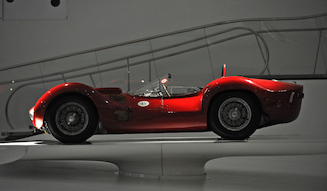
Maserati Tipo 61 (1959)
The result was the previous generation "Quattroporte," unveiled in 2003. With its superb 4.2-liter V8 engine developed with Ferrari's assistance, refined handling, and quality control to prevent problems, it achieved great market success, paving the way for the highly acclaimed "GranTurismo," Grancabrio" and the current "Quattroporte" and "Ghibli" models.
The exhibition features 21 historic models that have graced Maserati's 100-year history, starting with pre-war Grand Prix cars. With rotations, a total of about 30 famous Maseratis will be displayed. While most are well-known, many are rare models that even avid car enthusiasts may be seeing for the first time.
From the 16-cylinder "V4" (1932), of which only one road-going version was built, to the "250F" that brought glory to the Maserati racing team from 1954 to 1960 under Stirling Moss and Juan Manuel Fangio, the "Tipo 61" that defined the subsequent era, and the elegant "Coupe" that gained popularity in the United States, the exhibition offers a display that one can admire endlessly.
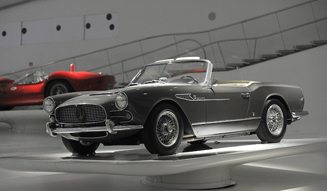
Maserati 3500 Spyder Vignale (1959)
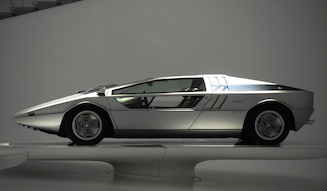
Maserati Boomerang (1971)
Maserati
MASERATI 100 - A Century of Pure Italian Luxury Sports Cars
Maserati 100: A Century of Pure Italian Luxury Sports Cars (Part 2)
Without Passion, Sports Cars Could Not Be Made
"What I remember most are the brilliant engineers," Carlo Maserati told us, reminiscing about the post-war "golden age." The son of Ettore Maserati, the sixth of the Maserati brothers and founder family, Carlo is now 84 years old. After studying industrial engineering at university, he worked at OSCA, a sports car manufacturer founded in 1947 after the Maserati brothers sold their company.
"What surprised me in the workshop was that the seasoned engineers already knew, from their on-site experience, what I had diligently learned at university. The chassis, engine, aerodynamics – the various elements that constitute a superb sports car – were already their domain."

Carlo Maserati is the 84-year-old son of Ettore Maserati, the sixth of the founding Maserati brothers.
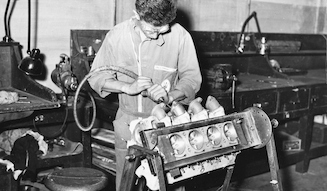
In the 1956 factory, engines were almost entirely handmade.
When asked what Maserati means to him, this living witness to history replied, "Passion." "Without it, sports cars could not have been made. I want people to remember that my father and uncles created Maserati and OSCA."
Carlo Maserati, who attended the opening reception with his son, said this. What must it feel like to look back at the history of cars bearing his own family name?
"I am deeply grateful that the current management has rebuilt Maserati and allowed us to reach this 100th anniversary. A great history has been preserved."
The exhibition largely omits models from the so-called supercar era, which remain highly regarded in Japan, and the Biturbo models that symbolized the bubble economy. While they may be displayed in the future, this is an excellent opportunity to understand the wide variety of cars Maserati has produced and the legendary automobiles it has created.
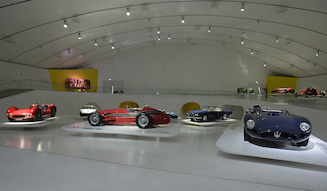
"Maserati 100: A Century of Pure Italian Luxury Sports Cars" is being held at the Enzo Ferrari Museum in Modena, Italy, until January 2015.