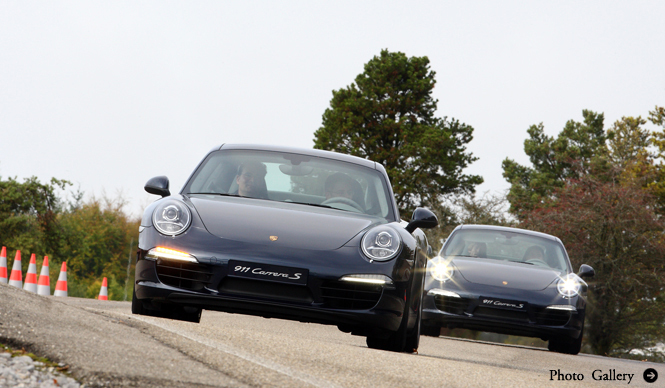
Porsche 911 Carrera: Technical Workshop Held | Porsche
Porsche 911 Carrera
First Report from Porsche's Workshop!
Full Report on the New 911!! (1)
Debuting at the Frankfurt Motor Show in September, the seventh-generation "Porsche 911 Carrera" captured global attention. About a month after its conclusion, a workshop was held in Weissach, Germany, the car's home country, to provide detailed lectures on its intricacies. We present a report from the scene by Yasuhisa Shimashita.
By Yasuhisa Shimashita
A Complete Overhaul, the Second in the Model's History
Frankfurt Motor ShowNew 911 CarreraAbout a month after the announcement of the new 911 Carrera at the Frankfurt Motor Show, in mid-October, an invitation arrived from Porsche to Weissach, the heart of its development. The invitation was for a technical workshop on the new 911 Carrera.
We weren't allowed behind the wheel yet. However, in the 46-year history of the 911, this complete redesign from the ground up is only the second time, following the model change to the 996 in 1997. As they promised to meticulously unravel all the technology of the new model, codenamed 991, we simply had to attend.
As expected, the depth of the content was astonishing and overwhelming. Visually, it's still a 911. Yet, every element seems to point towards a new dimension. It would be impossible to detail everything here, but we aim to convey the key elements as clearly as possible.
The day's lectures were divided into four parts: "Lightweight Design," "Efficiency," "Emotion," and "Performance." This indicates that these four areas are the technical highlights and key selling points of the new 911.
Porsche 911 Carrera
First Report from Porsche's Workshop!
Full Report on the New 911!! (2)
Lightweight Design
The new 911 Carrera measures 4,491mm long, 1,808mm wide, and 1,303mm high, making it 56mm longer and 7mm lower than the current 997 facelift model. The wheelbase is 2,450mm, an increase of 100mm. While the car has grown slightly, the Carrera S with PDK weighs 1,415kg, a reduction of 40kg.
Normally, improvements in occupant protection, fuel efficiency technologies, and the extended wheelbase for enhanced driving dynamics would have resulted in a 58.4kg increase in weight. However, the new 911 Carrera achieved a remarkable weight reduction of 98kg through the adoption of an entirely new lightweight body structure, along with weight savings in the engine, chassis, and other components, resulting in a net decrease.
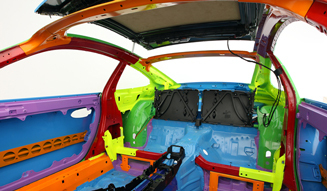
The body shell is color-coded by material. The light blue sections are all aluminum, accounting for 44% of the total. The light green represents deep-drawn steel, which is easy to form, but used in only 14% of the structure.
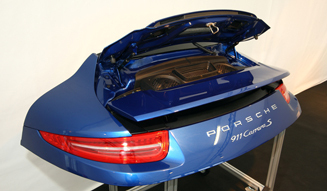
The rear spoiler, which extends to the rear of the vehicle and has increased in width from 898mm to 1,137mm, also features parts that have been reduced in weight by the gram. Ingenious solutions include giving a single part multiple functions.
Particularly noteworthy is the body structure. Not only the bonnet, front fenders, doors, and engine lid, but also the roof and almost the entire floor panel are made of aluminum. The chassis members, sill areas, and suspension mounting points are also aluminum die-cast. As a result, aluminum accounts for an impressive 44% of the entire body.
Conversely, deep-drawn steel is used for large panels, such as those extending from the roof arch to the rear fender. This material was chosen for its ease of forming to achieve Porsche's signature soft curves. By using a variety of materials—steel, aluminum, cast aluminum, magnesium—precisely where they are best suited, the car achieves a significant weight reduction while creating beautiful body lines that add a fresh touch to the 911's character, and substantially increasing body rigidity by 13% in bending and 20% in torsion.
Porsche 911 Carrera
First Report from Porsche's Workshop!
Full Report on the New 911!! (3)
Efficiency
Even for a sports car, fuel economy and environmental performance are aspects that cannot be ignored today. The new 911 Carrera has achieved a dramatic leap forward in this regard as well.
The 911 Carrera S equipped with PDK achieves a fuel consumption of 8.7 L/100km (approximately 11.5 km/L). This is an improvement of about 15% compared to the current model. With the Carrera's PDK, it's 8.2 L/100km (approximately 12.2 km/L). This is remarkable fuel efficiency for a sports car approaching a top speed of 290 km/h.
This was made possible by reducing running resistance, improving efficiency, and optimizing control systems. These are standard approaches, but Porsche's execution is thorough.
The direct-injection engine, introduced in the 997 facelift, has been refined. While the intake and exhaust systems have been revamped, and improvements made to the direct-injection system, VarioCam Plus, and friction reduction, the Carrera's displacement has been reduced from 3.6 to 3.4 liters, yet its maximum output has increased by 5 hp to 350 hp. The Carrera S, with its 3.8-liter engine unchanged, now boasts an additional 15 hp, reaching 400 hp.
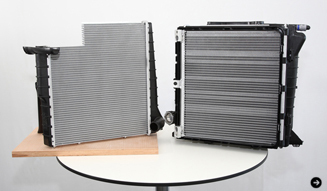
Meticulous temperature management is also key to high efficiency. Immediately after startup, the coolant temperature is raised quickly to reduce friction, improving fuel economy by 2%. Even after that, the operating temperature is kept relatively high, but during full throttle, the coolant temperature is lowered to maximize power output.
In addition to the PDK, a manual transmission is available, now with an extra gear, making it the world's first 7-speed manual for a passenger car. The 7-speed gearbox allows for engine speeds 19% lower than a 6-speed at the same road speed, contributing to fuel efficiency and quietness. A potential concern is accidentally shifting into 7th gear from 4th, but to prevent this, a shift gate lock is incorporated, preventing engagement into 7th unless the shift lever is in the 5th or 6th gear position.
Achieving High Efficiency Throughout
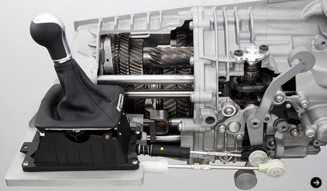
The noteworthy 7-speed manual transmission shares many internal components with the PDK. The shift feel is crisper than the current model, and the likelihood of shift errors seems reduced.
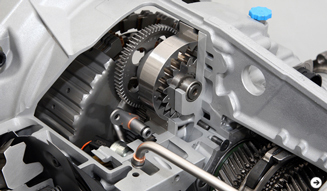
The 7-speed PDK has also undergone significant internal improvements. The PTV Plus incorporates an electronically controlled limited-slip differential, continuously varying the drive torque between the left and right wheels to balance cornering agility and stability.
The auto start/stop function, which stops the engine when the vehicle is stationary, is standard on both PDK and manual models. A quick-start system has been implemented, which uses the starter motor's rotational force to engage the clutch upon restart, allowing immediate acceleration once the engine starts.
Another notable feature is coasting. This function saves fuel by disengaging the clutch when the accelerator is released, allowing the car to coast. It is estimated to improve fuel economy by one liter per 100 kilometers. Both this and the start/stop function are deactivated in SPORT mode.
The improvements don't stop there, of course. The aforementioned weight reduction, improved aerodynamics with a Cd value reduced from 0.30 to 0.29, the adoption of electric power steering, a braking system with reduced drag, and the use of low rolling resistance tires—the car truly achieves high efficiency in every aspect.
Porsche 911 Carrera
First Report from Porsche's Workshop!
Full Report on the New 911!! (4)
Emotion
While there are various elements that stir emotion, the new 911 Carrera seems to place particular emphasis on sound. As the person in charge stated, "The design and tuning of the silencer are a core competence of Porsche."
The focus is on clearly conveying the car's current status or message to the driver in each situation: engine start, idling, gear changes, and load variations. Naturally, all sound sources in the 911 Carrera originate from the car itself—the intake system, engine, and exhaust system, all located at the rear. The key is determining which sounds to extract and how to present them in each scenario.
The development of this sound, as befits a "core competence," involved considering all elements, including silencer routing, from a very early stage of vehicle design. As a result, the sound is perceived as clearer than in previous models. While the 997 facelift with its direct-injection engine sometimes felt a bit rougher in sound, the new model is exceptionally smooth even at idle. Furthermore, the tone changes subtly with load, stimulating the driver's senses.
The improved shift speed of the PDK has also altered the sound during upshifts.
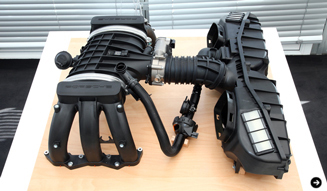
Instead of shifting unnoticed, the goal is to create a sense of crispness through short, distinct sound changes. These are not accidental but the result of meticulous tuning.
Wolfgang Hatz, a board member responsible for technical development, stated at the opening, "We invite you to a new six-cylinder orchestra." In fact, the department responsible for sound research has existed for at least 33 years, indicating Porsche's extensive experience in this area. The sound of the new 911 Carrera can be considered the culmination of this expertise.
Porsche 911 Carrera
First Report from Porsche's Workshop!
Full Report on the New 911!! (5)
Performance
As mentioned, the new 911 Carrera's body is 56mm longer. However, the wheelbase has increased even more significantly by 100mm, resulting in shorter front and rear overhangs. While the width remains the same, the front track has widened. The overall height has also decreased. Combined with the weight reduction, the moment of inertia has decreased by 2%, and the front-to-rear weight distribution has shifted slightly forward by 0.2%.
Aerodynamically, a Cd value of 0.29 has been achieved, with a 28% reduction in lift. With the optional PASM Sport chassis, which lowers the ride height by 20mm, drag is further reduced, and lift is eliminated. Above 120 km/h, the rear spoiler extends to generate downforce. Underbody airflow management is also actively addressed, with the floor being nearly flat when viewed from below.
Regarding the engine, a notable point is the increase in the redline by 300 rpm to 7,800 rpm. The 7-speed PDK also features reduced shift times.
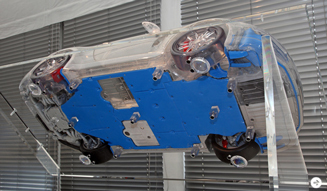
The new 911 Carrera actively manages underbody airflow, not just the body surface, to improve aerodynamics. The floor is nearly flat from front to rear.
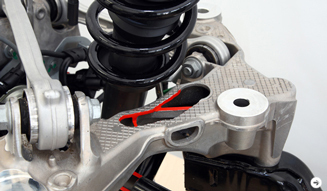
While the suspension layout remains the same, it is fundamentally newly designed. Efforts have been made not only to improve performance but also to reduce weight, achieving a reduction of 5.5kg in this area alone.
The suspension has also been completely redesigned, with a focus on weight reduction. The PASM electronic damping control system continues to be offered, and for the first time, PDCC (Porsche Dynamic Chassis Control) with active anti-roll bars is available.
PTV (Porsche Torque Vectoring) is also available, which controls torque distribution between the rear wheels to enhance cornering stability and agility. The "PTV" for manual transmission models is a combination of a mechanical limited-slip differential and brake control on the inner wheel during cornering. For PDK models, "PTV Plus" features an electronically controlled limited-slip differential, differing due to the use of PDK's hydraulic control system.
The Carrera is equipped with 19-inch wheels, while the Carrera S has 20-inch wheels. For the brakes, the Carrera S and PCCB-equipped cars feature monobloc calipers—6-piston front and 4-piston rear—paired with lightweight brake rotors that are 10mm larger than before at 340mm in the front and 330mm in the rear. The adoption of an electric parking brake is also a notable feature.
Symbolizing these advancements is the Nürburgring Nordschleife lap time of 7 minutes and 40 seconds for the Carrera S PDK model. This is 13 seconds faster than the 997 facelift Carrera S, a time nearly comparable to the Turbo.
Porsche 911 Carrera
First Report from Porsche's Workshop!
Full Report on the New 911!! (6)
Co-driver Test Drive
Actually, this event also included a co-driver test drive session. Although the narrow test track in Weissach had a rough surface and was half-wet, it served to vividly demonstrate the capabilities of the new 911 Carrera.
On the access road, the ride comfort was immediately apparent. The suspension movement was precise without being harsh, and the road noise was remarkably quiet, almost to the point of feeling un-911-like.
When lifting off the accelerator in D-range, the car enters coasting mode. And when the vehicle comes to a stop, the engine smoothly shuts off. It's remarkable that the 911 Carrera has reached an era where it behaves like this.
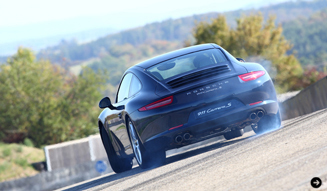
The notion of tricky behavior at the limit is a thing of the past. From the passenger seat, the impression was that controllability has been further enhanced.
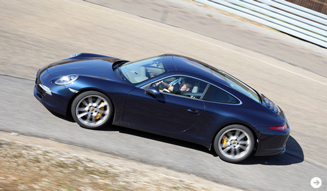
The co-driver test was in a 911 Carrera S with PDK, fully equipped with PDCC (active anti-roll bars) and PCCB (carbon-ceramic brakes).
Once on the track, we immediately accelerated to full throttle. Yet, even from the passenger seat, the grip of all four wheels was palpable, instilling no sense of unease. The acceleration was intense. The flat-six engine seemed to inhale as it reached the top end of its rev range. The powerful yet clear engine sound was impressive, making one instinctively want to press the accelerator harder.
Stability during full braking was exceptional. Despite concerns about the electric power steering, the driver expressed satisfaction, calling it "Great!" The development team is clearly confident in this area, making one eager to experience it firsthand.
The cornering performance exceeded all expectations. The front end gripped tenaciously, and the car carved through turns like a go-kart. There was virtually no body roll, and the rear end maintained a solid grip. As we accelerated out of the corner, the car launched forward with explosive force, aided by the PTV Plus. We were left in awe of the overwhelming performance as the test drive time quickly concluded.
The new 911 Carrera, while intensely conveying the characteristic 911 Carrera feel in every aspect, offered a glimpse of a different level of speed and controllability, almost as if it weren't a 911 at all. The hardware, representing the most significant evolution in its history, appears to have led to the most significant leap in driving performance as well. With the opportunity to drive it myself still some time away, this brief taste has only intensified my anticipation.

Porsche 911 Carrera
Body Dimensions | Length 4,491 x Width 1,808 x Height 1,303 mm
Wheelbase | 2,450 mm
Vehicle Weight (DIN) | 1,380 kg (7-speed MT), 1,400 kg (PDK)
Engine | 3.4-liter horizontally opposed 6-cylinder
Transmission | 7-speed MT, PDK
Max. Output | 257 kW (350 hp)
Max. Torque | 390 Nm / 5,600 rpm
Fuel Consumption | 9.0 L/100 km (7-speed MT), 8.2 L/100 km (PDK)
CO2 Emissions | 212 g/km (7-speed MT), 194 g/km (PDK)
Porsche 911 Carrera S
Vehicle Weight (DIN) | 1,395 kg (7-speed MT), 1,415 kg (PDK)
Engine | 3.8-liter horizontally opposed 6-cylinder
Max. Output | 294 kW (400 hp)
Max. Torque | 440 Nm / 5,600 rpm
Fuel Consumption | 9.5 L/100 km (7-speed MT), 8.7 L/100 km (PDK)
CO2 Emissions | 224 g/km (7-speed MT), 205 g/km (PDK)