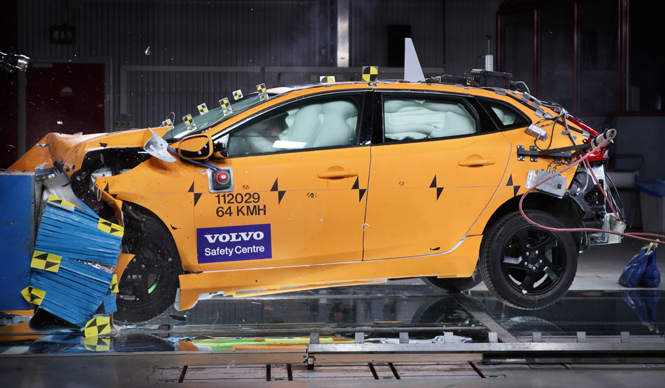
Volvo's Commitment to Safety | Volvo
Volvo Advanced Safety Experience 2013|
Volvo Advanced Safety Experience 2013
Focusing on Real-World Effectiveness
Volvo's Commitment to Safety
Zero fatalities or serious injuries in new cars produced by the company by 2020. With the slogan 'Vision 2020,' Volvo, aiming to be the world's safest car, is currently one of the automotive manufacturers most focused on the evolution of safety technology. How will the automotive society evolve by the year the Tokyo Olympics are held? Yasuhiko Kawamura reports from Volvo's home in Sweden on an extremely realistic near future.
Text by KAWAMURA Yasuhiko
The Theme of Safety
Volvo cars are safe.──Perhaps many people still think this not because of any particular evidence, but simply because they have a vague impression of it.
In the past, the distinctive angular silhouette of Volvo cars might have actually contributed to a perception of them being "somehow robust" and "somehow safe." However, in today's era, where Volvos on the street have been replaced by models with entirely new designs, it's unlikely that many people still think so simplistically that "a robust body equals safety."
Nevertheless, the general public's image of Volvo cars being synonymous with safety should remain unshaken. In fact, even when asking specialists in safety at rival manufacturers, many will tell you that "Volvo's capabilities are truly outstanding."
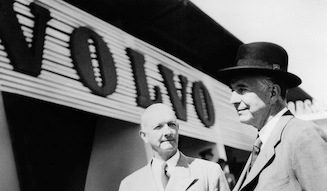
In 1924, Volvo was founded in Sweden by Assar Gabrielsson and Gustav Larson.

Legendary models that created Volvo's safety myth. Volvo 240, 832, 544, 654, OV4 (from left to right)
What is the reason behind this brand's reputation?
I believe it is because this manufacturer has long considered "safety" to be its core competence and has never wavered in its sincere commitment to it. And it seems that the time is now ripe to re-evaluate this unique characteristic of the brand.
Volvo Advanced Safety Experience 2013|
Volvo Advanced Safety Experience 2013
Focusing on Real-World Effectiveness
Volvo's Commitment to Safety (2)
Investigating and Recreating Real-World Accidents
This three-point seatbelt, now standard in all models worldwide and used by many almost unconsciously, is a fundamental safety feature.──Volvo was the world's first to "invent" this three-point seatbelt in 1959.
Recognizing its effectiveness early on, the company confirmed its advantages over the conventional two-point "lap belt" and, wishing for its rapid widespread adoption, made the decision to freely share the patent it had acquired with other manufacturers.
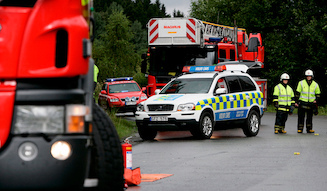
More than ten years later, in 1970, an accident investigation team was formed to immediately respond to serious accidents involving their models in the vicinity of the Swedish headquarters, analyzing the causes and vehicle damage in detail. Looking back, Volvo's image of safety may have truly begun to solidify around this time. Incidentally, the accident investigation team has been dispatched over 40,000 times to date.
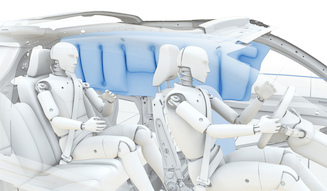
Based on these "real-world" events, Volvo has continuously strived to improve safety, releasing a series of "world-first" features: a child cushion integrated into the seat in 1978, a three-point belt for the rear center seat in '86, side airbags in '94, and curtain airbags in '98.
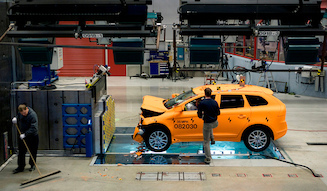
And in 2000, around the same time as Honda's announcement, they completed one of the world's earliest large-scale indoor all-weather crash test facilities. Since then, their approach of verifying real-world traffic accidents and recreating them to derive unique solutions has only accelerated.
Volvo Advanced Safety Experience 2013|
Volvo Advanced Safety Experience 2013
Focusing on Real-World Effectiveness
Volvo's Commitment to Safety (3)
The fundamental principle of design must always be 'safety'.
In 2008, Volvo proposed a bold commitment known as 'Vision 2020.' This ambitious goal is to "eliminate fatalities and serious injuries in new Volvos by 2020." Analysis of their proprietary accident database has revealed that the risk of injury when driving a Volvo has already been reduced by approximately 50% since 2000.
Fundamentally, "the basic principle of design must always be 'safety'" has been Volvo's mantra since its founding. And recently, this brand, with its philosophy, has been particularly focusing on various advanced driver-support features.
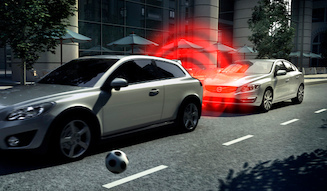
"City Safety"
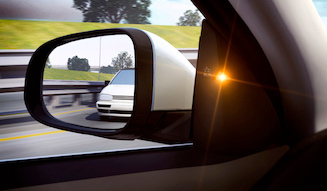
"BLIS"
Features include "City Safety" for avoiding or mitigating rear-end collisions with vehicles ahead; "Human Safety" which detects pedestrians with collision potential and automatically brakes; "BLIS," an evolution of the world's first introduced in 2004, which covers blind spots in door mirrors; "Cross Traffic Alert" which warns of approaching vehicles from the side when reversing out of parallel parking; and "Lane Keeping Aid" to prevent lane departure. Many of these features are already in practical use.
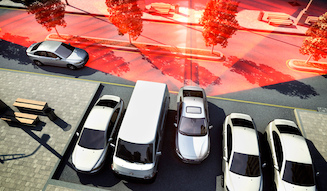
"Cross Traffic"
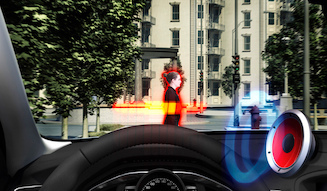
"Human Safety"
The event, "Advanced Safety Experience 2013," introduced here, was a workshop held recently at the test track adjacent to the Swedish headquarters, which "once belonged to Volvo," to showcase these technologies further and present realistic ideas planned for release in the near future.
Volvo Advanced Safety Experience 2013|
Volvo Advanced Safety Experience 2013
Focusing on Real-World Effectiveness
Volvo's Commitment to Safety (4)
Six Next-Generation Safety Technologies
As the title "Advanced Safety Experience 2013" suggests, this event was not just a study session but an "experiential" event where participants could actually confirm the operation of the features. A total of six next-generation safety technologies were presented, including four that were revealed to be "scheduled for introduction starting with the next XC90 to be released next year."Next-generation XC90With the exception of one item involving fully autonomous driving, all were experienced firsthand, either by riding in experimental vehicles or by taking the wheel.
The features scheduled for introduction in the next XC90 all use millimetre-wave radar and cameras as detection devices, which are already employed in current production models. These items achieve new vehicle behavior control by enhancing detection and analysis capabilities and skillfully operating brakes, electronic throttle control, and electric power steering.
The details of the six announced features are as follows.
Automatic Braking with Pedestrian Detection at Night
This is an upgraded version of "Human Safety," already in practical use, that operates even in darkness by increasing the sensitivity of the camera used. In a demonstration where I drove myself, an experimental V70 accelerated towards a pedestrian dummy set up in a completely dark underground hangar (used during the Cold War!) at 25 km/h.
Immediately after a warning from the head-up display glowing red and an audible alert, the automatic braking system initiated a rapid deceleration. It successfully stopped just before contact. The system is said to work not only with vehicles ahead but also with pedestrians.
Automatic Braking with Animal Detection
This system identifies an animal by its characteristic of "standing on four legs" and, if it determines there is a risk of collision, performs automatic braking similar to "Human Safety." During a demonstration ride in an experimental vehicle with a specially installed display in front of the passenger seat, we confirmed that the system recognized an object as an animal when the image of a moose model placed on the course was enclosed in a square from tens of meters away.
Large animals with long legs and bodies at the same height as the windshield pose a high risk of causing significant harm if they enter the cabin in a collision. This is an "invention" befitting a Swedish manufacturer, as "49,000 collisions with animals were reported in 2012 alone."
Collision and Lane Departure Avoidance System with Roadside/Obstacle Detection
Similar to the automatic braking function, this system uses millimetre-wave radar and cameras, but its key feature is that it performs avoidance maneuvers through steering rather than braking. In situations where there is little time before a side collision or lane departure, full braking may not be sufficient to avoid an accident. In Sweden, 53% of all traffic fatalities and 42% of serious injuries are due to lane departures, and data shows that this figure accounts for half of all fatalities in the United States.
During a "terrifying demo run" in a V70, where I drove at 70 km/h towards a guardrail on the right, the steering generated a surprisingly strong left-turning torque just before contact, successfully avoiding a collision. Its effectiveness on roads without lane markings suggests a high degree of real-world utility.
Volvo Advanced Safety Experience 2013|
Volvo Advanced Safety Experience 2013
Focusing on Real-World Effectiveness
Volvo's Commitment to Safety (5)
The Most Difficult Challenge
Adaptive Cruise Control with Automatic Steering
In addition to the safety benefit of avoiding rear-end collisions, this system is expected to offer significant comfort advantages in congested urban expressways. Its characteristic is that it handles not only acceleration and deceleration during following but also cornering. In essence, it's a control system that "copies the movements of the car ahead."
Once I got into the driver's seat of the experimental S60 and pressed the switch, no pedal or steering operations were necessary. Following the vehicle ahead "relentlessly" was a somewhat moving (or perhaps startling) experience.
However, the issue is that "autonomous driving" is not yet legally permitted in any country. For this reason, when released in the next XC90 next year, the system will incorporate logic that automatically disengages if the steering wheel is not held for several consecutive seconds.
Vehicle-to-Vehicle Communication System
This is considered an essential pillar of next-generation safety technology, although it requires not only the vehicles themselves but also infrastructure development. Demonstrations included advice on the optimal speed to maintain to pass through an intersection as the light turns green, and advance warnings about a broken-down vehicle around a blind corner ahead.
We experienced demonstrations of advance warnings for emergency vehicles approaching rapidly from behind, and notifications of "slippery road surfaces" due to the activation of ABS or stability control systems in the preceding vehicle.
Automatic Parking System
As this system involves fully autonomous driving for a portion of its operation, it was the only item observed from a "safe zone" during this workshop. The experimental V40, guided by a smartphone, autonomously navigated from the passenger boarding/alighting area to the parking space, both forward and backward, after the driver had exited and before they boarded. The precision, with deviations of mere centimeters even after repeated runs, was impressive.
Both forward and reverse driving utilize creep speed, making it "difficult to implement with a manual transmission." The control system also impressively activated "Human Safety" to temporarily stop when a pedestrian dummy emerged from behind a parked car.
Perhaps the most challenging hurdle will be the legal restrictions in various markets due to the "unmanned driving" aspect, as mentioned earlier. Incidentally, the developer commented, "Given it's our home market, Sweden might be the first to 'legalize' it."
As previously stated, what is noteworthy about Volvo's commitment to safety is that it is not merely theoretical; it is exemplified by its focus on "real-world effectiveness," as represented by the research conducted by the aforementioned accident investigation team.
The features introduced here, "scheduled for adoption in the next XC90," are naturally expected to be rolled out to other models in rapid succession in the near future. It is as if Volvo's long-accumulated dedication to safety is now blossoming into a magnificent display.