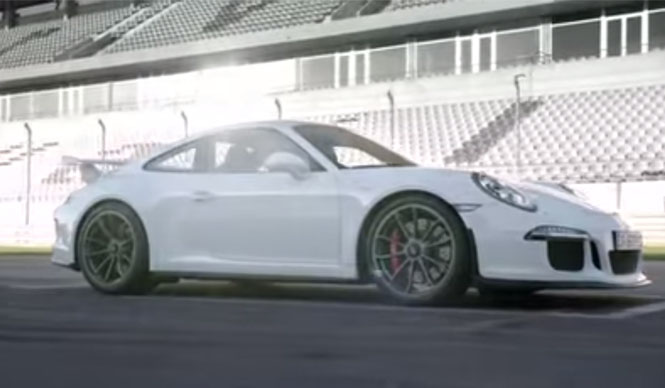
A Test Drive of the Porsche 911 GT3 | Porsche
Porsche 911 GT3 | Porsche 911 GT3
Test Drive: Porsche 911 GT3
Celebrating its 50th anniversary, Porsche's911911. In this milestone year, Porsche unveiled the "911 GT3 CUP," a one-make race car based on the "991 model" 911, and its road-legal counterpart, the911 GT3 CUP"911 GT3."911 GT3at the 2013 Geneva Motor Show.Geneva Motor ShowThis report by Yasuhiko Kawamura focuses on the latter. With a naturally aspirated engine producing 475 ps at 8,250 rpm and a maximum 9,000 rpm redline, mounted in the rear, this is the latest 911 model that is closest to a racing car for public roads. How does it perform?
Text by KAWAMURA Yasuhiko
The 5th Generation 911 GT3
Titles like "The Strongest" or "The Fastest" might cede their claim toTurbo Modelsthe turbocharged models. However, when it comes to "the most exciting 911," its popularity rating would undoubtedly soar.—That is the character of the "911 GT3," the "911 closest to the circuit."
Equipped with a typical high-revving, high-output naturally aspirated engine and chassis and suspension settings to match its powerful heart, combined with a manual transmission only, the GT3 grade has historically been defined by its "most sporty and hardcore" character within the 911 series.
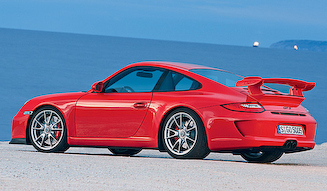
The previous generation, the 997 type 911 GT3
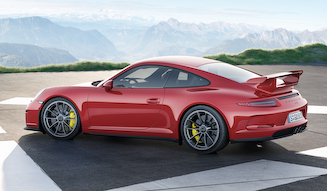
The latest model, the 991 type 911 GT3
The latest 991 type 911 GT3 introduced here is the fifth generation since the first model appeared in 1999. Its body shell, advertised as "reducing weight by approximately 13% while increasing torsional rigidity by approximately 25% compared to the previous model," employs a "hybrid structure" primarily of steel and aluminum, similar to the Carrera series.Hybrid StructureThis is a masterpiece.
As with the previous model, the "wide body" series, which features widened rear fenders, is used as the base.Carrera 4series.
Porsche 911 GT3
Test Drive: Porsche 911 GT3 (2)
All-New Engine
The heart powering this new GT3 is, as expected, a horizontally opposed 6-cylinder unit characterized by its high-revving, high-output nature. While the displacement remains 3.8 liters, similar to the previous model, it is a newly developed unit that the development team describes as "completely new," as can be inferred from the slight difference in bore and stroke values.
While the cylinder block is based on that of the Carrera S/4S, the valve train, featuring rocker arms "feedback from the world of motorsport," and the cylinder head, which adopts direct injection for the first time in a GT3, have been newly developed for this model. The connecting rods are made of titanium, and the pistons are forged, with premium materials used throughout.
The maximum permissible engine speed of 9,000 rpm and an output of 125 ps per liter significantly surpass the previous model's specifications of 8,500 rpm and 114.6 ps per liter, respectively.
The maximum output of 475 ps, generated at 8,250 rpm—650 rpm higher than the previous model—is a substantial 40 ps increase over the previous generation.
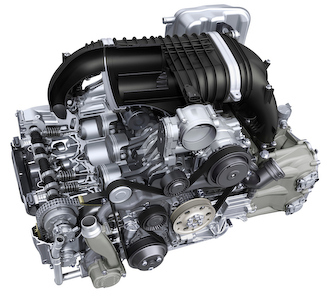
The GT3 Era Finally Embraces PDK
The transmission paired with this new engine is, for the first time in a GT3, the "PDK."
Indeed, the fact that the transmission, which had stubbornly adhered to a manual gearbox, has finally been changed to a two-pedal system is a major topic for this 991 type GT3.
Naturally, there will be divided opinions on the decision to abandon the manual transmission. Even now, after completing the test drive, I personally cannot completely shake the feeling that I would have liked to experience it with a manual transmission.
However, Porsche's development team, aware that such voices would arise globally, states that "in terms of speed, the PDK has an overwhelming advantage."
In fact, the 0-100 km/h acceleration times for the new and previous models are announced with a "decisive" difference of 3.5 seconds versus 4.1 seconds. In the case of the previous model, the adoption of PDK was deferred due to the importance of "lightness" for the GT3, but the time has finally come to overturn that decision.
Porsche 911 GT3 | Porsche 911 GT3
Test Drive: Porsche 911 GT3 (3)
The GT3's PDK is No Ordinary PDK
However, the PDK itself has undergone considerable modification for its integration into the GT3.
To minimize weight increase, lighter gears have been adopted, reducing the unit's weight by 2 kg compared to the Carrera's. The gear ratios have been revised to prioritize power performance, and the 7th gear ratio has been adjusted to "deliver maximum speed at this point," differing from the fuel-efficiency-focused Carrera series.
A new "paddle neutral" function has been added, which cuts drive power when both steering paddles are pulled simultaneously. The launch control function for quick standing starts also features custom tuning that reduces the time lag from brake pedal release to actual drive power engagement.
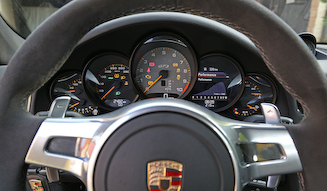
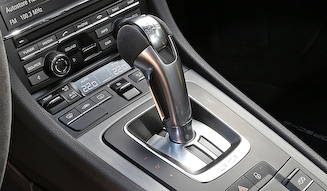
Interestingly, the sequential mode operation logic using the floor lever has been reversed from the previous system to "pull to shift up, push to shift down." This operation logic, standard in racing, is now adopted exclusively for the GT3 in the 911 series.
Regarding the future rollout of this operation logic to other Porsche models, the responsible engineer stated, "I am dedicated to the GT3, so..." However, Walter Röhrl, the brand ambassador and development driver, who was present, did not hide his pleasure, saying, "The point I have advocated for 15 years has finally been adopted."
However, such a sudden change is bound to cause confusion for users accustomed to the traditional logic from the "Tiptronic" era. Ideally, this aspect should be user-configurable according to preference.
Porsche 911 GT3 | Porsche 911 GT3
Test Drive: Porsche 911 GT3 (4)
Finally, Engaging Drive
Start the new engine, select the "D range"—a first for the GT3—and release the brake pedal.
However, the new GT3 remains stationary at this point. The creep phenomenon seen in the Carrera series' "PDK" has been deliberately omitted in this model.
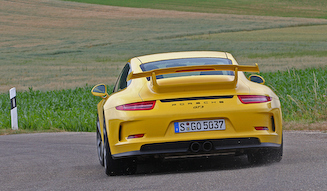
As you gently press the accelerator, the body of the new GT3, with its striking appearance featuring a large fixed rear wing atop a hood made of a combination of fiberglass and carbon fiber, begins to move surprisingly smoothly through the clutch engagement, comparable to the Carrera series.
However, unlike the Carrera series, the mechanical noise accompanying the "PDK" shifts is clearly audible.
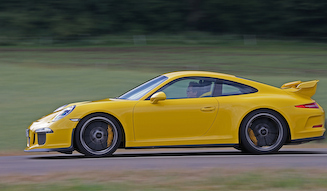
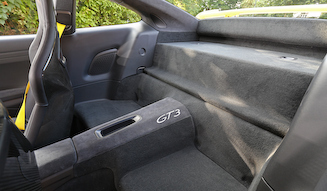
With the shift to a two-pedal system, if one were to perceive this model simply as "the fastest Carrera," this could become a point of contention.
Press the accelerator pedal further, and you will experience the "true essence of the GT3." The immense power, sharp throttle response, and the sound—everything is "flawlessly exhilarating."
The thrill experienced from around 6,000 rpm to the 9,000 rpm redline is on a different level compared to the "Carrera S" engine, which, on its own, could be considered "perfectly adequate."
Fundamentally, Porsche's latest flat-six engines in the 991 /981models have become even more inclined towards high revs than before.
However, with the GT3's engine, the impression of "refined sharpness" in its acceleration is particularly strong.
Porsche 911 GT3 | Porsche 911 GT3
Test Drive: Porsche 911 GT3 (5)
Porsche's First Rear-Axle Steering
Naturally, the chassis and suspension of the latest GT3, equipped with such a captivating engine, have received dedicated, matching settings.
The GT3 now actively incorporates high-tech mechanisms such as torque vectoring combined with an electronically controlled LSD and dynamically controlled engine mounts. However, the biggest highlight this time is the adoption of the "Active Rear-Steer System," a first for a Porsche vehicle.
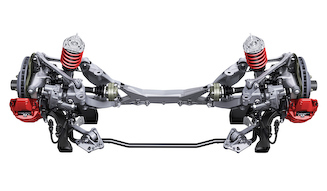
The rear axle of the 911 GT3
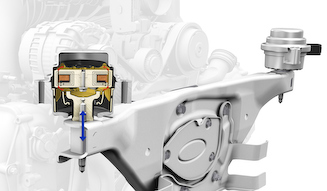
Dynamic engine mounts that can adjust the connection between the engine and the frame from a state resembling direct welding, as in racing cars, to a state with some play.
This device, which uses an electro-mechanical actuator to steer the rear wheels in the same or opposite phase as the front wheels by up to approximately 1.5 degrees, is described by the development team as aiming for "both the agility of a shorter wheelbase model and the stability of a longer wheelbase model."
During the test drive, the steering response was indeed remarkably agile, yet the sense of stability was on a completely different level compared to previous GT3s. Simultaneously, it was impressive that there was no sense of "a special device being attached."
"With the adoption of this device, the rear tire 'sag' during limit driving is delayed, allowing for stable lap times on the circuit," added Walter Röhrl.
The official lap time of 7 minutes and 25 seconds on the Nürburgring Nordschleife for this model is 15 seconds faster than the previous generation.
The explanation states that the counter-phase control at speeds below 50 km/h and the same-phase control at speeds above 80 km/h effectively "reduce the wheelbase by 150 mm or extend it by 500 mm."
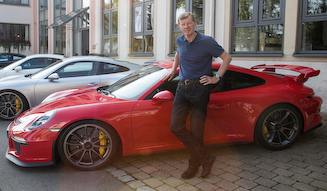
Former WRC champion Walter Röhrl, brand ambassador and development driver
At the same time, counter-phase control also contributes to a reduced minimum turning radius, but this is also finished in a way that makes you completely unaware that "such control is being performed."
Porsche 911 GT3 | Porsche 911 GT3
Test Drive: Porsche 911 GT3 (6)
PASM: Comfortable in Normal Mode?
Another point that impressed me was that the handling, despite its performance, offered a higher level of comfort than I had anticipated.
Of course, it is fundamentally "firm."
Especially when using the electronically controlled variable dampers "PASM" in Sport mode, its firmness could sometimes lead to a bouncy ride, and there were moments where ground contact felt reduced.
On the other hand, when using it in Normal mode, the suspension moved surprisingly well, and in synergy with the rigid body quickly damping vibrations, it was surprisingly comfortable without feeling overly stiff.
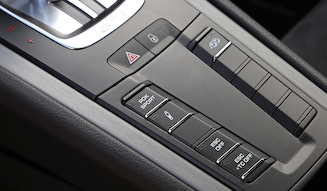
Incidentally, even on rough surfaces like the Nürburgring Nordschleife, "the PASM setting is preferably in Normal mode" (Walter Röhrl).
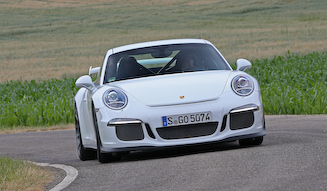
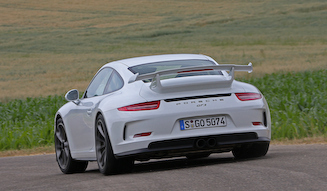
The latest generation GT3, with its new body, new engine, the decisive adoption of "PDK," and standard 4WS system, delivers a driving experience that is overwhelmingly powerful, overwhelmingly fast, and incredibly sensual.
For those who consider shifting gears an important part of the enjoyment of driving a sports car, the "disappearance of the manual transmission" will undoubtedly be a point of regret. However, Porsche's current stance is that "if such voices grow globally, there is a possibility of its reintroduction in the future."

Porsche 911 GT3 | Porsche 911 GT3
Body Dimensions | Length 4,545 x Width 1,852 x Height 1,269 mm
Wheelbase | 2,457 mm
Tread Front/Rear | 1,551 / 1,555 mm
Trunk Capacity | Front 125 / Rear 260 Liters
Weight | 1,430 kg
Engine | 3,799cc Horizontally Opposed 6-Cylinder
Compression Ratio | 12.9:1
Bore x Stroke | 102 x 77.5 mm
Maximum Output | 350kW (475ps) / 8,250 rpm
Maximum Torque | 440Nm / 6,250 rpm
Transmission | 7-Speed Automatic (PDK)
Gear Ratio | 1st 3.75
2nd 2.38
3rd 1.72
4th 1.34
5th 1.11
6th 0.96
7th 0.84
Reduction Ratio | 3.97
Drivetrain | RR
Suspension Front | MacPherson Strut
Suspension Rear | Multi-link
Tires Front/Rear | 245/35R20 / 305/30R20
Brakes Front | Cross-drilled ventilated discs, 6-piston opposed aluminum monobloc calipers
Brakes Rear | Cross-drilled ventilated discs, 4-piston opposed aluminum monobloc calipers
Maximum Speed | 315 km/h
0-100 km/h Acceleration | 3.5 seconds
Fuel Consumption (NEDC) | 12.8 ℓ/100km
CO2 Emissions | 306 g/km
Fuel Tank Capacity | 64 ℓ (Optional 90ℓ)
Price | ¥18,590,000