The Design of Golf: Giugiaro x De Silva | Volkswagen
Volkswagen Golf | Volkswagen Golf
Giorgetto Giugiaro x Walter de' Silva x Satoshi Wada
The Design of the Golf
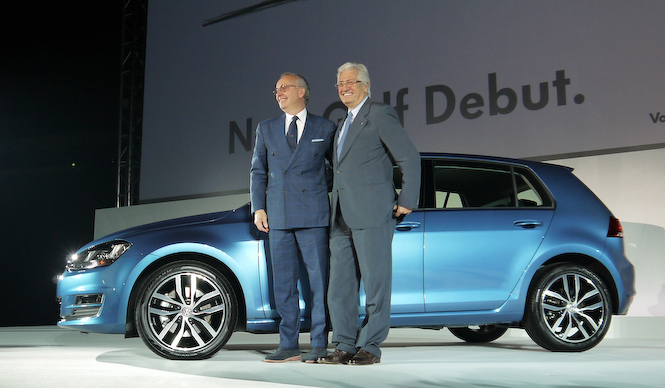
The styling of the "Golf," often called an evergreen, is renowned. What were the Volkswagen designers thinking when they created thenew Golf? We bring you a discussion among designers from the launch event held on May 20, 2013, at the Tokyo Metropolitan Gymnasium arena.launch eventWe bring you a discussion among designers from the launch event.
Text by OGAWA Fumio
What is a Golf Model Change?
Satoshi Wada(All titles omitted, hereafter Wada) It's an honor to be invited to the new Golf's launch event. When I was working on theAudidesign team and handled the "A5" and "A7," I had the opportunity to work with Mr. de' Silva. Today, please share your thoughts on the new Golf's design.
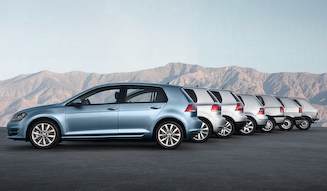
Walter Maria de' Silva(De' Silva) I'm delighted to be in Tokyo today. The new Golf has won the European Car of the Year award. For us, developing the Golf is incredibly important, especially considering that 29 million units have been produced in Wolfsburg over 40 years. The evolution of the Golf involves the difficulty of repeating without repeating.
Giorgetto Giugiaro(Giugiaro) Just as my children resemble me, some things are passed down in cars as well. I believe it's the same for the Golf. There are elements that should be inherited as part of the Golf's identity.
De' SilvaIf the form and details were to change completely, the logic of continuity would be lost. Many cars evolve with newness in mind, but the Golf is different.
We cherish the features that define the Golf, such as the horizontal lines, the thick C-pillars, and the beautiful body panels.
WadaMr. Giugiaro, what elements did you prioritize when designing the first generation?
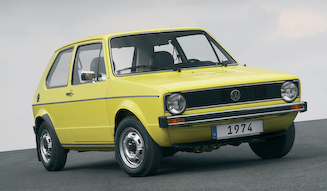
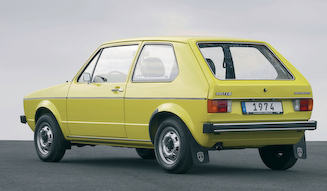
GiugiaroIt was in the 1970s. Volkswagen needed to consider a successor to the Beetle. They were looking for a model that could be mass-produced, was affordable, and economical. I designed with that in mind.
De' SilvaAs cars undergo model changes, there are various elements to update, such as technological advancements and improved handling. However, I believe VW has always prioritized the cultural aspect above all else. What VW considers important is the democratization of the automobile – providing good cars at affordable prices.
GiugiaroA true designer, in my opinion, is someone who grasps the core of a car and can also consider the company's perspective. When we consider why the first Golf was so well-received, it wasn't just about its looks. The architecture – the overall package including the engine and the price – was likely a key factor in its success. Therefore, we must not abandon these aspects during model changes.
Volkswagen Golf | Volkswagen Golf
Giorgetto Giugiaro x Walter de' Silva x Satoshi Wada
The Design of the Golf (2)
The Beauty of a Millimeter
WadaAutomotive design involves a complex interplay of aesthetic value, functional beauty, and cost. Nevertheless, appearance is generally very important and directly contributes to market appeal.
De' SilvaFor me, beauty is something that improves the world. So, what is beauty in a car? I believe the correct proportions are the most important element. When Satoshi (note: referring to Wada) was atAudi, we were always debating in extremely minute, millimeter-level details. Like, 'lower this character line by another 0.5 millimeters.'
WadaAnd surprisingly, the design would improve dramatically.
De' Silva: True beauty should emerge from the fine details.
Giugiaro: Exactly. Beauty is born in millimeters. Designers should be conscious of this. If they are careless, we end up with things like buildings that are nothing but visual pollution, ruining the urban landscape.
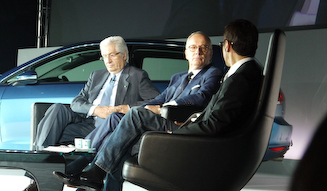
WadaWhat do you prioritize when designing a car?
De' SilvaEverything, not just cars, but cameras and chairs too, must be beautiful. Furthermore, they must be sold at an appropriate cost. Designers must always be mindful of these two aspects.
GiugiaroWe are egoists; we like ourselves and want to assert our presence, so we always have the desire to create something different. However, as professionals, it's also important to focus on functionality and adjust our desires accordingly. Design must be understood and accepted by the market to sell. Otherwise, a designer's value is nonexistent. It's not enough to think only of oneself; we must design products that gain user acceptance.
Only the Golf Inherits the Golf
Volkswagen Golf | Volkswagen Golf
Giorgetto Giugiaro x Walter de' Silva x Satoshi Wada
The Design of the Golf (3)
WadaThey say products have a life of their own.
De' SilvaI believe ethics are essential for automotive designers. When we work with appropriate ethical standards, we can create good things. There's no need to be swayed by trends. Cars involve enormous investment to develop and must sell for six to seven years. It's wrong to create something that loses everyone's interest in just a few months.
GiugiaroIn my design work, I strive for meticulousness, attention to detail, and avoiding ostentatious claims, ensuring authenticity. Just as there's equal temperament in music, there's a similar principle in car design. Cherishing this, I believe, can lead to creating designs that are loved for a long time, like the Golf.
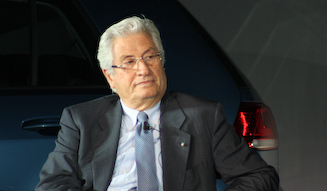
Giorgetto Giugiaro
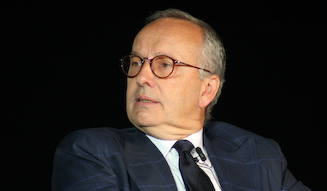
Walter Maria de' Silva
De' SilvaRegarding the Golf, I believe it's crucial to connect functionality with emotional elements. Some might say the Golf lacks emotional appeal, but there's also theGTI. Despite being designed with the Golf's characteristic simple lines, isn't it quite emotional?
GiugiaroWhen the first Golf was released, there were no cars with similar proportions. The impact was immense. Moreover, it had an identity that was easily recognizable by anyone.
Rivals have since created similar models, but none have persisted. Only the Golf continues to inherit the Golf's legacy. While some criticize its style as too simple, it might be akin to clothing. Designers' clothes are sold in Japan and Europe, but the people wearing them have distinctly different atmospheres because their lifestyles differ.
De' SilvaTo reiterate slightly, we meticulously focused on refining the details for the new Golf. We obsessed over every tenth of a millimeter in the lines.
Volkswagen Golf | Volkswagen Golf
Giorgetto Giugiaro x Walter de' Silva x Satoshi Wada
The Design of the Golf (4)
Changing the Design Isn't Difficult
WadaItaldesign Giugiaro joined the Volkswagen Group in 2010, correct?
De' SilvaThey've been a great asset. But working with the Maestro (referring to Giugiaro) is challenging (laughs). Because no one can be the Maestro's boss.
GiugiaroIs that so? (laughs) Having Mr. de' Silva in a key position is a significant advantage for Volkswagen's design. His discerning eye is crucial in determining design quality and proportions. With various proposals, it's important to have someone with a solid standard at the top.
De' SilvaI'm grateful that the Maestro offered significant advice when I was hired by the Volkswagen Group 15 years ago.
WadaBy the way, how was the design of the new Golf decided?
De' Silva: The common element with previous models is the C-pillar, a Golf characteristic. The major difference lies in technology. For instance, with glass, we can now achieve a curvature that was previously impossible.
Door gaps of just 3mm, which were considered impossible not long ago, are now achievable with the Golf. That's modern design.
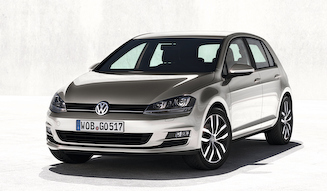
GiugiaroRadically changing the design isn't actually difficult. But what if it doesn't appeal to consumer tastes? For a model like the Golf, controlled evolution is necessary.
De' SilvaThe Golf is more product-oriented than styling-oriented. Beauty in the Golf is about functionality.
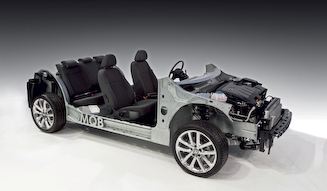
Furthermore, as a characteristic of the new Golf,MQB, a transverse-engine platform, is used. Twenty years ago, the Volkswagen Group's brands all used different platforms. Now, a single platform covers four brands – VW, Audi, SEAT, and Skoda – and 29 models. If I were to try and create a strong differentiation solely for the Golf, my superiors wouldn't be pleased.
Currently, a single platform covers four brands – VW,Audi, SEAT, and Skoda – and 29 models. If I were to try and create a strong differentiation solely for the Golf, my superiors wouldn't be pleased.
GiugiaroIn these times of global instability and economic uncertainty, we cannot afford to be frivolous. Simultaneously, safety standards and fuel efficiency requirements for automobiles are becoming increasingly stringent. To succeed, strong organizational power is essential, along with high intelligence and experience. This is an era where Volkswagen's strengths can truly shine.
The Golf is equipped to meet the demands of such times. It excels in safety and fuel efficiency, and its meticulous design, with perfect details and quality, aligns perfectly with Japanese preferences.

Walter Maria de’Silva
Oversees design for the Volkswagen Group. Born in Italy in 1951. Began his design career at Fiat in '72. From '77 to '86, he was the design director at IDEA, and from '86 to '99, he held the same position at Alfa Romeo. He joined the Volkswagen Group in '99 as design director for SEAT. Subsequently, he oversaw the design of Audi andLamborghiniat the Audi Group, before taking his current position in 2007.

Giorgetto Giugiaro
Born in Italy in 1938. His career began in '52 when he joined Fiat with the assistance of Dante Giacosa, who designed the iconic Fiat "600." In '59, he moved to Carrozzeria Bertone, then to Carrozzeria Ghia in '66. In '67, he founded his own company, Italdesign, with engineer Aldo Mantovani. Throughout his career, he has designed outstanding cars for various manufacturers in Europe, Japan, and the US. Italdesign's ability to handle everything from design to production for manufacturers led to its growth. In 2010, it became part of the Volkswagen Group, becoming Italdesign Giugiaro.

Satoshi Wada
CEO and Representative Director of SWdesign Inc. Born in Tokyo in 1961. Graduated from Musashino Art University, Department of Foundation Design. Joined Nissan Motor Co. in '84, where he worked on the first-generation Cefiro, the first-generation Presea, the Cefiro Wagon, and the electric vehicle Hypermini. In '98, he joined Audi AG / Audi Design, where he was responsible for models such as the A5, A7, and A1. In 2010, he established SWdesign TOKYO (Audi design partnership). In '12, he designed the "ISSEY MIYAKE WATCH \"W\"."