Porsche 911 50th Anniversary Event, Part 2 | Porsche
Porsche 911
50th Anniversary World Tour Report: Part 2
Establishing the 911 as a Modern Supercar──The 930, 964, and 993 Generations
More powerful, more comfortable. While expanding its model variations, the "911"2nd Gen "930"generation,3rd Gen "964"generation,4th Gen "993"generation, its position became firmly established. For our 50th anniversary test of successive 911 models,Part 1this installment sees Yasuhisa Shimashita test the air-cooled 911s, a golden era in the 911's lineage.
Text by SHIMASHITA Yasuhisa
Performance Surpassing the Legendary '73 Carrera
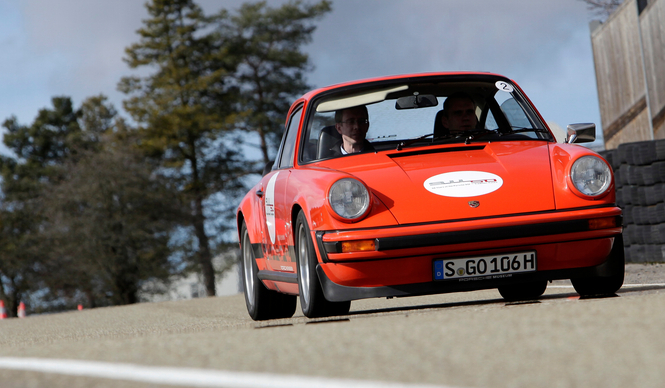
To meet increasingly stringent North American safety standards, models from 1974 onwards adopted larger bumpers and are often referred to as "Big Bumpers" or "930." Porsche itself now seems to officially use the internal code "G-Model" for the 1974 model year.
This G-Model was initially equipped with a 2.7-liter engine. In the 1978 model year, it transitioned to the "911 SC" with a 3-liter engine, and further in the 1983 model year, it received a 3.2-liter engine, achieving performance that surpassed the legendary "'73 Carrera RS," and was proudly renamed the "911 Carrera."
During this period, the epoch-making "911 Turbo" debuted in the 1974 model year. The Cabriolet also made its debut in 1983.
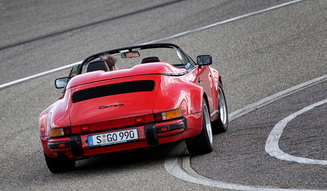
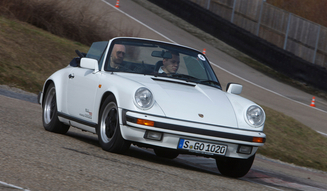
Among those prepared for this occasion was a rare "911 Carrera Clubsport," which debuted in 1987. Based on the 911 Carrera of the time, it featured a simplified and lightweight interior and exterior. While its power output remained 231 hp, comparable to other models, it pursued agile driving with features like a dedicated computer that increased the maximum allowable RPM by 400. Only 340 units were produced.
I've driven this car on another occasion, and the body felt incredibly solid, with the engine revving with explosive energy. The curb weight, just over 1,100 kg, is about the weight of one adult less, which likely contributes to this.
The form is unchanged from the narrow-body era, but the driving feel is more substantial and the stability is higher, with no perceived shortcomings even in today's traffic conditions. Contrary to its appearance, its substance had undergone significant evolution.
Porsche 911
50th Anniversary World Tour Report: Part 2
Establishing the 911 as a Modern Supercar──The 930, 964, and 993 Generations (2)
"Was the 964 always this enjoyable?"
The Type "964," introduced with the "911 Carrera 4" in the 1989 model year, evolved into a modern sports car with an increased engine displacement to 3.6 liters, along with the addition of power steering, ABS, and Tiptronic.
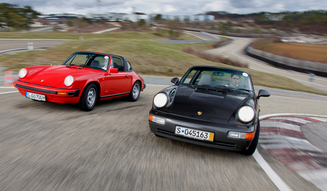
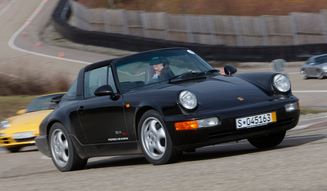
Meanwhile, its form, apart from the bumpers, once again followed the first generation. However, the drag coefficient (Cd) dramatically improved from 0.395 to 0.30.
The car I was able to drive was a '93 model, specifically the "Jubilee" 30th-anniversary limited edition released in the final year. It was a Carrera 4 with the Turbo look, meaning a wide body.
Driving the Type 964 again after a long time was a pleasant surprise. My honest impression was, "Was the 964 always this enjoyable?"
The solid, rigid body and the ride quality produced by the suspension, which used coil springs instead of the previous torsion bars, were both powerful even at low speeds and comfortable. The 3.6-liter flat-six engine, with its 250 hp output, offered a high-quality revving feel, exuding a sense of operating a fine machine.
The fact that this particular car hadn't covered many miles surely contributed positively as well.
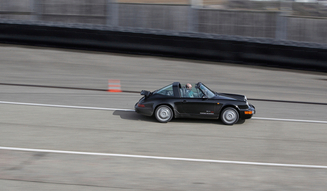
Although the Carrera 4 is sometimes overlooked in the used car market due to a negative image of lacking driving excitement, on this day, there were no instances where that was a drawback. I was once again convinced of the Type 964's enduring popularity, as it harmoniously blends performance and comfort that are still perfectly adequate today with classic charm.
Porsche 911
50th Anniversary World Tour Report: Part 2
Establishing the 911 as a Modern Supercar──The 930, 964, and 993 Generations (3)
The Last Air-Cooled 911
Speaking of enduring popularity, the Type "993" that followed shares the same sentiment. To improve aerodynamics, the front fenders were lowered, the rear suspension was changed to a multi-link setup, and the body became wider, marking the most significant visual changes to date.
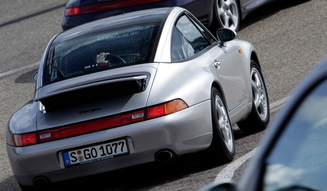
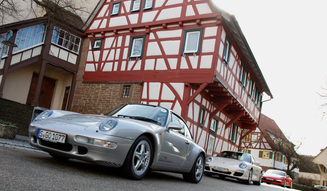
The engine displacement remained the same, but the maximum output increased to 272 hp, and for the first time, a 6-speed manual gearbox was incorporated. The high level of perfection in its hardware, along with the fact that it is the last air-cooled 911, contribute to the Type 993's popularity.
Although I couldn't drive it this time, Porsche Museum had a 911 Turbo available for test drives.
With the introduction of twin turbochargers, the engine power finally exceeded the 400 hp mark, reaching a maximum output of 408 hp. To transmit this power effectively to the road, this model became the first Turbo to feature a full-time four-wheel-drive system.
To be continued──