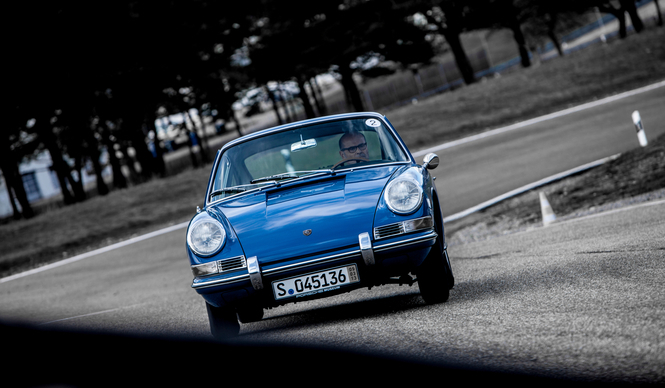
Porsche 911 50th Anniversary Event | Porsche
Porsche 911 | The 911
50th Anniversary World Tour Report: Part 1
Experience Seven Generations of the 911 in One Gathering──The 901 Chapter
Introduced by German sports car maker Porsche in 1963, the "911" has spent 50 years accumulating a brilliant record of victories in races and rallies. Germany reunified, the 21st century arrived, and the world changed dramatically, yet the "911" remained unchanged, continuing to be Europe's representative sports car. To celebrate the 50th anniversary of the "911's" birth, the "911 World Tour" event will be held worldwide this year. The press event, marking the start of this tour, took place in Stuttgart, Porsche's home ground. A report from the scene by Yasuhisa Shimashita.
Text by YASUHISA SHIMASHITA
An Unprecedented Test Drive
Porsche's "911" was first unveiled to the world under the name "901" at the Frankfurt Motor Show in September 1963. This year marks its momentous 50th anniversary.
To celebrate, Porsche has planned a year-long series of commemorative events worldwide under the banner "911 World Tour." The press event held on a certain day in March near Stuttgart was, in essence, the kickoff.
The main event was a test drive of various 911 models from the Porsche Museum's collection. Starting from the museum itself, we drove a succession of models spanning seven generations, from the first to the current, all the way to the Weissach research and development center, revered as a mecca by fans.
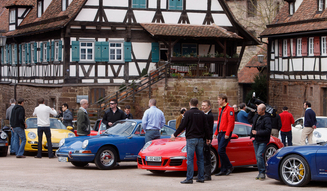
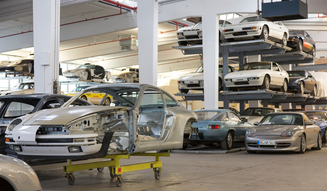
En route, we visited the "Porsche Classic" factory, and in the evening, we were able to view valuable exhibits at the "Retro Classics" event held at the Stuttgart Messe. The highlight, however, was undoubtedly the test drive. At Weissach, we were even allowed to take the wheel freely on the test track.
We were told that allowing an outsider to drive, rather than just ride as a passenger, was unprecedented. Indeed, I myself had only ever experienced the passenger seat here before. It was truly a precious opportunity. From here, let's delve into the models we tested, following their historical progression.
Porsche 911 | The 911
50th Anniversary World Tour Report: Part 1
Experience Seven Generations of the 911 in One Gathering──The 901 Chapter (2)
Testing the Narrow 911 First
While I myself have had several opportunities to test older models and thought I knew them reasonably well, this was my first time driving seven generations of the model almost simultaneously, and the day was filled with new discoveries, surprises, and emotions.
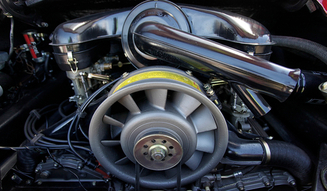
The earliest models, known by the nickname "narrow," refer to the model years from 1964 to 1973. As the famous anecdote goes, due to a complaint from Peugeot regarding the three-digit naming convention with a "0" in the middle, the model was quickly renamed the 911. Initially, it was equipped with a 2-liter air-cooled flat-six engine producing a maximum of 130 horsepower.
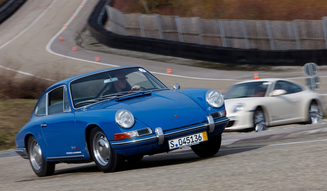
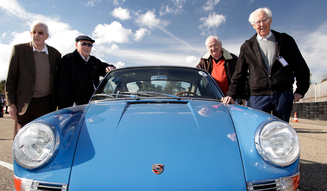
The lineup gradually expanded with the addition of the Targa, a semi-open body style, and the high-performance "911S."
Furthermore, the lineup evolved with extensions to the wheelbase to improve handling and increases in displacement to 2.2 and then 2.4 liters to meet stricter emission regulations.
The legendary "73 Carrera RS" appeared in the final year of this generation, its 2.7-liter flat-six producing a formidable 210 horsepower.
This time, we were able to test two of these models: a 1964 coupe and a 1967 Targa. A distinctive feature of this early Targa model is its vinyl rear window, which could be opened and closed with a zipper.
Porsche 911 | The 911
50th Anniversary World Tour Report: Part 1
Experience Seven Generations of the 911 in One Gathering──The 901 Chapter (3)
Uncompromising Satisfaction
As the engines in both models were carbureted, they were not particularly lively at low RPMs. Moreover, if you were to over-accelerate in haste, the engine's revs would climb even more sluggishly.
However, if you carefully applied the throttle, the engine would suddenly liven up past 5,000 rpm and smoothly rev all the way to the limiter. This era of the 911 demanded to be driven hard.
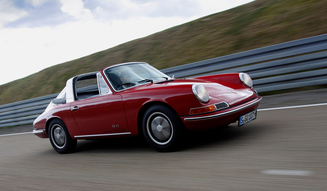
What was more impressive was the handling. When turning the large steering wheel, which seemed to be 420mm in diameter, the car would momentarily initiate a yaw with a noticeable amount of body roll, a characteristic RR behavior. It was the kind of behavior typical of an early model with a short wheelbase, and on the Weissach test track, it was thrilling enough to cause several heart-stopping moments, though perhaps less so on public roads.
However, as I became accustomed to it, I learned to use the slight instability of the car's behavior to turn it sharply, then immediately apply throttle to settle the rear and accelerate away like a startled rabbit. I became engrossed in pushing the car to its limits.
While the absolute speed was not high, the driving experience, which combined delicate control like threading a needle with the boldness required to push the engine to its top end to achieve speed, delivered an uncompromising sense of satisfaction.
To Part 2: The 930, 964, and 993──