The VW Group's Vision for an Autonomous Driving Society | Volkswagen
Volkswagen
An Interview with Dr. Helge Neuner, Head of Development
The VW Group's Vision for an Autonomous Driving Society
On January 15th, the German Volkswagen Group announced a global strategic partnership with US automaker Ford Motor Company. Following joint development in the commercial vehicle sector, the two companies plan to collaborate in areas such as electric vehicles, autonomous driving, and mobility services. Dr. Helge Neuner, head of the autonomous driving division at the Volkswagen Group, was in Japan to deliver a keynote speech at Automotive World. We took this opportune moment to speak with him about the challenges and current status of autonomous driving realization as envisioned by the Group.
Text & Photographs by Akira Hara
Autonomous Driving Divided into Five Levels
First, current levels of autonomous driving are divided into six stages defined by the US non-profit organization SAE, the outlines of which are as follows.
Level 0 (No Automation): The driver performs all operations.
Level 1 (Driver Assistance): The system assists with either steering or acceleration/deceleration. Automatic braking and ACC (Adaptive Cruise Control) fall into this category.
Level 2 (Partial Automation): The system assists with both steering and acceleration/deceleration. Volkswagen's 'Traffic Jam Assist,' which follows the vehicle ahead in highway traffic jams, is an example. The driver must constantly monitor the surroundings.
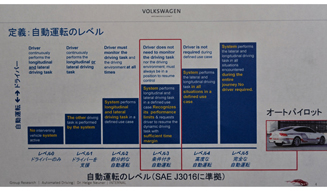
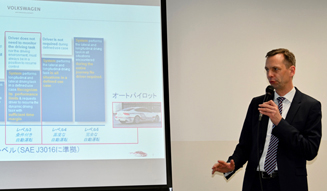
Level 3 (Conditional Automation): The system performs all operations under limited circumstances. The driver must take over in emergencies. What is generally referred to as autonomous driving begins at this level, with Audi's 'A8' being the first production vehicle to feature 'AI Traffic Jam Pilot.'
Level 4 (High Automation): In specific locations, such as highways, the system perceives traffic conditions and handles all driving and emergency responses.
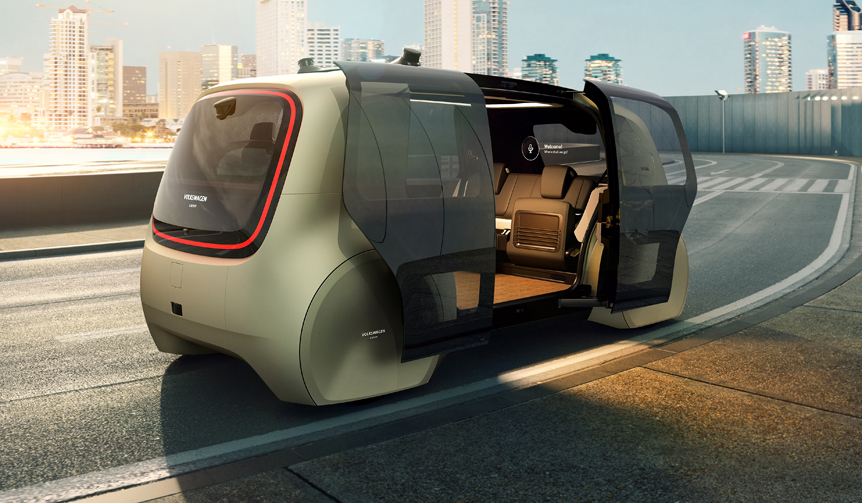
Level 5 (Full Automation): Regardless of location or situation, the system performs all driving operations, enabling driverless autonomous driving. Volkswagen's previously announced concept car, 'Sedric,' belongs to this category.
Dr. Neuner's explanation covered the technical challenges in transitioning from Level 2 to Level 3, the concept of Level 3 and its applied form 'Guardian Angel,' and the scenario for achieving Level 5.
Volkswagen
An Interview with Dr. Helge Neuner, Head of Development
The VW Group's Vision for an Autonomous Driving Society (Part 2)
'Guardian Angel' and Human-Machine Interface
Volkswagen's autonomous driving development, which has been underway for 15 years, began by addressing three challenges: first, making driving safer; second, making it more efficient; and third, enhancing comfort.
Regarding currently available autonomous driving features, which are up to Level 2, referred to as driver assistance, Dr. Neuner stated, 'The first challenge is how users interact with Level 2 vehicles. Users need to manage two modes: autonomous driving and manual driving. To address this, we introduced a dedicated HMI (Human-Machine Interface) where each mode is clearly indicated with distinct colors and shapes.'
Furthermore, with Level 3, there is the challenge of transitioning back to driver control from autonomous driving.
'During the initial design phase, we conducted a study on the handover time required to return to manual driving. We found that if the user is only using auditory senses, such as listening to music, the average time is 3.2 seconds. If they are using auditory, visual, and tactile senses, such as playing video games, it takes 8.8 seconds, with no significant age-related differences.' Therefore, the Level 3 interface was designed with a handover time of up to approximately 10 seconds in mind. Naturally, he added, 'This function needs to operate everywhere, and it's not a case of cost being no object, so we also had to consider the purchase cost relative to the benefits.'
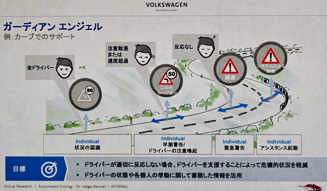
On the other hand, fatal accidents occur far more frequently in suburban areas than on highways. With this in mind, the approach known as 'Guardian Angel' was developed around mid-2018, aiming to extend the benefits of Level 3 autonomous driving technology, designed for highways, to other roads, including suburban ones.
'For example, imagine driving on a suburban road with a curve ahead. The car, using its onboard technology and map data, already detects the type of curve. The system then monitors the driver's behavior, checking their gaze and speed. If the probability of an accident increases, the system intervenes, providing early warnings, emergency alerts, and assistance with braking or steering to avoid risks and mitigate dangers. This is the concept of Guardian Angel,' he explained.
While technically simpler than Level 5, the human interaction (communication) aspect is different, and here too, the HMI plays a crucial role.
'With autonomous driving, it's straightforward: 'Press the accelerator and you don't have to do anything else.' But with Guardian Angel, the driver is usually in control, and the system intervenes when necessary. It's difficult for users to understand the nuances of how to respond. So, some time ago, we conducted a test called a 'Race Trainer,' where individuals who don't normally drive on a circuit experienced what happens when Guardian Angel activates. We are learning about HMI through such experiences,' he shared.
Volkswagen
An Interview with Dr. Helge Neuner, Head of Development
The VW Group's Vision for an Autonomous Driving Society (Part 3)
Accelerating Development with Partners Towards Level 5
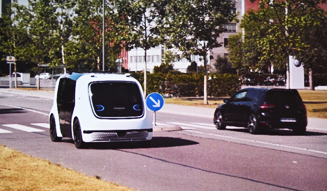
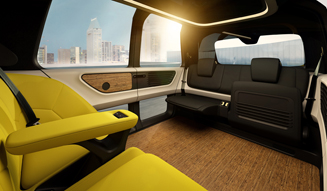
Next, he spoke about the 'Sedric,' a Level 5 autonomous driving concept car that is already undergoing test drives on public roads.
'Sedric represents a completely different business case; it's mobility as a service. It competes with existing taxis and other services, and the business model is being developed by comparing it with factors like labor costs for taxis,' he explained.
On the technical side, he noted, 'When humans drive, they anticipate the movements of other vehicles around them while operating. In a fully autonomous vehicle, sensors and radar gather information, and the processing software predicts and calculates the optimal trajectory. In reality, highway driving involves fewer operations. However, in roundabouts, common in Europe and elsewhere, there are many sub-tasks such as decelerating upon entry, yielding to other vehicles, accelerating to enter, and re-accelerating upon exit. The software uses algorithms for planning, but this calculation is a very complex task.'
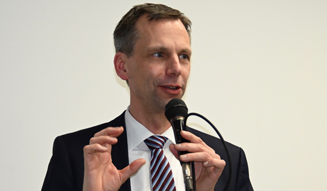
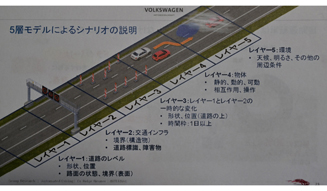
'Ninety percent of today's accidents are due to human error by drivers. Statistically, a fatal accident occurs only after a driver has traveled 600 million kilometers. We need to cover every conceivable scenario within those 600 million kilometers, and we have divided this into five layers. However, vehicles within these scenarios vary greatly in shape, manufacturer, color, and even the presence of stickers on bumpers. It's impossible for the system to cover every variation. Real-world data has gaps, overlaps, and repetitions. We don't believe it's necessary to cover all data; the crucial task is to collect the data required for the software to process, while verifying the system's approach against actual data.'
Regarding the launch timing for Sedric, he stated, 'We believe a launch in 2021 would be ideal. While hardware like computers and sensors are important for realizing autonomous driving, the most critical element is software. We know that partnering with others will accelerate development, so we are constantly exploring potential collaborations.'
The joint development with Mobileye, an Israeli semiconductor manufacturer announced at CES in Las Vegas, and the partnership with Ford announced recently, are part of this trend. With similar moves by Toyota with Uber and Honda with GM, the automotive industry's greatest challenge—autonomous driving—is likely to see accelerating collaboration. However, it is also true that realizing this goal involves numerous strategic challenges, including legal aspects and differences between developed and emerging nations.