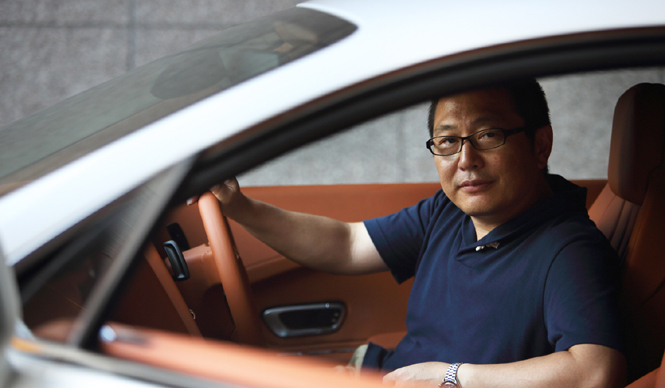
OPENERS CAR Selection 2012 | Tatsuya Otani
2012's Five Cars for OPENERS CAR Readers
OPENERS CAR Selection 2012: Tatsuya Otani
The editors of OPENERS CAR asked six of the writers who supported OPENERS CAR in 2012 to look back on the year and select five cars that they want OPENERS readers to pay attention to. Here are Mr. Tatsuya Otani's five picks!
Text by OTANI Tatsuya
2012: A Bright and Enjoyable Year for Cars
In recent years, global warming and the depletion of underground resources have been brought to the forefront, creating a powerful headwind for the automotive industry. At the start of this year, the European economic crisis was added to the mix, leading to anxieties that the future of cars was becoming increasingly bleak.
Yet, car manufacturers are not deterred by anything. In 2012, I felt as though we witnessed their unwavering resolve and the robust power of their technological innovation that underpinned it.
For example, environmental and resource issues were addressed through engine improvements and electrification technologies such as hybrids and EVs. Fuel cell vehicles, once thought to be technology of the distant future, are now slated for commercial release within two to three years. In response to the economic crisis, manufacturers are reducing costs through design and production efficiencies to create products suited for a deflationary society, while also pursuing strategies for emerging markets through similar cost reductions. Furthermore,some manufacturers, like the Volkswagen-Audi Group, have even expanded into energy development.Therefore, I no longer fear any situation. The anxiety I felt a few years ago, wondering if cars would disappear from the face of the earth in 20 years, seems to have completely vanished.
What was even more pleasing was that, in addition to tackling these negative challenges, car manufacturers also made a solid commitment to the positive theme of pursuing the joy of driving. While they have spoken of "dynamic driving feel" and "pursuit of agility" for quite some time, these are no longer mere platitudes but are now reflected in actual products, allowing drivers to experience them tangibly behind the wheel. As a result, I've found myself increasingly rediscovering the simple pleasure of driving a car.
Thus, I view 2012 as a year that offered bright prospects for the future of automobiles.
Tatsuya Otani's Top 5 Picks for OPENERS Readers in 2012
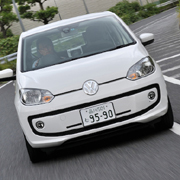
Every year, countless new cars are introduced and then disappear. Some models are clearly intended to be sold in limited numbers immediately after launch and then discontinued. But the up! is different. Volkswagen surely built this car with a vision for 10 or 20 years from now. That's why the up! is so well-executed. I recommend it as a compact car that you absolutely won't regret buying today (provided you don't mind the gearbox).
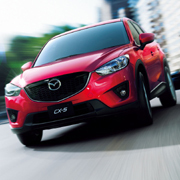
MAZDA CX-5
Mazda CX-5
Mazda CX-5
Twenty years have passed since the bubble burst. Since then, Japan's economy has been relentlessly pressured by the Lehman shock, the strong yen, and the Great East Japan Earthquake. As a result, Japanese car manufacturers have been exhausted, increasingly falling behind their European counterparts. However, this sense of crisis has spurred Mazda to action. They have revolutionized their vehicles with the innovative "Skyactiv Technology." In particular, their low-compression diesel engine, which leads global technological trends, is a masterpiece that has opened new frontiers in performance, emissions, and cost. It has reminded the Japanese people of the brilliance of modern diesel engines.

Volkswagen-Audi was the first to commercialize direct-injection turbo diesel engines for passenger cars. Mercedes-Benz was the first German manufacturer to bring the latest clean diesel to Japan. And now, Mazda's CX-5 is striving to widely convey its appeal. But, as expected from BMW, their pride as engine specialists has led them to create the first German-made diesel car that meets Japan's strict regulations without complex post-treatment. This car has taught us that diesel can be an advantage, rather than an excuse, in terms of performance.

Recent Lamborghinis are well-built, fast, and stylish, offering many positives, but they've become too well-behaved, lacking the excitement that stirs the soul. The engine, in particular, is easy to handle and powerful, but it lacks the dramatic flair expected of a supercar. This has been somewhat disappointing for those familiar with the "raging bulls" of yesteryear. However, the Aventador is different. Its latest V12 engine exudes a dangerous aura, a scent of mortality. The carbon bodywork and styling are flawless, but this engine alone is worth the 42 million yen price tag.
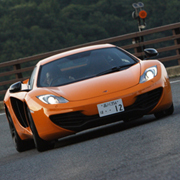
This is the complete opposite logic to the Aventador, but please don't be surprised. For an F1 car battling at 300 km/h, the most important factors are high stability and ease of handling. Therefore, the MP4-12C, built with the same philosophy, carries no dangerous aura. So, what is the appeal of the MP4-12C? McLaren has poured all of its technology and know-how into creating a frighteningly high-performance and high-quality supercar. As a result, even when driven at 60 km/h, the background of this car is palpable. This is likely the first supercar of its kind in history. It stands as a monument in sports car history, alongside the F1 road cars McLaren created in the 1990s.

Tatsuya Otani × OPENERS CAR 2012
SUBARU BRZ
Audi Q3
Audi S6, S6 Avant & S7
Volkswagen Golf blue-e-motion
Audi A1 Sportback
BMW 6 Series Gran Coupe
Bentley Continental GT V8
BMW M5
Renault Koleos
Porsche Boxster & 911
Volkswagen up!
McLaren MP4-12C
Mercedes-Benz G65 AMG
BMW 3 Series
Mercedes-Benz M-Class
Lexus LS
Lexus GS & BMW ActiveHybrid5
BMW 7 Series
Volvo S60 AWD R-Design Polestar Performance package