Test Drive: Porsche 911 Carrera 4 | Porsche
Porsche 911 Carrera 4 | Porsche 911 Carrera 4
Test Drive: 911 Carrera 4
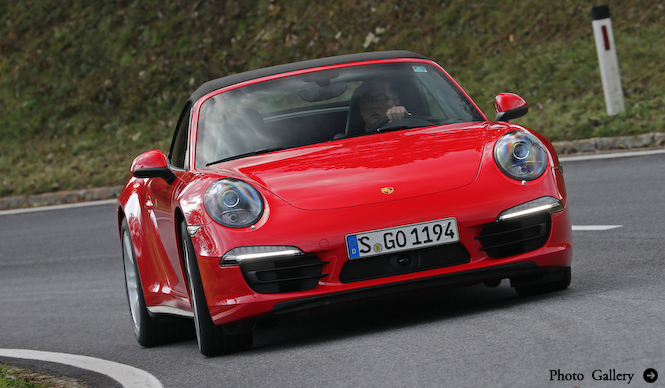
The engine is mounted above the rear wheels, transmitting power to the rear wheels—a rear-engine, rear-wheel-drive (RR) layout that Porsche has continued to employ to this day.Porsche "911"has hadthe third-generation 964 modelavailable as the four-wheel-drive "Carrera 4," which also drives the front wheels. The seventh-generation 911, the 991 model, which debuted in September 2011, also added the Carrera 4, and it made its world premiere at the Paris Motor Show 2012.Paris Motor Show 2012at theworld premiereToshifumi Watanabe was quick to get behind the wheel of the new "911 Carrera 4"!
Text by WATANABE Toshifumi
An All-Purpose, Confidence-Inspiring Partner for Life
PorscheFew would dispute that the "911" is Porsche's most iconic product.
Next year marks the 50th anniversary of the 911's birth. Its fundamental layout since inception has been the "RR" configuration, with the engine mounted behind the rear wheels and driving them.
The RR layout, due to the engine's weight constantly pressing down on the driven rear wheels, allows for efficient power transfer. However, a physical characteristic is that the load on the front, steering wheels, is naturally always lighter. In simple terms, it moves forward powerfully but is difficult to turn. The 911 has continuously battled this challenge throughout its history.
On the other hand, it's also true that many fanatics have supported this car by embracing the challenge of mastering its handling. They don't seek ease or simplicity from the 911; they appreciate the pure RR layout as a pursuit.
Perhaps for this reason, not many users in Japan actively choose the four-wheel-drive 911. However, globally, over 35 percent of 911s—more than one in three—are four-wheel-drive.
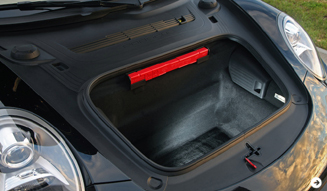
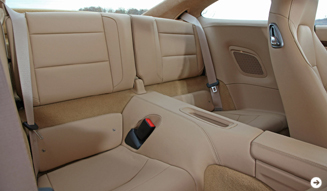
However, the inherent versatility of the 911's design, coupled with the proliferation of two-pedal models, is undeniably being recognized as a strong selling point here in Japan as well.
It's a pure sports car, allowing for precise control. Furthermore, it's compact and easy to maneuver, with ample cargo space—these aspects are now considered advantageous for a partner to share in daily life, forming the backbone of Porsche's business.
In other words, there is still significant potential for growth among users who choose four-wheel drive as a means to achieve greater versatility and confidence.
Porsche 911 Carrera 4 | Porsche 911 Carrera 4
Test Drive: 911 Carrera 4 (Part 2)
Its Mechanics
Like its predecessor, the 991 generation "Carrera 4" and "Carrera 4S" feature a wider body compared to the basic Carrera.
This 44mm increase in width, 22mm on each side, lends a more dynamic appearance than the numbers suggest, while the overall width remains within 1,850mm, maintaining a practical balance.
The rear garnish between the taillights, a carryover from the previous model, is more prominent on the 991, featuring illumination that acts like a marker light.
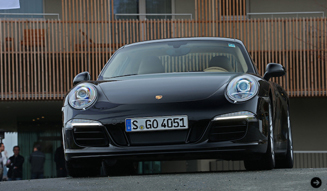
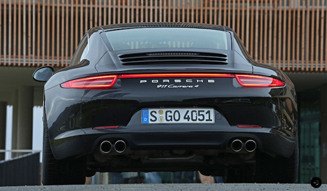
The drivetrain is the same as the previous model: a full-time four-wheel-drive system using an electronically controlled multi-plate clutch in the center differential. While normally operating with nearly 100% rear-wheel drive, it can distribute up to approximately 50:50 between front and rear depending on the vehicle's driving conditions.
The transmission options are the same as the Carrera series: a 7-speed manual and a 7-speed PDK. For the 7-speed manual, a new Synchro Logic system has been added, which automatically matches engine revs during downshifts, but only when the Sport Plus mode is selected.
Engine output is identical to the Carrera series. The suspension also features no changes to the dampers or spring rates themselves; only the stabilizers have been strengthened to optimize the setup.
Porsche 911 Carrera 4 | Porsche 911 Carrera 4
Test Drive: 911 Carrera 4 (Part 3)
Using All Four Wheels More Than Expected
Looking at the torque graph for the front and rear wheels displayed on the multi-information display within the traditional 911 five-gauge cluster, it's clear that power distribution to the front wheels—the four-wheel-drive state—occurs more frequently than anticipated.
Torque is applied to the front wheels not only during acceleration and cornering but also subtly during high-speed cruising. This means four-wheel drive is effectively utilized not just for front-rear grip balance but also for improving straight-line stability against disturbances like crosswinds.
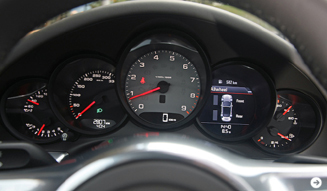
Despite this, the system's operation is remarkably natural, and the steering feel in normal driving conditions gives no hint of it being a four-wheel-drive vehicle.
Unless you are driving aggressively with excessive throttle input, the car doesn't pull into the corner as you turn the wheel; instead, it carves a neutral arc.
While the assistance is certainly present, the setup ensures that the presence of rear-wheel drive, a hallmark of the 911, is always felt.
Is Four-Wheel Drive Now the 911 Standard?
Of course, devices like brake vectoring strongly enhance cornering performance, but they are likely rarely needed at the speeds one would typically drive on public roads. The powerful mechanical grip from all four wheels is sufficient for most situations. The unwavering stability, which feels completely natural on public roads, provides the driver with a sense of security.
I have driven an RR 911 in adverse weather conditions that would normally make one hesitate to drive at all, on several occasions.
In situations where cars with lighter front-end weight distribution struggle, I was impressed that the 911 navigated them calmly, situations that would have had the driver's palms sweating in a typical sports car.
Conversely, it's also true that I felt a slight lack of confidence at high speeds.
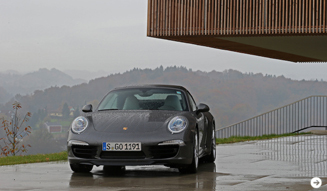
Because it's a car that offers long-distance comfort and practicality, having complete confidence is essential. For those seeking such utility, actively choosing the four-wheel-drive 911 might be the way to go. Moreover, even for dedicated sports car enthusiasts, the unparalleled refinement of the Carrera 4 is undoubtedly appealing.
Naturally, for those who wish to pursue the ultimate driving experience with an RR setup, a different option—the "GT3"—will be available in the future.
Within this broad product range, the Carrera 4's sense of being the standard has undoubtedly become even more pronounced than in the previous generation.

Porsche 911 Carrera 4 | Porsche 911 Carrera 4
Body Dimensions | Length 4,491 x Width 1,852 x Height 1,304 mm
Wheelbase | 2,450 mm
Tread Front/Rear | 1,532 / 1,560 mm
Trunk Capacity | 125 Liters
Weight | 1,430 kg [1,450 kg]
Engine | 3,436cc Flat-6
Max Output | 257 kW (350 hp) / 7,400 rpm
Max Torque | 390 Nm / 5,600 rpm
Transmission | 7-speed Manual [7-speed PDK]
Drivetrain | 4WD
Tires Front/Rear | 235/40R19 / 295/35R19
0-100 km/h Acceleration | 4.9 seconds [4.7 seconds]
Fuel Consumption (NEDC Combined) | 9.3 ℓ / 100km [8.6 ℓ / 100km]
CO2 Emissions | 219 g / km [203 g / km]
*Figures in brackets are for PDK specification.
Porsche 911 Carrera 4S | Porsche 911 Carrera 4S
Body Dimensions | Length 4,491 x Width 1,852 x Height 1,296 mm
Wheelbase | 2,450 mm
Tread Front/Rear | 1,538 / 1,552 mm
Trunk Capacity | 125 Liters
Weight | 1,445 kg [1,465 kg]
Engine | 3,800cc Flat-6
Max Output | 294 kW (400 hp) / 7,400 rpm
Max Torque | 440 Nm / 5,600 rpm
Transmission | 7-speed Manual [7-speed PDK]
Drivetrain | 4WD
Tires Front/Rear | 245/35ZR20 / 305/30ZR20
0-100 km/h Acceleration | 4.5 seconds [4.3 seconds]
Fuel Consumption (NEDC Combined) | 9.9 ℓ / 100km [9.1 ℓ / 100km]
CO2 Emissions | 234 g / km [215 g / km]
*Figures in brackets are for PDK specification.