The Autonomous Driving Era as Envisioned by the Volkswagen Group | Volkswagen
Volkswagen
Head of Autonomous Driving Research at the Volkswagen Group
An Interview with Dr. Helge Neuner
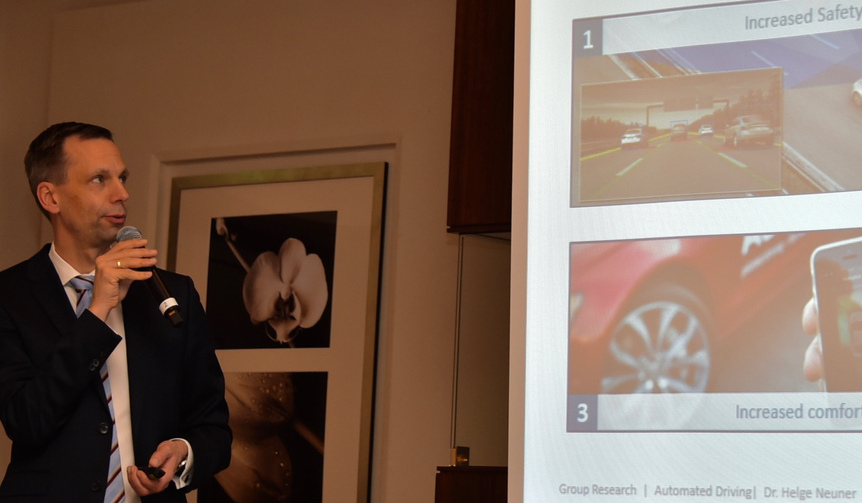
Autonomous driving technology is a field where automakers worldwide are engaged in a development race. In July of this year, Audi announced it would be the first in the world to equip a production car with Level 3 autonomous driving capabilities. The development was overseen by Dr. Helge Neuner, head of the Volkswagen Group's autonomous driving research division, to which Audi belongs. Dr. Neuner, who visited Japan as a guest speaker for the government project "SIP-adus (Cross-ministerial Strategic Innovation Promotion Program - Automated Driving System) 2017" held from November 14th, shared his insights on "Autonomous Driving as Envisioned by Volkswagen."
Text by HARA Akira
From Ownership to Sharing, From Manufacturing to Mobility Services
Before delving into specific topics, Dr. Neuner began with a general overview of autonomous driving.
Volkswagen began developing autonomous driving in the early 2000s, and when it becomes fully realized, it will offer
1. Enhanced safety for humans, reducing the number of accidents.
2. Improved fuel and energy efficiency compared to manual driving.
3. Alleviation of traffic congestion as a societal infrastructure benefit.
4. Increased user comfort, allowing individuals to utilize driving time for personal activities.
These are the benefits Dr. Neuner highlighted.
Autonomous driving is categorized into levels 0 through 5. Today's so-called autonomous vehicles achieve Level 2, where the car controls vehicle operations, but the human monitors the system.
At Level 3, the system monitors under certain conditions, with the car or human taking control depending on the situation. Crucially, it is necessary to clearly define the boundaries of control for each. Dr. Neuner's team has been researching the human-machine interface (e.g., indicator colors, sounds) for these transitions through test drives since around 2015.
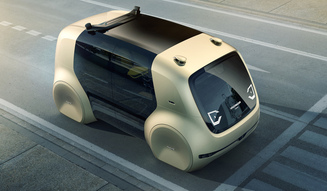
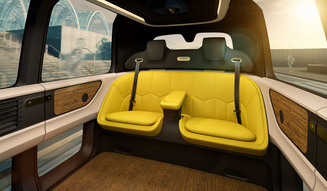
Volkswagen Sedric
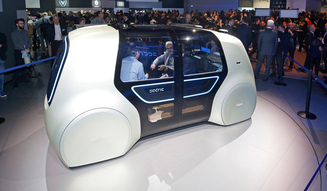
At the recent Frankfurt Motor Show, Volkswagen unveiled "Sedric," a fully autonomous vehicle equivalent to Level 5. Its exterior and interior are radically different from current cars, notably lacking a steering wheel. Sedric was developed with a new business model in mind: shifting from consumers buying and owning cars to a shared mobility service, where vehicles are used for transportation and can be summoned like taxis.
Regarding the progression to higher levels of autonomous driving, such as Level 4 and Level 5, Dr. Neuner's team believes it will not be a matter of choosing between a step-by-step approach or a revolutionary leap. Instead, they anticipate a parallel development driven by complex requirements including customer needs, technological challenges, and global conditions.
Volkswagen
Head of Autonomous Driving Research at the Volkswagen Group
An Interview with Dr. Helge Neuner (Part 2)
Reasons for Proactive Entry into Mobility Services
—A renowned figure in the automotive industry has stated that traditional cars will be obsolete in 20 years. Conversely, figures like Carlos Ghosn (former Chairman and CEO of the Renault-Nissan Alliance) have expressed different views. What is Volkswagen's perspective?
That's a crucial question. There isn't a single answer that applies globally, as markets vary. However, in major urban centers, mobility will indeed transition towards services. Manual driving will likely persist elsewhere. Volkswagen, though, is attuned to these trends. We are aiming for a transformation, moving from being a car manufacturer to a mobility services company.
—Could you elaborate on why automotive manufacturers are promoting business models that de-emphasize car ownership and potentially reduce the total number of vehicles?
A shift to mobility services means that individual vehicles will be used by many people, increasing their mileage. This necessitates durable vehicles, but also leads to more frequent replacements. Furthermore, as an automotive manufacturer, we have a role to play in addressing societal issues such as traffic congestion and accident reduction through these solutions.
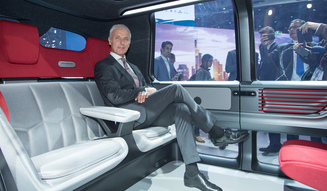
—Regarding autonomous driving in large cities: consider the Place de l'Étoile roundabout in Paris, where twelve roads converge. Can hardware truly be developed to ensure accident-free operation in such complex environments?
We will not bring a system to market unless it can drive better than a skilled human driver. Anything less is unacceptable. Through millions of kilometers of driving data and simulations, we are rigorously verifying whether the autonomous driving concept is superior to human driving and if it is technically feasible.
—We've heard that technologies like quantum computing are being used in development.
Quantum computers offer extremely high processing speeds, and we anticipate their use in developing AI systems in the future. However, we do not believe that autonomous driving systems are impossible to realize without them.
Volkswagen
Head of Autonomous Driving Research at the Volkswagen Group
An Interview with Dr. Helge Neuner (Part 3)
Brand Differentiation in the Era of Autonomous Driving
—We've heard that by 2020, you plan to offer Level 4 autonomous driving in EVs with a 600 km range, sold at a price comparable to theGolfmodel. Is this accurate?
While I am not directly responsible for product management, we must deliver on our promises. That is why we are investing. E-mobility is a company-wide strategy for Volkswagen, and integrating autonomous driving technology into electric vehicles is a natural progression. Development incurs costs, but as a large corporation, we have the advantage of scale. We aim to reduce costs by collaborating with startups in IT and other sectors to find solutions.
—Autonomous driving regulations vary by country. Is Volkswagen actively engaging with governments worldwide on this matter?
While regulations differ across nations, we are observing commonalities. We are advocating for common standards and harmonization not only with the German government but also with governments globally, aiming for a shared understanding in international markets.
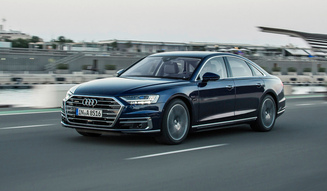
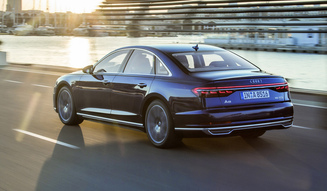
Audi A8
—What is the reason for Audi's apparent lead, such as the integration of Level 3 autonomous driving in the newA8model?
Audi is a premium brand, focused on providing a comfortable experience for its users. The Level 3 system in the A8 is ideal for alleviating the stress of traffic congestion. Meanwhile, each brand within the group has its own DNA; for instance, Porsche excels in acceleration performance. While we apply fundamental technological components across the group, we must redefine what is necessary for each brand and leverage core technologies.
—In a society with autonomous driving, won't differentiation between brands become more difficult?
The initial autonomous driving solutions will be deployed in limited regions. Therefore, privately owned vehicles and mobility services will coexist at first. However, the perception of cars is shifting from a focus on performance and horsepower to the in-car experience and comfort. The advent of autonomous vehicles is prompting a re-evaluation for all brands, and it is essential to establish a clear positioning.
This revelation that Volkswagen aims to transform from a car manufacturer to a mobility services company in an era of widespread fully autonomous driving is quite striking. It leaves one wondering how other manufacturers will survive and what will become of other brands. The intrigue is boundless.