"YET" Connects to Lexus's Brand Philosophy | Lexus
Lexus
"YET" Connects to Lexus's Brand Philosophy
Lexus exhibited at "Milan Design Week" again this year. The theme for the 10th iteration was "YET." Alongside installations featuring pillars of light and displays of past exhibition works, the annual "Lexus Design Award 2017" prototypes were also on display. This report is by Fumio Ogawa, who visited the event again this year.
Text by OGAWA Fumio
Classical Yet Cutting-Edge
"Milan Design Week" was held from April 4th to 9th, 2017. Lexus's exhibition there generated considerable buzz.
The Design Week encompasses both the so-called "Milan Salone," a furniture trade fair held at the international exhibition center, and "Fuori Salone," where not just furniture but all kinds of "design" are unveiled at various locations throughout the city.
There were many interesting exhibits from Japanese companies as well. Among them, Lexus stood out for its unique concept presented on a grand scale.
Every year, Lexus presents installations (exhibitions where the space itself is part of the artwork) based on bold ideas. The theme for 2017 was ""YET"".
Ancient Yet Modern
Ancient Yet Modern
The exhibition space at the "Triennale di Milano," located in the heart of Milan, was an overwhelming, pitch-black environment upon entering.
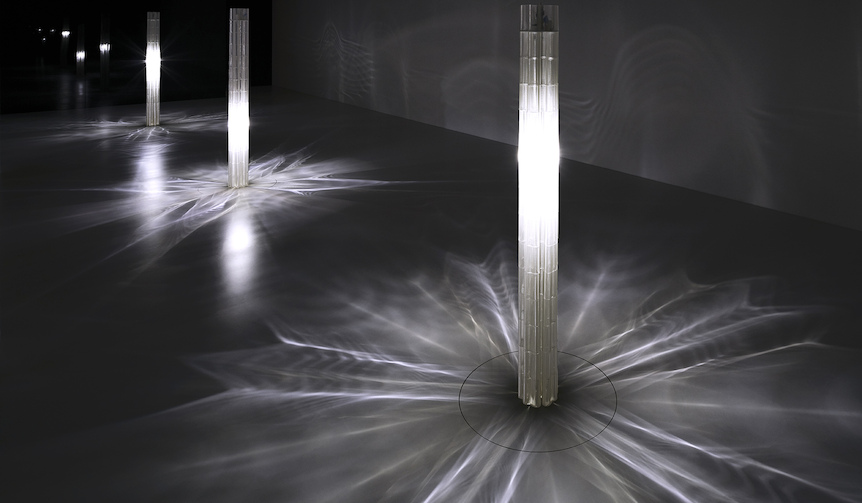
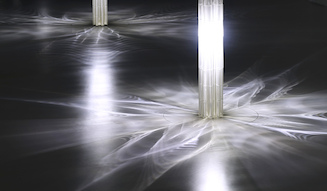
Emerging from the darkness were three pillars of light reaching towards the ceiling. They were created by Neri Oxman and her Mediated Matter group at the Massachusetts Institute of Technology.
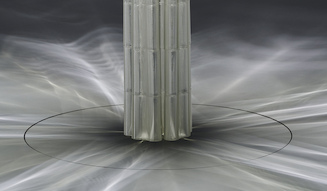
The pillars are made of glass, with organic forms achieved by winding thin tubes. They are constructed from blocks, stacked 15 high to form the pillars. The craftsmanship is incredibly intricate, even up close. The transmitted light is beautiful.
The concept is "Classical yet cutting-edge." The English title is "Ancient Yet Modern." The word "YET" connects these two adjectives.
The fascinating aspect lies in the use of glass. "Glass has been a familiar material for 6,000 years. But we are using the latest technology for its formation," explained Oxman.
The manufacturing of the thin glass tubes is, in a sense, traditional. It relies on craftsmanship (and was apparently quite difficult to produce).
On the other hand, the shapes were determined using the cutting-edge technology of 3D printing. The cross-sections are designed for stability when stacked. The form, which creates beautiful transmitted light, also involved precise computer calculations.
Lexus
"YET" Connects to Lexus's Brand Philosophy (2)
10th Exhibition This Year
The Triennale, where Lexus exhibited at Milan Design Week, is located a bit further from the Brera, Tortona, and Cinque Vie districts, which are hubs for many installations, though it is in the city center.
Despite this, many visitors enjoyed Neri Oxman's pillars of light. I later heard from Lexus representatives that the number of visitors, especially at night, was surprisingly high.
Perhaps it was due to the festive atmosphere, with a special stage set up in Sempione Park near the Triennale for live performances.
In any case, Lexus's exhibition seemed to fully meet the expectations of those visitors, as it offered a diverse range of displays in addition to Oxman's pillars of light.
Lexus Design Award 2017
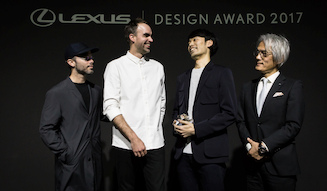
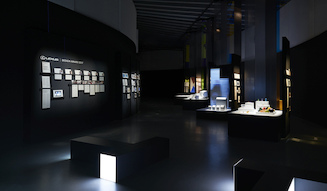
One part of the exhibition featured the award-winning works from the Lexus Design Award. Above this display, a large banner hung from the ceiling.
Titled "Static Yet Dynamic," this exhibit is striking with its dancing light projections.
As you watch, the light coalesces into the form of the Lexus UX concept, and images of the car appear to drive outwards. It is indeed a work where stillness and motion coexist.
At the end of the exhibition hall was a unique panel display called "Retrospective." It summarized Lexus's exhibitions over the past nine years, year by year.
I wrote "unique," but perhaps "interesting" would be a better word. Each exhibition is presented in 24 frames per second, like a movie. As you walk past, you can enjoy the images moving like a flipbook.
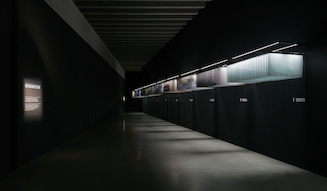
Retrospective
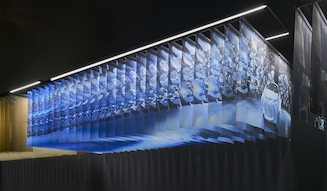
Retrospective
"When Lexus first participated in Design Week, there were no other car manufacturers," said Hiroshi泽, President of LEXUS INTERNATIONAL, at the venue.
"We have continued to participate because architecture and art align well with Lexus as a lifestyle brand, in terms of our ability to create new things."
Lexus
"YET" Connects to Lexus's Brand Philosophy (3)
Lexus Design Award Winners Also Exhibited
At the 2017 Milan Design Week, Lexus exhibited the award-winning works from the "Lexus Design Award," now in its fifth year, as previously mentioned. The Grand Prix winner was also announced at this venue.
"To nurture and support the next generation of creators, aiming for a better society..." With these goals, Lexus has been publicly soliciting outstanding designs.
A total of 1,152 entries were received from 63 countries. From these, eight works were selected for panel displays, and four were chosen for prototype production.
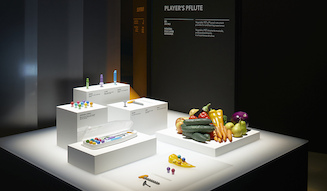
PLAYER'S PFLUTE
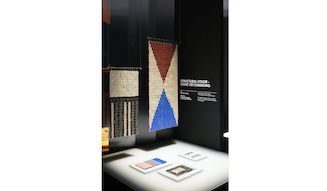
STRUCTURAL COLOR - STATIC YET CHANGING
Let's briefly touch upon the award-winning works for which prototypes were created. One was by Jia Wu, a Chinese student at the UK's RCA. Her proposal was "Player's Flute," an instrument made from raw vegetables.
The second was by Jessica Hoogers from the US. She created pieces with different colors on each face, forming a rug (a type of textile) by connecting them. The key feature is that the pattern changes when the pieces are rotated.
The third was Arlan Won from Ewha Womans University in Seoul. Her proposal was a carry-on suitcase containing all the elements needed to furnish a room.
The fourth was Hiroto Yoshizoe, who proposed "PIXEL." This is a structure made of small units, characterized by the reflection of light visible from the opposite side.
A structure resembling a folding screen is assembled from pixels made with meticulous calculations and carefully selected materials. When a person stands on the opposite side, their silhouette is vaguely discernible, and the color of their clothing is also reflected to some extent.
"I conceived it as a new era's shoji screen," Yoshizoe explained at the venue, a statement that had a significant impact. This work won the Grand Prix.
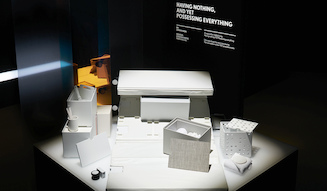
HAVING NOTHING, AND YET POSSESSING EVERYTHING
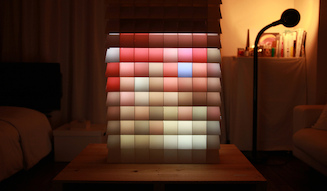
PIXEL
"They were wonderful creations full of imagination, under the theme of 'YET'" commented design critic Alice Hawthorne, reflecting the high praise from the judges. What these works have in common is that they all consciously embody the philosophy of "YET."
Lexus interprets "YET" as "duality" or "paradox." This is the philosophy behind the brand's vehicles.
For example, "the harmony of high driving performance and responsible environmental performance" (Lexus). Lexus aims to move forward into a new era with this approach.