Boxster and 911 Cabriolet – Two Open Porsches | Porsche
Porsche Boxster S
Porsche 911 Carrera Cabriolet
Simultaneous Test of Porsche's Latest Open-Top Sports Cars
Boxster S and 911 Carrera Cabriolet
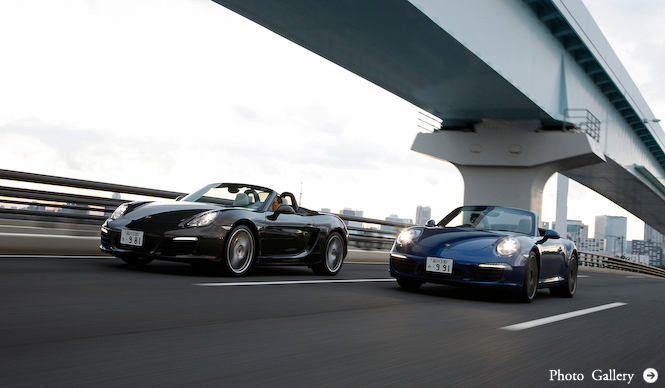
Porscheits flagship open-top sports cars, theBoxsterwhich underwent a full model change in January of this year,underwent a full model change in January.OPENERS tested this Boxster, newly introduced to Japan,this Boxster, newly introduced to Japan,alongside the open-top model of Porsche's flagship sports car, the911's open-top model, the911 Carrera Cabriolet.When placed side-by-side, Porsche's latest two open-top sports cars are similar in size, appearing more like twins than siblings. Both are powered by a 3.4-liter flat-six engine mounted behind the driver. So, what are the differences between these two Porsches? Tatsuya Otani investigates.
Text by OTANI TatsuyaPhotographs by MOCHIZUKI Hirohiko
Which One is Superior?
If you were shown these two cars without knowing their identities and asked which one was the higher class, wouldn't many people answer, "The one with the brown body and the '981' license plate"?
Porsche aficionados would likely scoff at such a notion, but at least in photographs, the Boxster, bearing the '981' designation, appears somewhat more substantial than the 911 Cabriolet with its '991' tag.
The width is nearly identical, with the '981' model Boxster at 1,801mm and the '991' model 911 Cabriolet at 1,808mm. However, the Boxster, with its vertically oriented headlights, seems slightly more imposing. In terms of detailing, the differences visible in the photos are minimal. I can understand why someone might say, "The '981' looks more luxurious than the '991'."
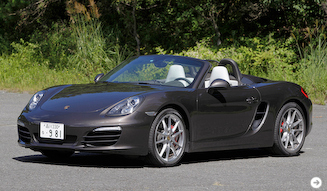
Porsche Boxster S
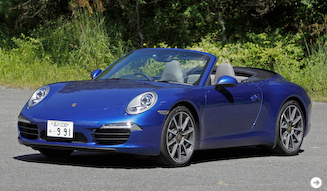
Porsche 911 Carrera Cabriolet
Now, to get to the rather unglamorous details, the actual price of the '981' is 7.74 million yen, while the '991' is 13.59 million yen, nearly double. With such a price difference, any car manufacturer would surely differentiate the exterior, making the '981' intentionally look cheaper. But Porsche did not do this.
Why?
The answer is simple. Porsche itself possesses an intense confidence, believing that "people will understand the difference when they drive it, and even those who don't drive it know it."
Before we proceed, let's briefly explain the background of these two cars.
Porsche Boxster S
Porsche 911 Carrera Cabriolet
Simultaneous Test of Porsche's Latest Open-Top Sports Cars
Boxster S and 911 Carrera Cabriolet (2)
Rear-Engine, Rear-Drive: The 911's Choice
Porsche's iconic "911" debuted in its first generation in1964.Since then, through six full model changes, the latest, seventh-generation "991" model 911 was released in 2011.the latest, seventh-generation "991" model 911was released in 2011.
The most significant characteristic common to all generations of the 911 is the placement of its flat-six engine behind the rear axle. This configuration is called rear-engine, and because it drives the rear wheels, it's abbreviated as "RR." Nowadays, the 911 is virtually the only car to use the RR layout. However, in the 1960s, when the first 911 was born, RR was not uncommon for passenger cars due to its space efficiency. The Volkswagen Beetle is a prime example.
As many may know, Dr. Ferdinand Porsche, who conceptualized the Beetle, created the company's first sports car, the "356," based on the Beetle. Therefore, the 356 was also RR, and its successor, the 911, naturally adopted the RR layout.
However, over the subsequent half-century, RR models have gradually disappeared, leaving only the 911. In reality, RR has several drawbacks, such as difficulty in achieving stable handling, which led to a shift towards front-engine layouts for mainstream passenger cars. Yet, the 911 alone defied this trend and persisted with the RR configuration.
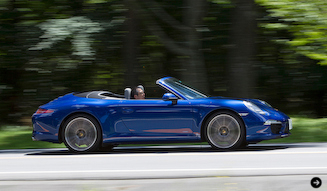
Porsche 911 Carrera Cabriolet
Or rather, it's more accurate to say that Porsche fans wouldn't accept a Porsche that wasn't RR. In fact, Porsche has produced front-engine models like the "928," "924," and "944" multiple times, but none could usurp the 911's leading role. Eventually, Porsche itself decided to continue producing the RR 911. Thus began the "RR Evolution Theory" that leads to the latest 991.
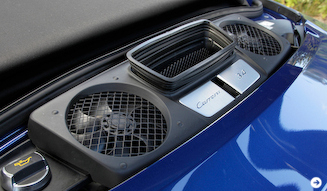
Porsche 911 Carrera Cabriolet
The engine mounted at the rear cannot be directly observed.
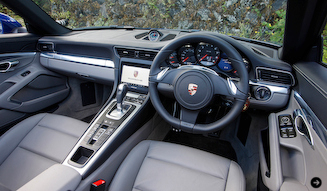
Porsche 911 Carrera Cabriolet
During this time, Porsche has maintained the 911's status as the "world's premier sports car" while continuously refining it to adapt to the changing times. The cabin became more spacious and luxurious. Vibrations were reduced, quietness increased, and ride comfort improved. The engine and gearbox became easier to handle, and the pursuit of handling stability intensified...
In addition to these improvements, performance was enhanced, and measures for emissions control and fuel efficiency (i.e., reduction of CO2 emissions) were implemented. It is no exaggeration to say that these have been the guiding principles of the 911's evolution over the past half-century.
Porsche Boxster S
Porsche 911 Carrera Cabriolet
Simultaneous Test of Porsche's Latest Open-Top Sports Cars
Boxster S and 911 Carrera Cabriolet (3)
As the Accomplished Elder Brother's Younger Sibling: The Boxster
Meanwhile,the "Boxster," which debuted in 1996,was not born out of an ambition to usurp the 911's leading role, but rather to serve as the 911's junior sibling. The decisive differences from the 911 are that the body is exclusively an open-top type, and it employs a mid-ship layout, with the engine mounted in front of the rear axle, not behind it.
The mid-ship layout was chosen because it is physically more logical. As a consequence, the Boxster is a two-seater, lacking rear seats. This is in stark contrast to the 911, which has traditionally remained a 2+2 seater, albeit with small rear seats.
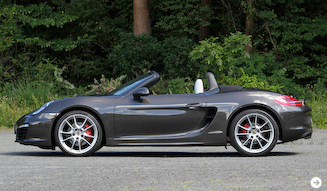
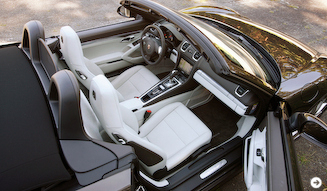
The differences between the two cars are, of course, not limited to this. From the outset, the Boxster was considerably less expensive than the 911, so, regrettably, its construction also reflected that. Or rather, that phrasing is misleading. The quality of the 911 has always been exceptional. Its body rigidity, the quality of its finish, and the precision of its mechanics were second to none, even when compared to much more expensive cars. In fact, they were superior.
Therefore, there was no shame in the Boxster, born as its junior sibling, being inferior to the 911 in terms of quality, including driving performance. In fact, the Boxster has consistently been the benchmark for sports cars in its class, holding its own against any rival. The pride of Porsche, emblazoned on its nose, also lived on in the Boxster.
Porsche Boxster S
Porsche 911 Carrera Cabriolet
Simultaneous Test of Porsche's Latest Open-Top Sports Cars
Boxster S and 911 Carrera Cabriolet (4)
The Real Porsche, The Real Sports Car
And,the "981" model Boxster, which debuted in 2012,has completely broken away from the excuse of "ultimately can't match the 911." Even looking at the interior, its sense of quality is comparable to the 911. The exterior appearance is as noted at the beginning. And in terms of driving quality, we no longer feel a clear inferiority to the 911 in areas like body rigidity or drivetrain precision.
Frankly, I have no hesitation in evaluating the latest Boxster as a true sports car, a truePorsche.
Furthermore, the "Boxster S" tested here is equipped with the same 3.4-liter engine as the standard "Carrera" model of the 911. While the maximum output is slightly downgraded to 315 ps at 6,700 rpm (compared to the 911 Carrera's 350 ps at 7,400 rpm) and the maximum torque to 360 Nm at 4,500-5,800 rpm (compared to 390 Nm at 5,600 rpm), its weight is 120 kg lighter than the 911's 1,470 kg. Thus, the Boxster S's power feels even stronger than the "base" 911 Carrera.
Speaking of weight, the latest Boxster and 911 models have undergone significant weight reduction.
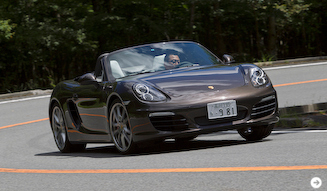
Despite an increase in body size, the Boxster S has successfully shed weight, from 1,380 kg in the previous model to 1,350 kg, and the 911 Carrera Cabriolet from 1,530 kg to 1,470 kg.
These results are partly due to the extensive use of aluminum. Weight reduction in automobiles contributes to both improved performance and better fuel economy. The only drawback is the increased cost. However, improved fuel economy and reduced CO2 emissions are the most critical development themes for car manufacturers, and they cannot be avoided. In any case, performance improves without significant increases in engine output, so fans should be delighted.
Porsche Boxster S
Porsche 911 Carrera Cabriolet
Simultaneous Test of Porsche's Latest Open-Top Sports Cars
Boxster S and 911 Carrera Cabriolet (5)
The Difference Between the Boxster and the 911
So, is there absolutely no point in paying an "extra" 5.85 million yen for the 911 Cabriolet compared to the Boxster?
No, the driving quality is still superior in the 911.
Human senses are fascinating. While the Boxster alone feels exceptionally refined and leaves no room for dissatisfaction, as soon as you switch to the 911, you become acutely aware of the various vibrations your body was previously perceiving. Honestly, the ride feel of the Boxster and the 911 is very similar. However, the subtle vibrations felt in the Boxster are masterfully suppressed in the 911, offering a clearly superior level of smoothness.
The same can be said for the handling. Even on winding roads, the Boxster offers direct feedback, allowing you to strongly feel the experience of driving. The 911, on the other hand, is tuned for a refined taste with minimal extraneous elements, as if an extra filter has been inserted. Pushed to its limits, the Boxster exhibits natural slides while maintaining excellent road feel, whereas the 911 offers a slightly more viscous, tenacious sensation. As a machine, the 911 undoubtedly feels more premium.
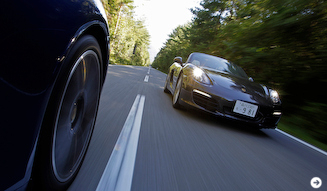
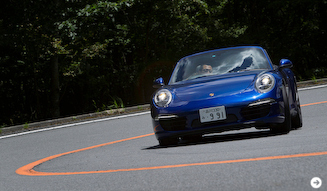
So, is it worth paying the "extra" 5.85 million yen? The gap in quality has clearly narrowed, so the justification for that price difference has diminished compared to before. Furthermore, the number of people satisfied with the Boxster's quality has undoubtedly increased. If a friend asked me, I would confidently recommend the new Boxster.
However, there is undeniably a world that can only be experienced in the 911.
For those who understand this, the 911 continues to shine with its solitary brilliance.

Porsche Boxster S
Body Dimensions | Length 4,374 x Width 1,801 x Height 1,281mm
Wheelbase | 2,475mm
Engine | 3,436cc Flat-Six
Max. Output | 315ps (232kW) / 6,700rpm
Max. Torque | 360Nm / 4,500-5,800rpm
Transmission | 7-speed PDK
Weight | 1,350kg
0-100km/h Acceleration | 5.0 seconds
Top Speed | 277km/h
Price | 7.74 million yen
Porsche 911 Carrera Cabriolet
Body Dimensions | Length 4,500 x Width 1,810 x Height 1,305mm
Wheelbase | 2,450mm
Engine | 3,436cc Flat-Six
Max. Output | 350ps (257kW) / 7,400rpm
Max. Torque | 390Nm / 5,600rpm
Transmission | 7-speed PDK
Weight | 1,470kg
0-100km/h Acceleration | 4.8 seconds
Top Speed | 284km/h
Price | 13.59 million yen