Participating in the 718 Boxster Workshop
Porsche 718 Boxster | Porsche 718 Boxster
Participating in the 718 Boxster Workshop
Experiencing Enhanced Power and Acceleration from Turbocharging
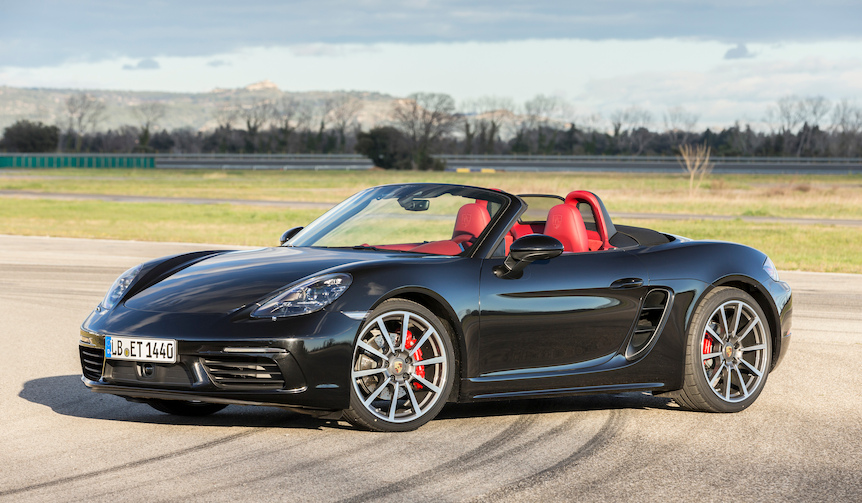
Like the new 911, the new Boxster features downsizing and turbocharging. As you know, the model name has also been changed to "718 Boxster." Here is a report from journalist Hirohisa Kaneko, who participated in a workshop for this model.
Text by KANEKO HirohisaPhotographs by PORSCHE JAPAN
The New Heart: A 4-Cylinder Turbocharged Boxer Engine
Porsche typically gathers media from around the world for workshops just before announcing important new models.
The event held in France was for the "718 Boxster." The workshop took place on February 25th, five days before the official unveiling at the Geneva Motor Show on March 1st, at a Michelin tire test track near Marseille. Media from around the world were divided into several groups; our group from Japan was joined by participants from Canada, Finland, and France. We were all separate.
The half-day workshop consisted of four classroom sessions and a taxi ride. The sessions covered introduction, chassis, powertrain, and design. This was followed by the taxi ride on the outdoor test course.
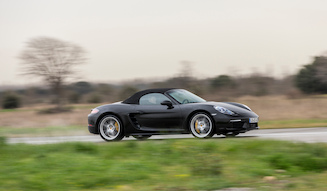
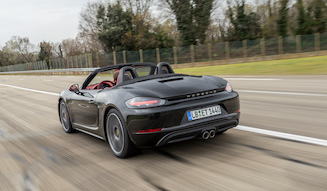
To explain chronologically, the 718 Boxster is the successor to the previous Boxster, with "718" added to its name. This naming is a self-homage to the legendary "718" racing car that achieved victories in races like the Targa Florio and the 24 Hours of Le Mans from the 1950s to the 1960s. The "718" was named because it featured a mid-mounted flat-four engine.
Incidentally, its code number is "982." While Porsche 911 models are sometimes referred to by their generation, such as "964" or "993," this "718 Boxster" is "982," and the previous "Boxster" was "981." It's enough to cause confusion.
Indeed, the 718 Boxster now features a turbocharged 2.0-liter or 2.5-liter (718 Boxster S) flat-four engine, replacing the previous flat-six. Compared to the previous generation's 2.7-liter and 3.4-liter (Boxster S), this is a significant downsizing.
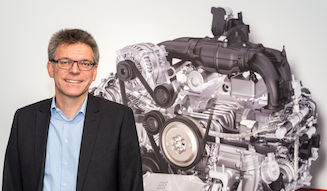
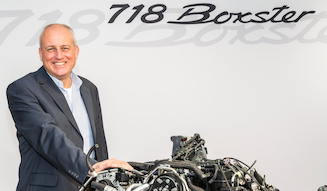
Matthias Hofmann, Director of Drivetrain
"The newly developed 4-cylinder turbocharged boxer engine is the most important aspect of the new Boxster," stated Matthias Hofmann, Director of Drivetrain.
Hofmann continued, explaining that Porsche has a proud tradition of success with mid-mounted four-cylinder engines, just like the original 718.
"Porsche's 919, which won the 24 Hours of Le Mans last year, also uses a four-cylinder engine. The tradition of four-cylinder engines is strongly carried forward within Porsche."
The old 718 was air-cooled and too archaic to compare directly with the 718 Boxster, and the 919 is a pure racing car with no relation to the 718 Boxster. However, the ability to leverage tradition and brand value allows Porsche to claim a connection, and I believe that's the power of branding. Let's examine the details.
Porsche 718 Boxster | Porsche 718 Boxster
Participating in the 718 Boxster Workshop
Experiencing Enhanced Power and Acceleration from Turbocharging (Part 2)
The Purpose of Downsizing
Powertrain
Dr. Ralf Schmidt, Technical Specialist, explained the reasons for downsizing:
"It is to achieve three goals: efficiency, performance, and emotion. Efficiency, of course, means improved fuel economy and reduced CO2 emissions. However, as a sports car, Porsche must also enhance the performance and emotion unique to a sports car."
The new 2.0-liter four-cylinder engine for the 718 Boxster has a maximum output of 300 ps and a peak torque of 310 Nm. The 2.5-liter for the 718 Boxster S produces 350 ps and 420 Nm. Notably, the peak torque for both engines is available across a wide RPM range: 1,950-4,500 rpm for the 2.0-liter and 1,900-4,500 rpm for the 2.5-liter.
A 6-speed manual transmission is standard, with a 7-speed PDK (Porsche Doppelkupplung) as an option.
Dr. Ralf Schmidt, Technical Specialist
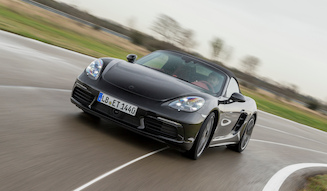
Performance figures, with the optional Sport Chrono Package and PDK transmission, show a 0-100 km/h acceleration of 4.7 seconds (0.8 seconds faster than the previous model) and 4.2 seconds for the S model (0.6 seconds faster). Top speed is 275 km/h, and 285 km/h for the S.
Fuel economy is 14.5 km/ℓ (1.3 km/ℓ improvement over the previous model) for the standard model and 13.7 km/ℓ (1.5 km/ℓ improvement) for the S. CO2 emissions are reduced by 13 percent compared to the previous generation.
Regarding the "emotion" aspect, Dr. Schmidt explained that engine sound is key.
"The engine sound of the 718 Boxster is different from that of an inline-four. Even though it's a four-cylinder, it's a true boxer sound."
I decided to verify this point during the taxi ride described later.
In pursuing downsizing, Porsche's engineering team undertook various technical trials. The already released "911" also saw its displacement reduced to 3.0 liters for both the 3.4-liter and 3.8-liter (S) variants. However, the number of cylinders remains six for both.
"Because the displacement differs between the 911 and the Boxster, we decided whether to reduce the number of cylinders," explained Dr. Schmidt.
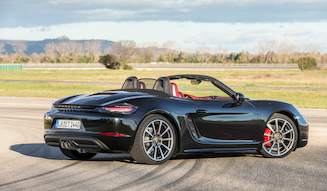
This means that if the 718 Boxster, like the 911, had only its displacement reduced while retaining six cylinders, there wouldn't be enough space for the turbocharger and intercooler. Furthermore, while the 911 uses two turbochargers, the 718 Boxster uses only one, a decision linked to reducing cylinder count to four for maximum efficiency. The difference in displacement and cylinder count clearly distinguishes the powertrains of the 911 and 718 Boxster, but commonalities are also noteworthy.
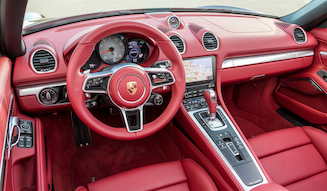
With the optional Sport Chrono Package, the 718 Boxster now offers four driving modes, similar to the 911: Normal, Sport, Sport Plus, and Individual.
Additionally, equipping the PDK enables the "Sport Response" button. By pressing the button in the center of the driving program switch located on the steering wheel spoke at the 4 o'clock position, the engine and PDK response can be set to an extremely direct mode.
Porsche 718 Boxster | Porsche 718 Boxster
Participating in the 718 Boxster Workshop
Experiencing Enhanced Power and Acceleration from Turbocharging (Part 3)
Riding Shotgun in the S with Test Driver Lars Kern
Chassis
The chassis has also undergone numerous optimizations. Key among these are the addition of a lateral member to the rear suspension to reinforce the rear subframe, larger pistons and cylinder tubes for the front and rear shock absorbers, a half-inch wider rear wheel, and a 10 percent increase in steering directness for the electric power steering.
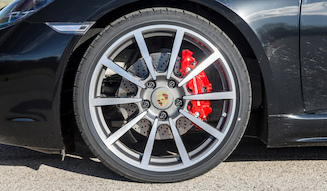
The brakes have also been enhanced to match the improved performance. The 718 Boxster uses the brake system from the previous Boxster S, while the 718 Boxster S adopts the four-piston calipers and thicker brake discs from the new 911 Carrera. Furthermore, the brakes feature a multi-collision brake system to mitigate damage in secondary collisions.
Standard tire sizes are 18 inches for the 718 Boxster and 19 inches for the S. 20-inch wheels are available as an option for both.
With the optional PASM (Porsche Active Suspension Management), the ride height is lowered by 10 mm (20 mm for the S), further lowering the center of gravity.
Design
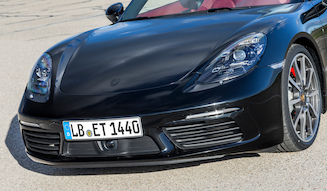
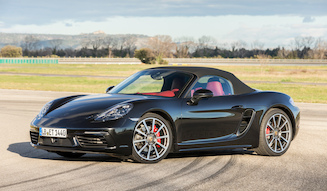
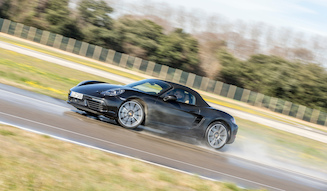
While the exterior design shares a similar image with the previous Boxster, all body panels are newly designed. Indeed, the air intakes below the front bumper are larger, and the front lights have been newly installed above them.
Optional LED headlights are now available, incorporating four-point daytime running lights similar to the 911. These headlights have a distinctive illumination signature, making the car easily recognizable even from a distance, which is a significant safety feature.
The rear styling also echoes the motif of the previous model, but it is not identical. A high-gloss black accent strip connects the taillights on either side, from which a retractable rear spoiler emerges. The taillights themselves are intricately designed, with a three-dimensional structure visible behind the clear glass.
Taxi Ride
I was given a seat in the S model driven by test driver Lars Kern, the same driver who recorded a lap time of 7 minutes and 42 seconds at the Nürburgring in the previous S model, a full 16 seconds faster than the predecessor.
Even from the passenger seat, I could immediately feel the strong torque available from low RPMs, contributing to powerful acceleration. While the test driver was naturally pushing the car hard on the test track, I felt I got a glimpse of the new 2.5-liter four-cylinder turbo engine's capabilities. I then drove the 2.0-liter version, and the impression was the same: I felt the enhanced power and acceleration from turbocharging more strongly than any perceived reduction from downsizing.
The engine sound was also a point to check, but due to the near-full throttle acceleration and the loud volume from the optional sports exhaust system, I couldn't discern the characteristics of the four-cylinder engine. This is something that would likely only be apparent when driving the car myself on public roads.
Regardless, the more I learned about the 718 Boxster, the more I had to acknowledge the meticulous and thorough testing and development that went into it, consistent with Porsche's standards. The continuous stream of "optimization" and "improvement" only heightened my anticipation. I can't wait to drive it myself.

Porsche 718 Boxster | Porsche 718 Boxster
Body Dimensions | Length 4,379 × Width 1,801 × Height 1,281 mm
Wheelbase | 2,475 mm
Tread Front/Rear | 1,515 / 1,532 mm
Vehicle Weight | 1,335 kg
Engine | 1,988cc Flat-four Turbo
Bore x Stroke | 91.0 × 76.4 mm
Compression Ratio | 9.5
Max. Output | 220 kW (300 ps) / 6,500 rpm
Peak Torque | 280 Nm / 1,950-4,500 rpm
Transmission | 7-speed Dual-Clutch (PDK) / 6-speed Manual
Drivetrain | MR
Minimum Turning Radius | 5.49 meters
Brakes Front | φ330×28mm Ventilated Discs
Brakes Rear | φ299×20mm Ventilated Discs
Suspension Front | MacPherson Struts
Suspension Rear | MacPherson Struts
Tires Front/Rear | 235/35R18 / 265/45R18
Top Speed | 275 km/h
0-100 km/h Acceleration | (7-speed PDK) 4.9 sec (4.7 sec in Sport+) (6-speed MT) 5.1 sec
0-200 km/h Acceleration | (7-speed PDK) 18.1 sec (17.8 sec in Sport+) (6-speed MT) 18.3 sec
Fuel Economy (NEDC) | (7-speed PDK) 6.9 ℓ/100km (approx. 14.5 km/ℓ) (6-speed MT) 7.4ℓ/100km (approx. 13.5 km/ℓ)
CO2 Emissions | (7-speed PDK) 158 g/km (6-speed MT) 168 g/km
Price | (7-speed PDK) ¥7,104,000 (6-speed MT) ¥6,580,000
Porsche 718 Boxster S | Porsche 718 Boxster S
Body Dimensions | Length 4,379 × Width 1,801 × Height 1,280 mm
Wheelbase | 2,475 mm
Tread Front/Rear | 1,515 / 1,540 mm
Vehicle Weight | 1,355 kg
Engine | 2,497cc Flat-four Turbo
Bore x Stroke | 102.0 × 76.4 mm
Compression Ratio | 9.5
Max. Output | 257 kW (350 ps) / 6,500 rpm
Peak Torque | 420 Nm / 1,900-4,500 rpm
Transmission | 7-speed Dual-Clutch (PDK) / 6-speed Manual
Drivetrain | MR
Minimum Turning Radius | 5.49 meters
Brakes Front | φ330×34mm Ventilated Discs
Brakes Rear | φ299×20mm Ventilated Discs
Suspension Front | MacPherson Struts
Suspension Rear | MacPherson Struts
Tires Front/Rear | 235/35R18 / 265/45R18
Top Speed | 285 km/h
0-100 km/h Acceleration | (7-speed PDK) 4.4 sec (4.2 sec in Sport+) (6-speed MT) 4.6 sec
0-200 km/h Acceleration | (7-speed PDK) 15.0 sec (14.7 sec in Sport+) (6-speed MT) 15.2 sec
Fuel Economy (NEDC) | (7-speed PDK) 7.3 ℓ/100km (approx. 13.7 km/ℓ) (6-speed MT) 8.1ℓ/100km (approx. 12.3 km/ℓ)
CO2 Emissions | (7-speed PDK) 167 g/km (6-speed MT) 184 g/km
Price | (7-speed PDK) ¥9,044,000 (6-speed MT) ¥8,520,000
Porsche Customer Care Center
0120-846-911
http://www.porsche.com/japan/jp/