Show Us Your Car: Part 4 - Katsuhiko Taniguchi x Jaguar XJ6
Part 4: Katsuhiko Taniguchi x Jaguar XJ6
A Tale of Machines and Men
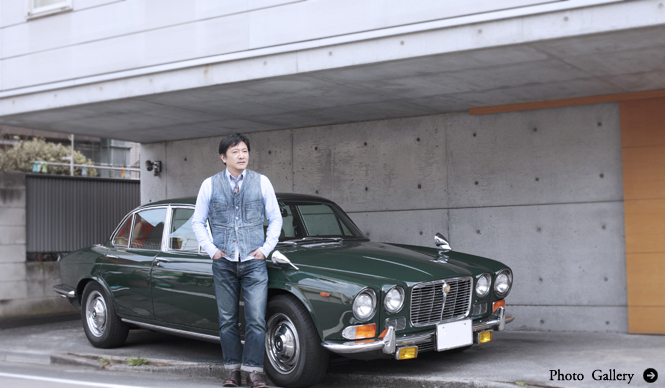
Katsuhiko Taniguchi, Creative Director at Barnaby's Japan, a familiar face on the OPENERS blog,Katsuhiko Taniguchiis a devoted car enthusiast. What's more, he finds joy, like a boy, in conversing with machines by fixing their ailments and mastering their intricacies himself. His current beloved car is a Jaguar XJ6. Specifically, the "Series 1" driven by Mr. Taniguchi is the first generation of the XJ6, handcrafted by artisans between 1968 and 1972. Why does Mr. Taniguchi drive this particular model? And what are his views on cars?
Text by SUZUKI Fumihiko (OPENERS)
Photographs by JAMANDFIX & Alfa Romeo
& TANIGUCHI Katsuhiko
So Much to Talk About!
It's only done about 40,000 km! I just got it in mid-December. But the transmission is leaking oil, so I'm thinking of getting a rebuilt transmission. It's much cheaper than an overhaul.
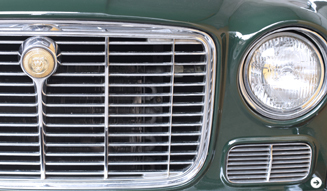
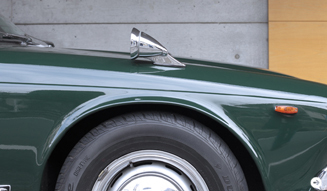
It has a 'grumpy old man' face, doesn't it? Thick and looks like it's coughing. The fender mirrors just have flat glass, so they're useless. Everyone's cars were like this back then. The car stereo is an 8-track, too.
—Is this your only car?
This is my only car. Actually, I have two Series 3 XJ6s at the factory for parts. Those are from '84, so they're incredibly new to me. But the Series 1 and Series 3 share the same suspension. Other than that, they're completely different from the Series 1, like separate entities.
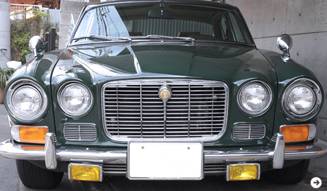
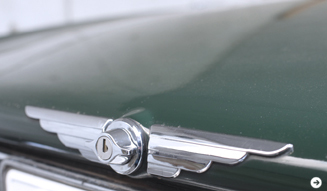
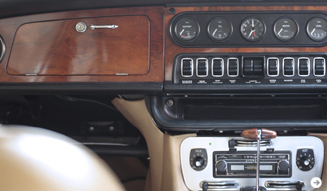
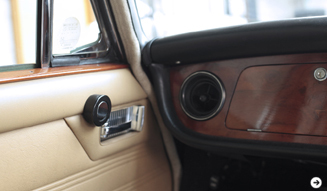
This XJ6 Series 1 was only produced for 4 years. It was built-to-order, meaning artisans made it by hand. From Series 2 onwards, production lines were established, and it was modernized all at once. It's still 40 years old. Before the XJ, there was a larger model called the '420' as a saloon, and this transitioned from that. They probably didn't expect it to be such a hit. The Series 1 had many issues, like the dashboard panels not fitting when reinstalled. The dashboard is solid walnut. The bumpers, too, you don't see steel bumpers with these overriders anymore. The trunk lid's design is also more complex than what's done today. The wedge-shaped embossing. Even the JAGUAR logo has a soft mold. But that's part of its charm, I suppose.
—Was its condition good?
The seats were still original and not torn. Apparently, the previous owner won an award at a Jaguar Day contest with this car.
The car I drove before this one was a Series 3, which is now used for parts. It had 210,000 km on it. I was debating whether to replace the engine or buy a new car when this one came up. The engine is the traditional inline-six. It's completely original. Ideally, if I replaced the intake manifold and installed triple Weber carburetors, it might run better and be more stable. Because the 'E-Type' is popular and parts are readily available, I think there are kits for the intake manifold.
Would you like to take it for a spin?
Part 4: Katsuhiko Taniguchi x Jaguar XJ6
A Tale of Machines and Men (2)
Within the XJ
This one technically has air conditioning, but if it overheats and causes percolation (a phenomenon where gasoline vaporizes before reaching the carburetor, creating bubbles in the fuel line), it's over. I don't think cars with carburetors can handle Japan's summers. I only drive mine on weekends, but anything could happen at any time. So, I drive it with the insurance company's phone number handy, taking a chance.
—The steering wheel area is simple, isn't it?
There are no levers on the column. Everything is operated by switches on the center console. The headlights, the panel lights, everything.
It has a strong handmade feel, unlike today's computer-controlled cars. Cold starts also require a knack.
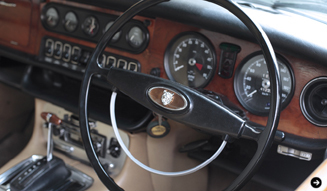
—It seems it's already been repaired?
In the four months since it came to me, it's been in and out of the shop multiple times, and there have been various issues. The muffler uses a spigot joint instead of a flange, so when I tried to swap it with one from a Series 3, the mechanism and support points were different. I repaired the rusted parts of the original, but while driving, it fell off with a loud bang.
The speedometer, too, in cars from this era, is driven by a cable. It's a complex, handmade setup where the cable enters at a right angle from the transmission case, originating from the rear axle. That's why it broke. The Series 3 doesn't use a cable, so it's incompatible. I sourced parts and repaired it, but it was defective and failed again, leading to another hospital stay. At that time, I replaced the alternator, the squealing brakes, everything, and it was revived. This car, like old racing cars, has its brake rotors right next to the differential, in the center of the car. The speedometer, however, seems to be calibrated for miles, as the displayed speed is abnormally fast!
—How is its performance?
Performance is not an issue. It has that characteristic Jaguar 'cat's paw' suspension, a tenacious feel. I've even dozed off in it. The ride quality after 40 years!
It has a 3-speed automatic transmission. I do miss driving a manual. I used to practice heel-and-toe shifting. Around high school, when F1 cars were still cigar-shaped, drivers could shift in 0.2 seconds. It would be shown on TV, and even when they focused on their feet, you couldn't tell when they were heel-and-toeing. I admired that.
Part 4: Katsuhiko Taniguchi x Jaguar XJ6
A Tale of Machines and Men (3)
Taniguchi's Car History
Before the XJ6, I drove Alfa Romeos the most. The '1750' and '2000GT Veloce' from 1975. I tinkered with them a lot myself. I replaced the brakes and the clutch release cylinder. For the 2000, parts supply couldn't keep up during production, so even for the same car model, the parts manufacturers were different. Basically, there were 'Bandieria' and 'Ate'.
—What sparked your love for cars?
I've loved cars since kindergarten. I had a mountain of toy cars. Maybe my father was a car enthusiast. We lived in the shitamachi area of Arakawa Ward, and it was the Showa 40s (1965-1974), so there weren't many foreign cars around. There were auto rickshaws, Subaru 360s, that kind of era. Amidst that, my father bought an Opel station wagon. I loved watching him operate the column shift and the smell of gasoline.
I became fond of Alfa Romeos in junior high school, so around the early 1970s. There was a Bridgestone commercial featuring a white Alfa Romeo 1750 – its actual displacement was 1800cc, derived from older models – that was driving at high speed on a forest road. It would downshift and pass by a father and child in raincoats with a loud roar! Ever since then, I've desperately wanted one. I researched everything, from the mechanics to the origin of the emblem, to how Enzo Ferrari, starting with a race in 1923 with the Alfa factory team, went on to establish his own Scuderia Ferrari...
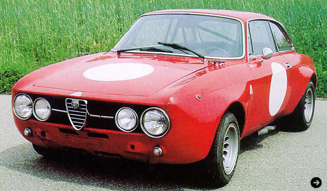
Alfa Romeo 1750 GT AM
I actually got one around age 27 or 28. Enthusiasts like the 'step-back' (Alfa Romeo Giulia Sprint GT), but I like it too. Alfa Romeos from that era were incredibly beautiful. They had a great balance, with shapes designed by Giorgetto Giugiaro, who was at Bertone at the time.
Before I got that Alfa Romeo, I bought a second-generation Corolla from a friend who worked at Toyota. I put cutting stickers on itMartini Racing liverywith black borders, calling it 'Martini Racing livery.' I even put my name on it with dry transfers. You know, like blood type or WRC (World Rally Championship). When I did that, my cousin asked, 'Are you turning it into a taxi?'
Even back then, as a student with no money, I was constantly tinkering with cars with my Toyota friends. That's where it all started. I also bought a gold metallic Volkswagen Beetle that might have had a Porsche 914 engine. The oil burned out on the Odawara-Atsugi Road, and it stopped. For the 37-year-old Levin (second-generation Toyota Corolla Levin), while trying to install some part, I forgot I had tightened a nut with my finger. Then, while driving, the rear wheel came off. Nuts were falling out at intervals of about 1 meter into the ditch.—
So, nothing surprises me anymore. I have no interest in new cars; I only drive old ones, so they're full of trouble. Even cars I don't own, I've driven many different kinds. There was the BMW '3.0 CS,' called 'the noblewoman,' and the one that left a strong impression was an '86 Porsche Turbo (likely the second-generation 930 Turbo). The clutch was so heavy to press and engage!
Part 4: Katsuhiko Taniguchi x Jaguar XJ6
A Tale of Machines and Men (4)
Taniguchi's Car Selection Criteria
—Have you always enjoyed working on machines?
If I have the equipment and space, I want to work with metal. I can even operate a lathe. You have to be able to do everything. My grandfather did metal casting, and when I was in first or second grade, he had me make spinning tops. Using asbestos, an alcohol lamp, plaster, and oil clay. He taught me how. My father worked in a toy factory, making toys for infants and toddlers. So, I had all sorts of tools, from grinders to everything else. My uncle was a professor at an art university.
Playing in that kind of environment has greatly influenced me. Back in my day, we didn't think about getting a job. We just liked metal and didn't think about the future.
So, I love tinkering with carburetors. Absolutely love it. You can't tinker with modern cars anymore. I'm also a certified welder, I've worked with metal, and I really love metal. Engine heads, for example, are precision castings. Don't men love machines?
Even as a child in kindergarten or elementary school, if I got a toy, I'd immediately take it apart. I'd wonder, 'What's inside?' I also loved dry batteries; their weight? They didn't even light up. That kind of appreciation for simple things. In my era, we didn't have many things, so these small details were fascinating. Nowadays, children have computers from a young age, but...
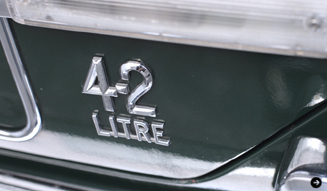
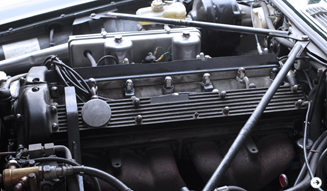
For the XJ6, a service manual and parts catalog are essential at the workshop. Since we don't work with computers, I really wanted the books. So, I bought a reprint of the original dealer manual, which has over 600 pages, for about 20,000 yen, and it's now at the workshop.
—What are your criteria for choosing a car?
For me, cars are all about design. First and foremost, design. I studied design, but when I look at cars, I wonder if we can still create designs today that hold up after 40 years.
The reason cars from that era are timeless is that their designs reached a state of perfection. They created designs so complete that nothing could be added or subtracted.
That's how design becomes universal.
We don't do that anymore. There are certainly people who could. But the way companies operate has changed. To achieve continuous growth in performance, a certain level of design is sufficient. Designs that age are fine. For everyday use, the performance of modern passenger cars is more than adequate. That makes design even more crucial. In the 60s and 70s, you could tell which manufacturer a car was from at a glance, even without the emblem.
Nowadays, it's rare for a designer's drawing to be directly translated into the actual car. The body is separate, the interior is separate, the color is separate. Everything is divided, involving many people and departments. Individual subjectivity is difficult to incorporate.
But when choosing, users today only have design to go on. If they made the 'S800' (Toyota Sports 800, produced from 1965 to 1969) with modern components, I think it would be a hit. I want them to incorporate playfulness,余裕 (yoyu - leeway/room), and the company's character. I wish they'd make the SR (1967 Fairlady 2000), the predecessor to the Fairlady. I want them to make the Bellett again. If they made those, I'd be completely on board. Japanese electrical components are top-notch, so just using Japanese harnesses would be like giving old cars a blood transfusion. They'd be reborn.
Part 4: Katsuhiko Taniguchi x Jaguar XJ6
A Tale of Machines and Men (5)
I Want an E-Type
In Britain, they cherish old things, so I imagine most parts are available? The Jaguar XJ6 Series 1, its side proportions, the tapering front and rear, the way the surfaces transition, the integration of the lights, and the placement of the chrome trim – it's such a magnificent design.
As someone who studied design at university and works in design, my job requires me to explain why a design is good in words. It's not enough to just say 'it's good' based on feeling; if you can't articulate why you think it's good, it's not a job. But the Jaguar's indescribable composition. Even the interior, with its uniquely British craftsmanship, has a certain atmosphere. As people get older, they tend to favor Britain, and I feel like I understand why after turning 50. So, perhaps that's the reason.
—Are there any cars you particularly want?
I'll probably always drive old cars. It's going to be tough from now on. I'm starting to feel self-deprecating. When it's running smoothly, I wonder if something is broken.
In the past, you could tell a car's condition by its symptoms. Not by sound or smell, but if you understood the mechanics to some extent, you could predict its behavior. It wouldn't just stop suddenly. That human element, perhaps that's what's good about things made by people. Modern cars stop if the computer fails. And you can't fix them yourself. Replacing a spark plug is a major operation, isn't it? I can't forget the goodness of handmade things. I don't like it if I can't do something myself. It feels like you lose your connection. If I bought a new car, I don't think I'd wash it. It would just become a means of transportation.
Around 1966 was perhaps the most glamorous era for various manufacturers. In the future, I'd like to collect and drive cars from that period.
I absolutely want a Jaguar E-Type. A Series 1 with a red badge. When I can afford to buy one, please come interview me again. But I'll probably keep driving this XJ6 for a long time. It hasn't been with me for long yet. Whether it becomes just transportation or not, I don't care.

Katsuhiko Taniguchi
Creative Director at Barnaby's Japan. Born in 1959. After joining Barneys New York in 1990, he apprenticed under Creative Director Simon Doonan (at the time) at Barneys USA. Currently, he oversees the store's image, including advertising visuals and window displays for Barneys New York Japan.