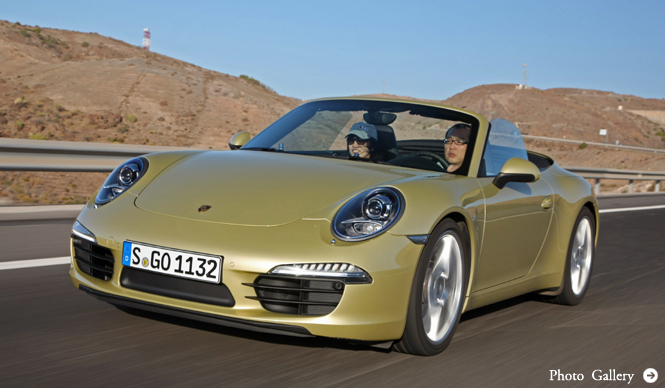
911 Cabriolet Test Drive – Toshiyuki Watanabe
Porsche 911 Cabriolet | Porsche 911 Cabriolet
Porsche 911 Cabriolet: Overseas Test Drive
Thirty years after its debut in 1982, the Porsche "911 Cabriolet" has finally achieved a silhouette identical to the coupe. Toshifumi Watanabe test drove it in the Canary Islands, Spain.
Text by WATANABE Toshifumi
Photographs by Porsche Japan
Finally, the Same Side View as the Coupe!
Cayenne Cayman andPanamera. Since the turn of the 21st century, Porsche has significantly increased its sales volume through the expansion of its model range. However, regardless of these changes, the "911" remains Porsche's unwavering spiritual cornerstone, a fact that can be inferred even from its design.
Indeed, all of its lineup ultimately leads back to this car in some way. The reason the 911 is an immutable icon, not only for its users but also for Porsche itself, is largely due to its history as a car that has continuously stood at the forefront of sports car development.
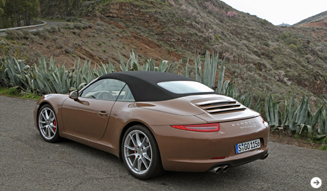
At the conference for the new 911 Cabriolet, the most time was dedicated to explaining its styling. It was stated that after 30 years since the debut of the first Cabriolet in '82, it has finally achieved a silhouette identical to the coupe.
This was likely a long-cherished goal for Porsche. While the previous model had a noticeable bulge for the retractable roof, this has been elegantly resolved, and the side profile is now completely identical to the coupe. To achieve this, the adoption of a soft-top roof, which can be stored compactly unlike a hardtop, was essential; in fact, they likely had no intention of using a hardtop at all. However, considering its rivals in the class, ensuring weather resistance and comfort comparable to a hardtop must have also been a requirement.
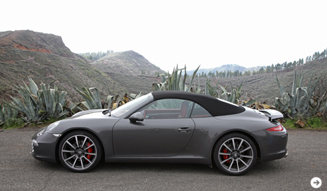
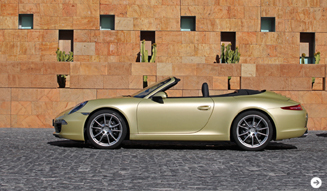
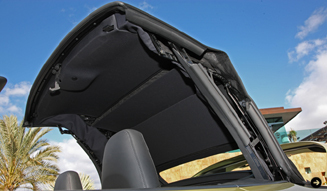
As a result, the soft-top roof, while featuring a high-quality German canvas exterior, incorporates a board extending to the rear seats, along with newly developed sound-absorbing material and an inner liner, creating a four-layer structure.
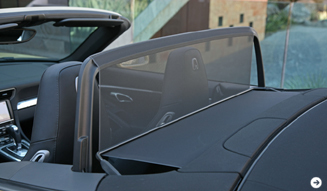
Viewed from inside, it offers a crisp finish comparable to the coupe, which also significantly influences the car's poised appearance when the roof is up. Incidentally, the operation of the soft-top, like the previous model, is electro-hydraulic, fully automatic with the push of a button up to 50 km/h, and the opening/closing time has been reduced to 13 seconds. Furthermore, a power-folding draft stopper, operable up to 120 km/h, is provided for the rear seats.
Porsche 911 Cabriolet | Porsche 911 Cabriolet
Porsche 911 Cabriolet: Overseas Test Drive (Part 2)
What About the Driving Difference?
Regarding the comfort of the 911 Cabriolet when closed, I had previously experienced firsthand during a past test drive how remarkably refined it was even in the late 997 generation. I once drove 1,000 km in a storm that closed down highways, and I was astonished by the roof's structural rigidity against wind and rain, and its high level of sealing that prevented even a single drop of water from leaking.
Although I couldn't experience rain during this test drive due to favorable weather, the sound insulation was even superior to the previous generation. Beyond the effect of the internal board, the rigidity of the frame, lightened with materials like magnesium, is solid. Even under high power or over bumps, the roof does not creak, and at high speeds, the wind glides smoothly over the roof.
It is also well-suited to Japan's climate, where closed-roof driving is often more common.
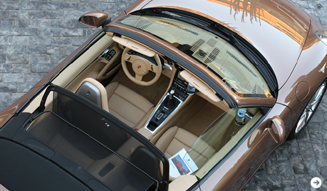
When driving with the top down, the airflow from the windshield over the head is fine, but even with all four side windows up, some wind buffeting into the cabin from the rear seat area is unavoidable. The aforementioned draft stopper mitigates this; with it deployed, the cabin remains remarkably stable even at speeds close to 200 km/h.
Even at those speeds, there is no sense of vibration from the floor or scuttle, which is common in convertibles. For normal driving, the difference from the coupe is virtually nil, apart from a slight increase in weight.
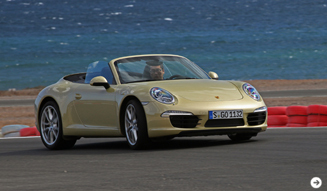
Even on the circuit, using the same vehicle provided for the public road test, there was no perceived lack of body rigidity during high-load, tight corners or rapid direction changes, allowing the car to navigate corners precisely as intended. It's possible that the weight reduction in the new 911 is even more pronounced in the Cabriolet than in the Coupe. This is because, in high-speed maneuvers, the previous generation Cabriolet tended to feel heavier in the rear compared to the Coupe. While not aiming for lap times, the sensation at circuit speeds for enjoyment is now virtually indistinguishable between the new 911 Coupe and Cabriolet.
Porsche 911 Cabriolet | Porsche 911 Cabriolet
Porsche 911 Cabriolet: Overseas Test Drive (Part 3)
No Reason Not to Choose It
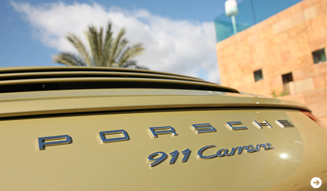
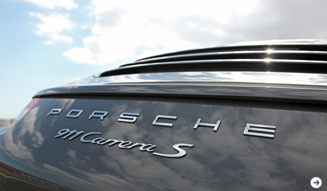
At this international press event, the Carrera was also available, which had not been ready in time for the Coupe's launch. This meant we could test both the 3.8-liter Carrera S and the 3.4-liter Carrera, and the differences between the two engines are more pronounced than in the 997 generation.
Simply put, the Carrera exhibits a slight lack of torque in the low-rev range below 2,000 rpm, but it delivers sharp power as it climbs to higher revs – a characteristic that thrives on being revved.
In contrast, the Carrera S boasts substantial torque from the outset, followed by seamless, first-class power. Both offer an experience that belies their CO2 emissions of approximately 200 g/km, making them remarkably environmentally friendly. For car enthusiasts accustomed to power, the Carrera S would likely offer greater satisfaction. The Carrera, on the other hand, might be recommended for those who prioritize comfort for daily driving.
With its handy size and the ability to create ample luggage space by utilizing the rear seats, the 911 is undeniably a sports car, and its practicality is one of its major selling points.
The new Cabriolet fulfills these characteristics without compromise, while matching the Coupe in terms of a refined ride and world-class handling performance. With nothing to hold it back, and the added exhilaration unique to an open-top model, the honest impression is that there is simply no reason not to choose it.
Of course, Porsche is well aware that there are many fanatics worldwide who believe such a 'soft' car is not a true 911. For them, the GT3 grade will undoubtedly hold even greater significance.