New vs. Old 911 Comparison Drive – Sadayuki Aoki
Porsche 911 | The Porsche 911
New vs. Old 911: A Comparative Drive
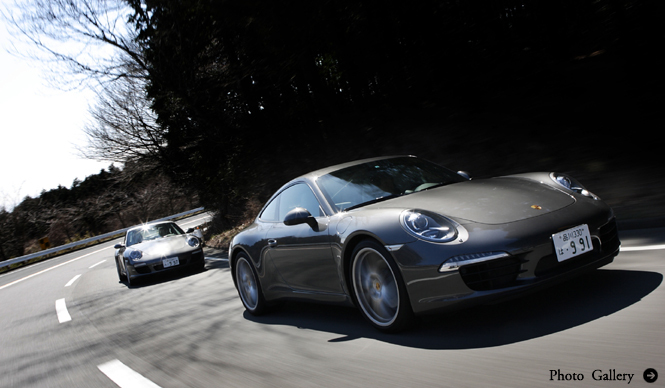
The seventh generation of the Porsche 911, the 991 model, has finally debuted on Japanese public roads. OPENERS has prepared the seventh generation and the 997 model, which has become the previous generation with the arrival of the seventh. We conducted a comparative test drive. The first installment is a thorough analysis by Yoshiyuki Aoki.
Text by Yoshiyuki Aoki
Photographs by Masayuki Arakawa
No New Coke Here
Early in the morning, I arrived at our meeting spot to find two Porsche 911s lined up. The OPENERS editorial team had prepared two generations of the 911, the 997 and the 991, for us to compare.
To clarify, the 997 with the larger number is the previous generation, and the 991 is the new 911. The confusing model numbers like 997 and 991, and the fact that the numbers are decreasing, was apparently to protect the secrecy of the new 911 from new model watchers worldwide. It’s like giving the Lockheed stealth fighter designations like F117 instead of F19 or F20 following F18, or using numbers in the 100s that were used in the old Century series... but explaining it further only complicates things. Today, the "Porsche 911" is more than just a single model; it's a social icon, so such consideration was likely necessary. Although the Type 997 will continue to be sold for a while, it is not strictly an old model, but it is expected to be gradually replaced by the upcoming variations of the 991.
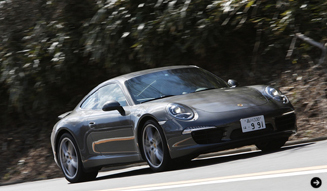
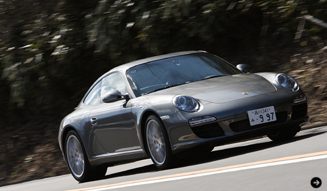
Now, about the new 911. The 911, now designated Type 991, features a longer wheelbase and wider track, with a slightly lower overall height. At first glance, the design appears little changed from the previous model, but this is the 21st-century 911. It exudes a unique aura that hints at significant performance improvements, and it’s easy to tell them apart... or so I'd like to write, but that would be professional vanity. In reality, unless you're a Porsche enthusiast, or rather a 911 freak, it might be difficult to instantly distinguish between the new and old models. The fact that both test cars were in a subdued metallic gray (Meteor Gray Metallic for the 997, Agate Gray Metallic for the 991) also makes identification difficult.
Why do they look so similar, especially for a new model? If I were to answer as a marketing guru, it's because Porsche "can't afford to release a New Coke."
The Essence of the 911
The latest Porsche 911 debuted at the 2011 Frankfurt Motor Show in September. 911 enthusiasts worldwide scrutinized the comparisons between the old and new, debated heatedly with friends, wrote blog posts about the new model, exchanged tweets, and those fortunate enough to have the means meticulously studied spec sheets and option lists, got excited about new body variations, paid close attention to rumors of special editions, and agonized over the timing for purchasing the new 911 (all a bit exaggerated, of course).
But are users merely puppets dancing to Porsche's tune? Not at all. Porsche itself is strongly bound by the market. The "911" has long been beyond Porsche's sole control, becoming a shared asset among car enthusiasts, consumers, and the market.
When the 996, the generation before the previous one, appeared in 1997, what 911 users (customers buying new, not used) couldn't tolerate wasn't the water-cooled engine, but the significantly changed headlight design. So, Porsche quickly changed the headlight design during the 996's minor facelift and returned to the round headlights in the subsequent 997 model. It was the right decision. The stronger the consumer's attachment to a product, the fiercer the backlash when betrayed. The Stuttgart automaker did not repeat Coca-Cola's mistake of "releasing" New Coke with a changed flavor.
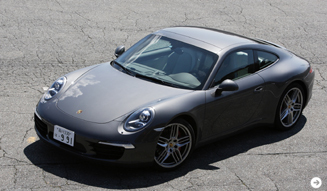
Porsche is now more of a luxury brand with "sport" as its flagship than purely a sports car manufacturer. Paradoxically, it must adhere more strictly than ever to the established image of the "911." Compared to the first strategic self-copying in the late 1980s and early 1990s when it faced a management crisis, the transition from Type 930 to 964 was somewhat clumsy. This latest model change, while implementing unprecedented fundamental dimensional changes like a "100mm extension of the wheelbase," has succeeded in making the exterior appear remarkably similar. Over twenty years later, Porsche has mastered the 4WD system that was a challenge during the 964 era, and has become accustomed to model changes. This is likely the reason.
Porsche 911 | The Porsche 911
New vs. Old 911: Comparative Drive (2)
911: Still Room to Spare
The new Porsche 911 measures 4,491mm in length, 1,808mm in width, and 1,295mm in height. Despite a 100mm longer wheelbase of 2,450mm, the overall length increase was limited to 56mm. The ride height is about 15mm lower, making the side windows appear narrower on the new model. It's likely that the use of glass, a heavy component, was reduced.
Speaking of "heavy," the Type 991 model has made 44% of its overall structure, including the hood, front fenders, doors, and engine lid, from aluminum to reduce weight, which is essential for improving fuel economy and environmental performance. The registered weight of the Carrera S test car (7-speed AT/PDK) is 1,450kg. This is lighter not only on paper but also in the actual Japanese specification vehicles compared to the accompanying 997 Carrera (6-speed MT) at 1,460kg.
The front track of the new model has been widened by 52mm for the Carrera S and 46mm for the Carrera. More than the increase in track width, the distance between the headlights has been widened, resulting in a wider, lower, and flatter appearance despite the same overall width. The most significant change is the rear, where the combination lamps are positioned higher and have a thin, sharp design. To call it "a bit Aston Martin-like..." would be blasphemous; one must say it "quotes the image of the 21st-century supercar, the Carrera GT."
Within the "Porsche 911" mold, it's impressive how the designers have paid attention to detail. The headlight covers are convex and rounded, and the fenders have a slight crease (!).
The outer edge of the rear lights, near the center, is treated as if scraped with a spatula, which also feels "modern." Compared to the 997's gently sloping rear fenders, the 991's fenders have a more horizontal line that drops sharply. Observing the two cars side-by-side in detail, the 991 gives an impression of having more definition overall.
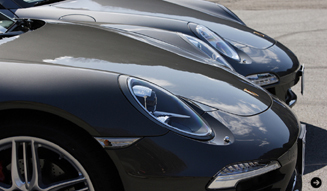
The potential of the new 911 is hinted at by the gap between the wheel arches and the tires. In the side view, the 997, fitted with 19-inch wheels, looks "tightly packed," while the 991's wheel wells, fitted with 20-inch wheels, still have room to spare. It must be preparing for rivals that will appear in the future.
A Lavish Yet Classic Cockpit
The interior has become considerably more luxurious. While the Carrera S test car uses luxurious materials like "leather and Alcantara," the presence of the center tunnel console extending between the front seats is significant. It's a translation of the Carrera GT's, or rather the Panamera's, design for the 911, with a dazzling control system that extensively uses chrome around the shifter and buttons. The interior of the new 911 completely lacks the "workplace" atmosphere that sports car enthusiasts prefer, and personally, I found it, dare I say, "a bit matronly." For enthusiasts who consider Teutonic stoicism to be "911-ness," this interior might feel jarring, but considering the growing market, this level of clarity might be necessary.
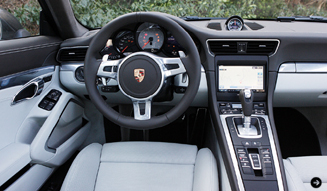

In terms of functionality, the 991 no longer has a lid for the door pockets, while the console with buttons is now mounted above the armrest. The door mirrors have moved from the triangular windows to the body, and the option for power-folding mirrors is also news.
In stark contrast to the opulent interior, the seat comfort is "as usual" for a 911. Whether you like it or not, being snugly held by the slim, integrated headrest seats makes you feel ready to drive. After adjusting the seat and mirrors and looking at the instruments, the message "Please start the engine manually" appears. The Japanese font within the meters has become cleaner! Regardless, the 991 features the "Auto Start/Stop function," also known as idling stop. Reaching out with my left hand, I turn the key, and the 3.8-liter flat-six engine roars to life.
Porsche 911 | The Porsche 911
New vs. Old 911: Comparative Drive (3)
The 991 in Motion
The 991 Carrera S's flat-six engine is the same 3.8-liter as the previous generation (294kW/400ps at 7400rpm, 440Nm at 5600rpm), while the Carrera's is a slightly smaller 3.4-liter (257kW/350ps at 7400rpm, 390Nm at 5600rpm). Both are paired with either a 7-speed manual (!) or a 7-speed automatic (PDK). Compared to the previous generation, the Carrera S has an increase of 15ps in maximum output, reaching 400ps. Although the new Carrera has a smaller displacement, it achieves a 5ps increase by raising the peak power output RPM. The RPM for maximum torque has also been raised, securing 390Nm, equivalent to the old 3.6-liter.
As I start driving the metallic gray Carrera S, it's undeniably a "911." The suspension precisely transmits information from the road. Yet, the robust body resolutely rejects excessive input. The cabin is quiet, but there's a subtle hum from behind – a rear-engine car. The steering weight felt "slightly artificial," but this is likely due to the prior knowledge that "the power steering has become electric from the new model." The PDK, which shifts gears between its two clutches, is smooth and handles stop-and-go traffic with ease. In the city, it shifts up continuously, keeping the boxer engine's RPM mostly below 3000rpm. The engine stops at red lights, and the restart from idling stop is smooth.
On the highway, checking the gear coverage, the lowest gear is around 75km/h, and second gear... already exceeds 100km/h! Japanese Porsche owners can only use first gear to its full potential. Cruising at 100km/h and shifting the selector from "M" to "D" causes the RPM to drop in distinct steps: from 6200rpm in second gear to 4400rpm, 3400rpm, 2800rpm, and 2300rpm. The shock is almost imperceptible. Unlike a torque converter automatic, where the tachometer needle gently rises and falls, it confirms "this is indeed PDK." Incidentally, the top gear, seventh, is the so-called "economy gear," with the engine running at a mere 1600rpm at 100km/h.
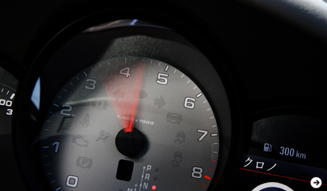
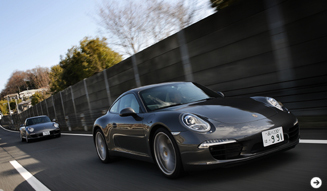
While satisfying the driver as a "luxurious grand tourer" on the highway, the 991 is also exhilarating on winding mountain roads with larger curves. It navigates corners at a constant speed, and as the exit approaches, it applies firm power to the rear tires. Explosive acceleration. The sensation of the rear spinning outwards around the driver during cornering is characteristic of a rear-engine sports car, making you instinctively grip the steering wheel tighter. Of course, the car's limits are far beyond reach.
The latest 911 is packed with electronic devices to control the quirks of its rear-engine layout: "Porsche Stability Management" to stabilize erratic behavior, "Porsche Torque Vectoring" to apply slight braking to the inner wheel during cornering to aid turning, "Porsche Dynamic Chassis Control" to suppress roll by controlling the front and rear stabilizers, and "Dynamic Engine Mounts" to suppress engine vibration. Yet, at unexpected moments, it reminds you that "the engine is mounted at the rear overhang," making the driver a little tense... this is why the 911 has such fanatical fans.
Porsche 911 | The Porsche 911
New vs. Old 911: Comparative Drive (4)
An Impressive Automatic Transmission
The performance of the Porsche 911 has long been beyond the reach of the average driver, but it's never boring. Pressing the "SPORT" button on the center console makes the engine response more aggressive and adjusts the shift schedule sportily. Furthermore, the "Sport Exhaust System" also activates in conjunction. The entire car becomes more taut, and the exhaust note boldly encourages the driver.
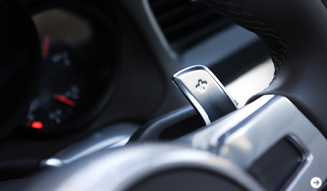
Driving the latest 911, the 991, on mountain roads, what impressed me most was the accuracy of the PDK's shift schedule. When braking moderately before a corner, even with "D" engaged, it downshifts at the perfect moment and, after exiting the corner, it holds the gear as if reading the driver's mind. Straight. Powerful acceleration. Braking! And the exhilarating blip of the throttle before the corner!! My photographer companion and I couldn't help but exclaim in admiration. While the 911 is equipped with shift paddles on the steering wheel, I felt no need to reach for them.
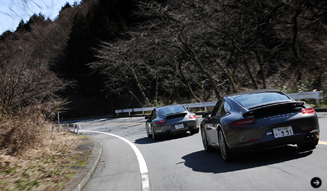
And when I switched to the previous generation 997... the photographer and I exchanged glances. It felt, well, old. The test car was a new model with just over 2000km. Although it was a Carrera with a 6-speed manual, so a transmission comparison wasn't possible, the engine feel, ride comfort, and behavior before and after cornering... immediately after driving the new 911, it felt somewhat rough. The 997 is still a first-class sports car, undeniably fast, and balances performance and comfort at a high level, but...
Reflecting on my first impression when driving the new 991 again, I felt awe at the sheer capability of Porsche's development team. From the moment I gripped the steering wheel and started driving, I felt the 991's driving feel was "traditionally inherited, the "911 itself." It's engineering that makes you feel and believe that while undergoing thorough refinement, the core remains unchanged. The essence of the 911, unlike Coke, is filtered with each model change, but the components within remain the same. The happy relationship between Porsche and its users, where they dance and are danced with, seems set to continue.

Porsche 911 Carrera S (Type 991)
Body Dimensions: 4,491 x 1,808 x 1,295mm (L x W x H)
Wheelbase: 2,450mm
Transmission: 7-speed Manual (7-speed PDK)
Vehicle Weight: 1,395 (1,415) kg
Engine: 3,800cc Flat-six engine
Max. Output: 294kW (400ps) / 7,400rpm
Max. Torque: 440Nm / 5,600rpm
Top Speed: 304 (302) km/h
0-100km/h Acceleration: 4.5 (4.3) sec. With Sport Chrono Package: 4.1 sec.
Fuel Consumption: 9.5 (8.7) ℓ/100km
CO2 Emissions: 224 (205) g/km
Porsche 911 Carrera (Type 997)
Body Dimensions: 4,435 x 1,810 x 1,310mm (L x W x H)
Wheelbase: 2,350mm
Transmission: 6-speed Manual (7-speed PDK)
Vehicle Weight: 1,460 (1,490) kg
Engine: 3,613cc Flat-six engine
Max. Output: 254kW (345ps) / 6,500rpm
Max. Torque: 390Nm / 4,400rpm
Top Speed: 289 (287) km/h
0-100km/h Acceleration: 4.9 (4.7) sec. With Sport Chrono Package: 4.5 sec.
Fuel Consumption: 10.3 (9.8) ℓ/100km
CO2 Emissions: 242 (230) g/km
*Values in parentheses are for PDK equipped vehicles.