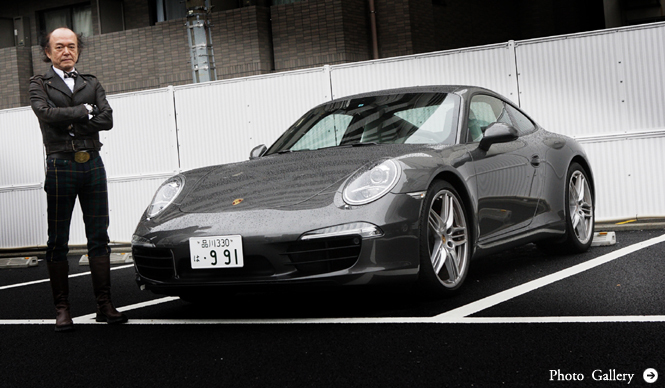
Porsche 911 Test Drive – Masafumi Suzuki
Porsche 911 | The Porsche 911
Interview: Fumihiko Suzuki Drives the Porsche 911
The seventh-generation Porsche 911, the 991 model, has made its debut in Japan. OPENERS asked Fumihiko Suzuki, editor-in-chief of GQ magazine, to test drive it. How does Suzuki, who has driven previous generations of the 911, view this new model?
Text by Fumihiko Suzuki (OPENERS)
A Tool Through Which Nerves Flow
This might sound a bit abstract, but just as with people, some bodies are more attuned to their nerves than others. For instance, some people can run with great effort but still feel clumsy, while others can lift their toes all the way to their head, and some cannot. As we age, our nerves can become less responsive, making it difficult to even move our arms. There are times when this happens.
Tools, by their nature, are inorganic. However, tools used by humans can become an extension of our organic bodies. The philosopher Hiroshi Ichikawa once said that for a master swordsman, their senses extend to the edge of the blade; at times, the sensation from the sword's edge can feel more real than recognizing something with their bare hands. Driving a car is similar: it involves extending one's nerves into the automobile, making it a part of one's own body. What emerges is a fusion, neither just the car nor just the human body sealed within a shell, but a composite entity. The space where this fusion occurs is the driver's seat.—With this way of thinking as a premise, the 911 truly becomes a sports car when one's nerves flow into it.
Even when my nerves flow into it, the composite of myself and myCitroën 2CVcan achieve many things, but its athletic performance is not particularly remarkable.—Therefore, it cannot perform astonishing feats of speed that make you think, 'Look what this car-human composite can do!' For example, Kohei Uchimura can inspire awe with his gymnastics on the horizontal bar or floor exercise, showing what humans are capable of. That's a different level from someone who can only manage a somersault and struggles with a backflip. While a 2CV can certainly do a somersault, it might not be able to do a backflip. (Laughs)
In other words, if we liken a car to the human body, it's a matter of physical conditioning. The new 911 Carrera S I drove this time, equipped with a 3.8-liter engine, has been conditioned to a level that would allow it to compete in the Olympics, provided it finds the right driver. Of course, as an automobile, it can also be driven normally on ordinary roads. A chef's knife, wielded by a master, might not be ideal for chopping simple greens. But in the automotive world, such professional tools, like racing cars, can also function as road cars. The 911 can move like a 2CV walks. However, this doesn't necessarily make the new 911 any less engaging.
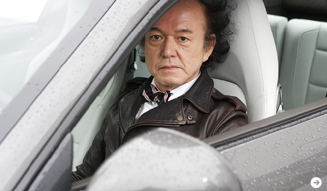
Porsche 911 | The Porsche 911
Interview: Fumihiko Suzuki Drives the Porsche 911 (Part 2)
The Most Important Aspect for the 911
Every generation of the 911 has possessed the capabilities of a top athlete of its time. Simultaneously, as a road car, it ensures a level of safety margin and stability that remains unfazed even when driven by a skilled driver whose nerves are merely connected.
Older 911s lacked sophisticated control technology, meaning there was a possibility of losing control, akin to cutting one's own hand. Things could go beyond mere injury. However, with normal operation at regular speeds, even older 911s presented no major issues. Yet, in extreme cornering situations, the rear-engine, rear-wheel-drive layout could lead to unpredictable behavior that even professionals might struggle to manage. It's like having a heavy iron ball at the rear overhang; acceleration further lightens the front, and if the tires exceed their grip limit, causing a loss of adhesion, the rear can slide. Correcting this can be difficult due to the limited yaw control. If steering inputs are mistimed or incorrect in such a situation, the result can be chaos. In this regard, the new 911, with its advanced electronic control technology compared to its predecessors, offers a wider safety margin.
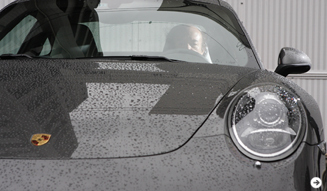
However, it would be contrary to Porsche's ethos and likely unacceptable to those who build the 911 if this increased safety diminished the joy of driving. When one fully connects their nerves and enhances the capabilities of both car and driver, the new 911 becomes a world-class athlete, and therein lies the driver's pleasure. I believe that skilled drivers will find ample enjoyment in the latest 911. This is the most crucial aspect for the 911. While it's beneficial if the journey to that point is stimulating, even if that stimulation is somewhat reduced, it doesn't pose a problem for a practical car.
Certainly, a certain degree of stimulation is desirable. Hence, the switchable exhaust note—this is purely theatrical, and I don't believe it represents a decline. Whether it's enjoyable or not is just one facet within the world the 911 inhabits, and it's not an essential one. This becomes clear when one truly connects with the car; at that level, the nuances of the exhaust's theatricality become irrelevant. Shift speed, however, is relevant, but that's not an issue either.
Porsche 911 | The Porsche 911
Interview: Fumihiko Suzuki Drives the Porsche 911 (Part 3)
The 991 is Undeniably a 911
The exterior of the 991 model is an evolution of the 997, with perhaps less pronounced contours on the sides. Compared to older models, the 911's front fender and door contours have softened, becoming more linear. It feels as though it has expanded planarly from front to rear. The 991 is slightly larger overall and, I believe, has a stance reminiscent of the Panamera.
However, once you drive it, you know it's a 911. It's undeniably a 911.
The interior has become more luxurious, but the 911 has always been a luxurious car. With German quality, a solid body, and exceptionally durable suspension and engine components, it's a luxury. And now, selling for millions of yen, it must naturally provide the comfort expected of cars in its price range. This is delivered as a contemporary offering. While it might be a different approach than, say, an Aston Martin, it possesses what Porsche considers essential for a car at this price point in this era.
Nevertheless, it's not as quiet as a Mercedes-Benz SL. When you open the throttle, the sound enters the cabin, and while the ride quality, even with the standard PASM (Porsche Active Suspension Management system, an electronically controlled damping system) on the Carrera S, is good, it doesn't achieve the same level of comfort as a S-Class or a heavier car with a longer wheelbase.
Indeed, the 991 model has a longer wheelbase, which contributes to stability. However, this hasn't fundamentally altered the 911's character. Speeds of around 300 km/h are legal in Germany, and some people actually reach them. Therefore, the car has been engineered with the focus on enabling skilled drivers to utilize speeds of 300 km/h in practical scenarios. This involves rigorous testing to ensure the body doesn't deform, the glass doesn't shatter, and the wheel's slight inherent distortion doesn't affect brake pad contact. The suspension and handling have been designed with these factors in mind. Consequently, the suspension is firmer. While the longer wheelbase might also be due to cost and production considerations, one primary reason is enhanced performance. From the principles of automotive dynamics, a longer wheelbase is natural for straight-line stability. It wasn't lengthened to improve ride comfort in everyday driving by reducing pitching moments, but rather to ensure safety at high speeds. This logic aligns with the 911's philosophy and also benefits city driving.
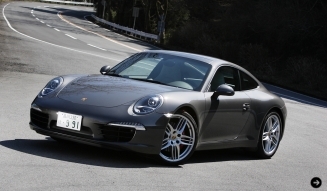
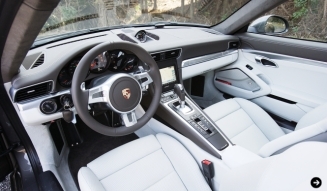
The 911's Position in the Modern Era
In today's world, marked by simultaneous global trends of impoverishment and enrichment, the 911, like any car, faces competition. Within this context, the 911, with its +2 rear seating, is incredibly practical, offering more luggage space than many hatchbacks. I believe there are no rivals to the 911 as a sports car that also boasts such advanced practicality. Even now, the 911 remains a unique entity: a highly capable sports car and a highly practical vehicle. If it's not versatile, perhaps only its color is. There might be situations where a certain color isn't suitable.
The 911 has become safer and easier to drive without compromising its worldview. The visibility differs slightly from the 997 and previous models, which might be disorienting at first. However, when driven with a sense of compact control, as if held in your hand, the car doesn't feel large at all.
I personally favor the 964 generation convertible for its nostalgic appeal in terms of shape, sound, and direct feel, but that's an emotional preference, not a judgment of right or wrong. The 991 model, like the 964 was in its time, is a car that can wear a suit and still perform athletically, even while other sports cars are designed from the outset for competition.

Porsche 911 Carrera S
Body Dimensions | Length 4,491 x Width 1,808 x Height 1,295 mm
Wheelbase | 2,450 mm
Transmission | 7-speed manual (7-speed PDK)
Vehicle Weight | 1,395 (1,415) kg
Engine | 3,800cc Flat-6 Engine
Maximum Output | 294 kW (400 PS) / 7,400 rpm
Maximum Torque | 440 Nm / 5,600 rpm
Top Speed | 304 (302) km/h
0-100 km/h Acceleration | 4.5 (4.3) seconds (4.1 seconds with Sport Chrono Package)
Fuel Consumption | 9.5 (8.7) L/100 km
CO2 Emissions | 224 (205) g/km
*Values in parentheses are for PDK equipped models.

Fumihiko Suzuki
Born in Tokyo in 1949. After working as a journalist for an English-language newspaper, he joined Kodansha. He participated in the launch of the automotive magazine 'NAVI' and became its editor-in-chief in 1989. Under his leadership, the magazine adopted the slogan of critically examining automobiles not just by numbers but also by social and cultural standards, fostering a magazine of automotive culture. He became independent in 1999 and launched the men's lifestyle monthly magazine 'ENGINE' (Shinchosha) the following year. Since January 2012, he has been actively serving as the editor-in-chief of 'GQ'. His books include 'Marx' and 'Run! Yokoguruma'.