A Closer Look at the New Generation Turbocharged 911 Carrera | Porsche
Porsche 911 Carrera | Porsche 911 Carrera
A Closer Look at the Turbocharged New Generation 911 Carrera
This September, Porsche announced a minor change to the "911 Carrera" series, replacing its naturally aspirated engines with its first-ever turbocharged power units. How will this tradition, which has continued for seven generations since its debut, change with turbocharging? Yasuhiko Kawamura reports on the future of the 911 from the Hockenheimring circuit in Germany, where a workshop was held.
Text by YASUHIKO KAWAMURA
A Miraculous Sports Car
Despite being an exceptionally long-lived model with over half a century of history, all seven generations have consistently captivated people with their unparalleled driving potential, leaving rivals far behind. This track record has built its reputation and established the Porsche "911" as a "miraculous sports car."
With its distinctive front fascia, sometimes jokingly called a "frog face," and its rear-engine layout, along with its horizontally opposed six-cylinder engine and its hunched-over body proportions—— this model carries various iconic elements, embodying the sentiment, "If we lose these, it's no longer a 911."
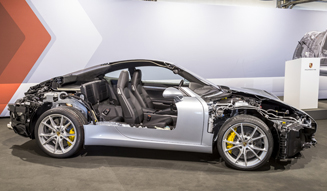
Porsche 911 Carrera S
Such newsShocking News for the 911was delivered to the 911. Officially unveiled at the recent Frankfurt Motor Show and already available for order in Japan, the latest Carrera series features a newly developed engine with a reduced displacement and the addition of turbochargers.
A workshop was held in Germany to focus on this new engine and the innovative technologies incorporated into the new model.
The event, held at the Hockenheimring circuit, included "taxi rides" with a test driver from Porsche's development center in Weissach, driving the new model. Unfortunately, reporting on the driving impressions will have to wait a little longer, but for now, we'll share the information gathered from the "scene."
Porsche 911 Carrera | Porsche 911 Carrera
A Closer Look at the Turbocharged New Generation 911 Carrera (2)
A Miraculous Sports Car
While some "special" models, such as those bearing the "Turbo" designation, have previously featured performance-oriented turbocharged engines, this marks the first time a turbocharged engine has been adopted for the Carrera series, which has consistently used naturally aspirated units.
The new 911 Carrera/Carrera S series is powered by a horizontally opposed six-cylinder unit that has undergone significant refinement, including a completely redesigned cylinder head with fuel injectors positioned directly above the combustion chambers, a new coating process for the cylinder walls, and a new polymer oil pan.
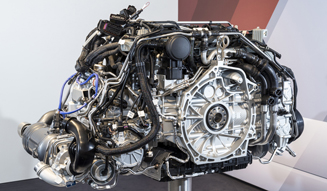
3-liter horizontally opposed six-cylinder twin-turbo engine
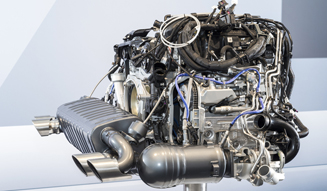
Compared to the previous 3.4 and 3.8-liter displacements, the new engine, boosted by two turbochargers, has a common displacement of 3 liters for both the Carrera and Carrera S. This volume was "standardized after testing engines of various capacities, also considering future development potential."
Incidentally, Porsche refers to the reduced displacement not as "downsizing" but as "rightsizing." The new engine achieves a maximum output of 370 hp for the Carrera and 420 hp for the Carrera S, a 20 hp increase over their predecessors, due to differences in turbocharger size, management systems, and exhaust configurations.
Simultaneously, it delivers maximum torque of 450 Nm and 500 Nm, respectively, a significant increase of 60 Nm over the previous models, while also achieving a substantial efficiency improvement of approximately 12 percent, depending on the model, according to the latest European test cycle (NEDC).
Porsche 911 Carrera | Porsche 911 Carrera
A Closer Look at the Turbocharged New Generation 911 Carrera (3)
Engine Sound: Another Important Icon
Alongside the new engine, the significantly refined telematics system is also noteworthy.
Dubbed PCM (Porsche Communication Management), it features a new specification with a 7-inch multi-touch screen, voice control, and smartphone connectivity. While it remains unclear whether the Japanese version will have the same "full spec" as the European version, a担当 engineer commented that "most functions will be consistent with the European version."
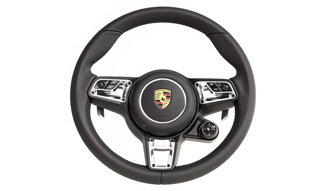
New steering wheel design for the new Carrera
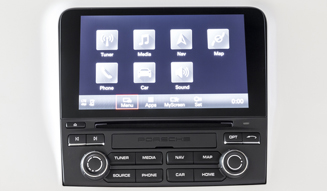
PCM (Porsche Communication Management)
The navigation system included is also a VICS-compatible system co-developed with Aisin. This means that Porsche cars in Japan, which have historically relied on integrating commercially available 2DIN navigation units while claiming "genuine" status, will finally be upgraded to a level comparable to overseas markets, including other models. Some may even consider this the most significant highlight of the new model.
However, some may worry, "What will happen to the '911 sound' with a turbocharged engine?!" Logically, with reduced displacement and turbochargers absorbing exhaust energy, it seems natural to assume this would be detrimental to producing a "good sound."
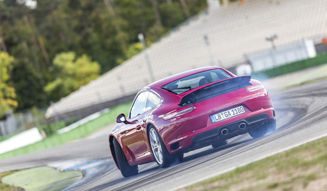
Porsche 911 Carrera S
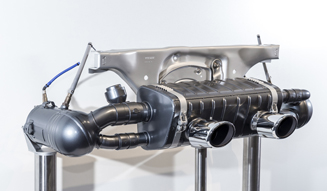
Sports exhaust system for the new 911 Carrera
Yet, for a model like the 911, engine sound is undoubtedly one of its important icons. Indeed, Porsche's development team, who state that "emotion is the most crucial element for the 911 engine," have clearly put immense effort into achieving the characteristic, appealing 911 sound, even with significant mechanical changes. This was evident even from the "taxi ride" experience.
Porsche 911 Carrera | Porsche 911 Carrera
A Closer Look at the Turbocharged New Generation 911 Carrera (4)
Porsche's Refined Approach
The model I experienced during the passenger ride was a 7-speed PDK-equipped Carrera S Cabriolet with the optional "Sports Exhaust System." The moment the engine started, the unmistakable 911 sound filled the air. While the overall volume seemed slightly reduced, the characteristic popping sound on deceleration in "Sport Plus" mode, reminiscent of afterburners, was still present.
Even more impressive than the sound was the driving feel itself, which was clearly perceptible from the passenger seat: the rich torque from low to mid-RPMs, and the sharp, uninhibited power delivery all the way to 7,500 rpm, comparable to a naturally aspirated unit.
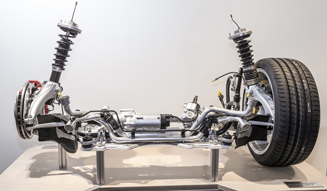
Front axle of the new 911 Carrera
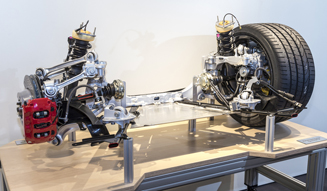
Rear axle
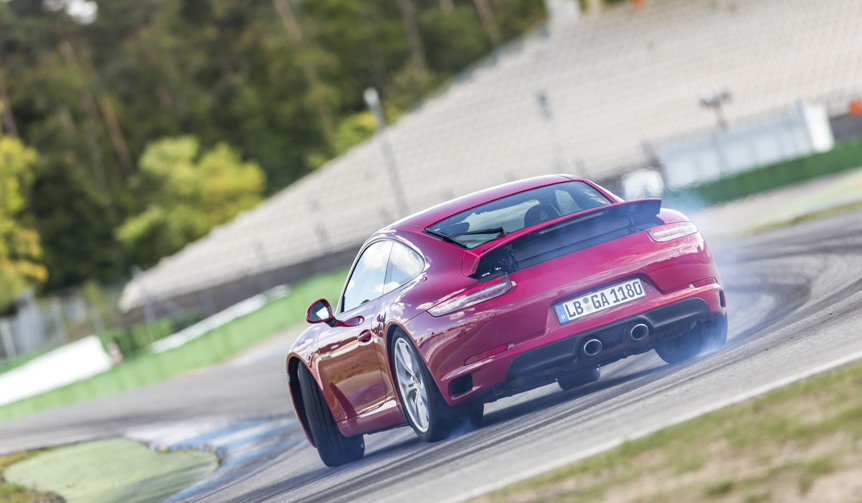
The chassis's excellence was also evident during the "taxi ride," with a new stability control mode that "allows for large drift angles without leading to a spin." The suspension, with revised spring and stabilizer specifications and a standard rear tire width increased by 0.5 inches to 11.5 inches, also features the option of rear-axle steering, a technology pioneered in the "Carrera S" and previously seen in the "GT3" and the "Turbo" grades.
The new 911 Carrera series also boasts visual updates, such as newly designed lights and a revised engine lid. However, its true essence lies in the "updates to all aspects related to driving," a typically Porsche approach to refinement.
This is the birth of a new generation 911 that promises to deliver an evolution far beyond simply having a "turbocharged engine," an experience that will surely be fully appreciated when driving it oneself.